Excellent explanation.
you said above "While water as solid ice can
gain maximum thermodynamic stability by forming 4 hydrogen bonds
per water molecule in a tetrahedral geometry".....
This is not totally correct. in ice two bonds are covalent while
two bonds are H-bonds making a total of four.
The following question also appered in A-level Nov 2012 CIE
variant 13. the above N-question appeared in the
same session but variant was 12.
How may nitrogen exist in compounds?
1 bonded by a triple covalent bond
2 as part of a cation
3 in an oxidation state of +5
The answer according to CIE MS is A.
1 is correct due to N2
2 is correct due to NH4+
3 is also correct due to what I am thinking is due to Nitrogen
in HNO3.
My original statement regarding hydrogen bonds in ice remains
correct.
Each water molecule can have up to four
simultaneous hydrogen bonds in ice. Different crystalline forms of
ice will have different number of hydrogen bonds per water
molecule.
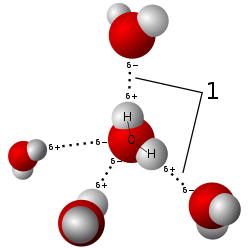
For instance, in one crystalline form of ice, each water
molecule has three intermolecular
hydrogen bonds, as shown below :

In another crystalline form of ice, each water molecule has
four intermolecular
hydrogen bonds (as shown) :
In practice, similar to amorphous carbon, in which there is a
mixture of the different allotropes of carbon present, most samples
of solid ice consists of a mixture of the various crystalline forms
of ice, in which some water molecules have 2 intermolecular
hydrogen bonds, while some have 3 intermolecular hydrogen
bonds, and some other water molecules have up to 4
intermolecular hydrogen bonds, as shown below :

For A level purposes, as long as the diagram is labelled
correctly, full credit will be awarded. The following 4 points
may be used as a checklist in the Cambridge Mark Schemes.
1) All relevant partial charges must be shown.
2) Length of hydrogen bonds must be slightly longer than
covalent bonds.
3) The lone pair on the hydrogen bond acceptor must be shown
at the base of the hydrogen bond.
4) The geometrical angle of the hydrogen
bond to the H atom to the covalent bond, must be linear (ie.
180 deg).
(Note : many Singapore JCs don't teach point #4, and admittedly
it is not always possible to show point#4 in 2D-drawings, but there
have been Cambridge Mark schemes which require this marking point,
so the exam-smart student will play safe and show point#4 whenever
possible.)
-----------------------------------------------------------
Regarding your Nitrogen question :
Correct, the OS of N atom in HNO3 (conjugate acid) and NO3-
(conjugate base), is +5.
Oxidation State (OS) = Formal Charge + Electronegativity
Consideration.
Apply this formula to any 1 of the 3 resonance contributors
here :

Oxidation State (OS) of the N atom
= Formal Charge + Electronegativity Consideration
= (+1) + (+1 +2 +1)
= +5
Whether you apply the formula to the resonance contributors or
the resonance hybrid, or to the conjugate acid or the conjugate
base, the OS of the N atom remains as +5.
In some other molecules, eg. the dinegative tetrathionate anion,
applying my BedokFunland JC formula (ie. a University level
formula, that most Singapore JCs teach only to their H3 and
Olympiad students, leaving the pitiful H2 students in the
cold) for Oxidation State (OS) yields :

For the oxo-bonded S atoms :
Oxidation State (OS) = Formal Charge + Electronegativity
Consideration = (0) + (+5) = +5
and for the thio-bonded S atoms :
Oxidation State (OS) = Formal Charge + Electronegativity
Consideration = (0) + (0) = 0
Hence the average OS of sulfur in the thiosulfate anion = [ (+5) +
(0) + (0) + (+5) ] / 4 = +2.5
