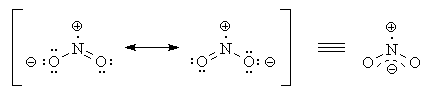
Exploring the technique of drawing NO2 and checking with formal
charges.
Its a bit difficult to describe without an image.
Total valence electrons = 5 + 2(6) = 17
I ended up deciding between two outcomes.
Case 1
O - N = O, where the unpaired electron is found on the left
oxygen.
Case 2
O = N = O where the unpaired electron is found on the N atom
Both cases seeming gives me a formal charge of zero on all 3
atoms. Would there be any reason why we should choose one over the
other?
Googling seems to show that case 1 is more widely drawed, but
Nitrogen dioxide (apparently) dimerises, which supports
case 2.
Both structures you've proposed are incorrect.
Case 1 is incorrect because the singly bonded O atom does not
have an unpaired electron. If it had one, it would have no formal
charge, then because the N atom has a unipositive formal charge,
the sum of formal charges would be 1+ and not zero (neutral
molecules have an ionic charge of zero). Recall that ionic charge
is the sum of formal charges.
Case 2 is incorrect because if your central N atom has 4 bond
pairs as well as an unpaired electron, its octet would be violated.
Cambridge requires H2 students to state, "Period 2 elements do
not have vacant, energentically accessible 3d orbitals to use to
expand their octet".
The correct structure is :
O=N-O
with a unipositive formal charge on N, half a lone pair (ie. an
unpaired electron) on N, and a uninegative formal charge on O. For
physical chemistry, it is advised that students indicate formal
charges within the molecules and ions, and (for ions)
indicate the ionic charge outside the square brackets (which
symbolize summation : of formal charges or oxidation states, to
give the ionic charge).
For physical chemistry (but not organic chemistry;
never show dative
bond symbols in organic chemistry, but instead use curved arrows or
normal line bonds, for organic chemistry mechanisms and
non-mechanism structures respectively (just be sure you
always indicate all
formal charges in organic chemistry; do not use square brackets for
ionic species in organic chemistry, thus you only need to show
formal charges, and not ionic charges); a dative bond symbol is in
terms of function, a sort of mini-mechanism used only in physical
and inorganic chemistry), a dative bond symbol must be indicated
from N to O (the donation of a dative bond explains the formal
charges; because we're showing formal charges after dative bond
formation, the dative bond is always from the +ve formal charged
atom to the -ve formal charge atom; ie. the formal charges are a
consequence of a dative bond).
The unpaired electron is indeed on N, which is why NO2 dimerizes
to N2O4 (an equilibrium reaction), as well as why NO2 combines with
NO to generate N2O3 (another equilibrium reaction).
Finally, H2 Chemistry students are required to state
and explain the NO2
bond angle. Although the electron geometry is trigonal planar and
the molecular geometry is v-shape or bent, but because half a lone
pair occupies much less space or has much less repulsion, than
either a lone pair or a bond pair, hence the bond angle is
increased from 120 deg to 134 deg.