This topic is something best dealt with in person during
tuition, and is difficult to explain over an online forum. I'll
give brief comments, do the best you can to understand them, and
anything further (eg. if you still do not fully comprehend
this topic) ask your school teacher or tuition teacher if you
have one.
I'll comment directly on your self-drawn structure, which should
go some way to auto-answer your previous queries.
First of all, these are more correctly called Kekule structures,
rather than Lewis structures (unsurprisingly, different chemists,
schools, examiners, use different terms).
Secondly (and you'll find some school teachers disagreeing on
this point; (unlke fussy school teachers) Cambridge actually
doesn't care about petty little details like this, and will accept
either presentation or method), you should always show all formal
charges within the square brackets, as well as
simultaneously show the ionic charge outside the square
brackets. Afterall, the square brackets symbolize summation (for
physical and inorganic chem purposes; we do not use square brackets
for organic chem purposes).
Accordingly, your drawing of the sulfate(VI) ion is erroneous in
that you omitted the formal charges on your atoms : a dipositive
formal charge on the S atom, and a uninegative formal charge on
each of the singly bonded O atoms.
Also you neglected to show dative bonds. Everytime you see
positive and negative formal charges on adjacent atoms, you should
suspect the presence of dative bonds.
(Interestingly, dative bond presentation is different for
all three : physical chemistry, inorganic chemistry and organic
chemistry. Again, different JC teachers will disagree with each
other on the best presentation for these, and again Cambridge
doesn't care so much, and will accept a variety of presentations.
Nonetheless, I'll briefly indicate the best presentations
:
physical
chem : show formal charges after dative bond
formation. And there should not be any lone pair at the base of the
dative bond arrow.
inorganic
chem (complex ions) : show formal charges
before dative bond formation. And there should be a lone pair at
the base of the dative bond arrow, on the ligand.
organic
chem : show a curved arrow (for which the lone
pair must be shown at the 'base' of the curved arrow) to
illustrate electron flow, and in the next stage of the mechanism, a
straight line (*no* dative bond arrowhead should be
shown) is used to indicate the bond formed.
The difference between physical and inorganic chem
presentations, arise from the fact that the electronegativity
difference between non-metals is small, but between metals and
non-metals is large. As such, formal charges after dative bond
formation is more accurate for species in which all atoms
are non-metals, but formal charges before dative bond
formation is more accurate for complex ions in which ligands are
significantly more electronegative than the metal ions they donate
dative bonds to)
What you've drawn (ie. all singly bonded O atoms) is favoured by
US chemists, while UK chemists favour the expanded octet
version (ie. with some doubly bonded O atoms). If you could
shrink yourself to the size of an atom and observe the sulfate(VI)
ion, which structure would you see? The US version or the UK
version?
Tis a trick question. Both versions are equally correct, because
they are really resonance
contributors of each other. The actual structure
(that you would see, if you could shrink yourself to the size of an
atom) is known as the resonance hybrid, and
has partial double bond character for all 4 bonds with all 4 O
atoms.
Cambridge will accept either the UK or the US presentation, but
of course, the UK presentation is recommended for Cambridge 'A'
level students. Note however, for period 2 elements (since they do
not have vacant, energetically accessible 3d orbitals to use to
expand their octet), both UK and US structures are the same.
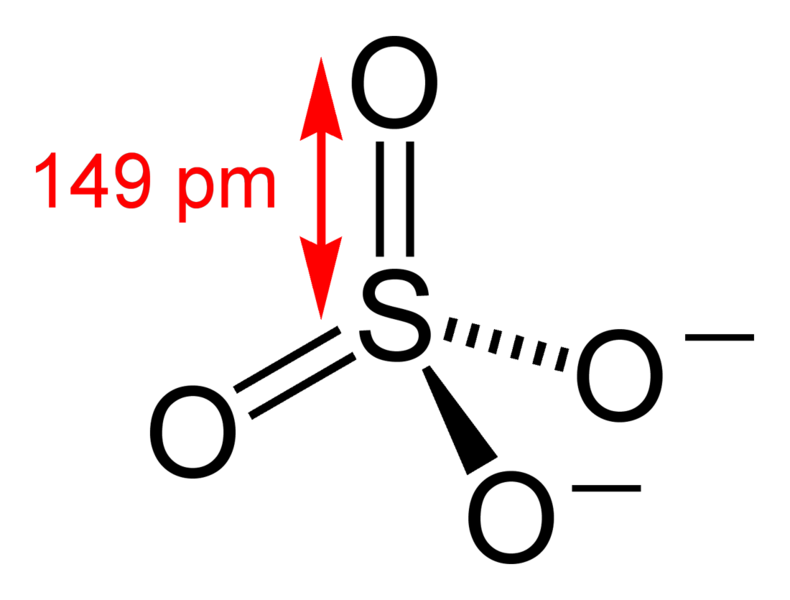
For the UK presentation, this is how you draw the Kekule
structure of the sulfate(VI) ion :
Ionic charge is the sum of formal charges.
Since the ionic charge is dinegative, we assume two of the O
atoms have a uninegative formal charge.
This means these two O atoms must have 1 bond pair and 3 lone
pairs.
The other two O atoms must have no formal charge, ie. 2
bond pairs and 2 lone pairs.
The S atom thus has 6 bond pairs, and being in Group
VI, thus has no lone pairs, because we do not wish the S
atom to have any formal charge (since the condition or
formula, that ionic charge = sum of formal charges,
is already satisfied by the two singly bonded uninegative
formal charge O atoms).
That's how you arrive at the UK presentation of the Kekule
structure of the sulfate(VI) ion :

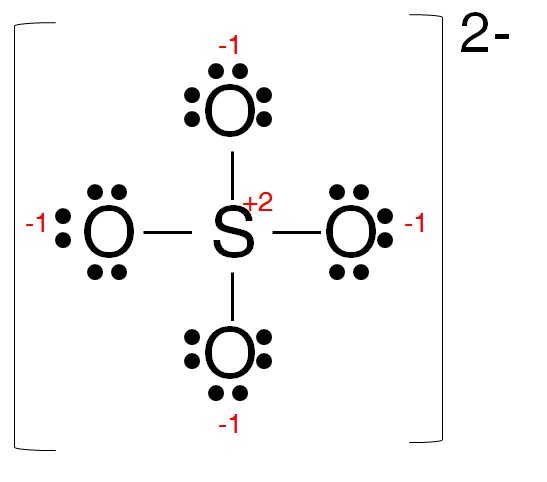
For the US presentation, this is how you draw the Kekule
structure of the sulfate(VI) ion :
Since we do not wish to expand the central S atom's octet, thus
all O atoms must be singly bonded, and thus have 1 bond pair and 3
lone pairs, and therefore a uninegative formal charge each.
Since ionic charge is the sum of formal charges, it means we
require the central S atom to have a dipositive formal charge, to
balance out the tetranegative formal charges of the O
atoms. Accordingly, we deduce the S atom has no lone pairs,
because only when it has 4 bond pairs (which it already does, based
on the O atoms' bonding) and zero lone pairs, will it have a
dipositive formal charge, as S belongs to Group VI.
And that's how you arrive at the US presentation of the Kekule
structure of sulfate(VI) ion :
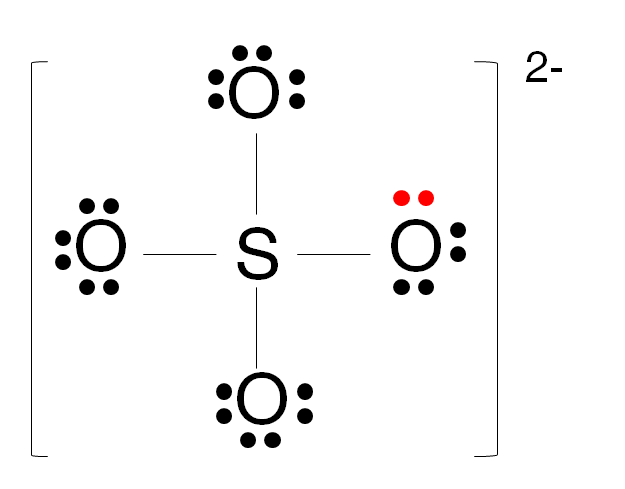
Thank you for your wonderful post. I still have a question
though. If I am given the ion SO4, and asked to find out the
charges, how would I be able to find that out based on the Kekule
structure ?
Is it by
1. Realising that 2 more electrons is need for the last oxgyen
atom to achieve stable octet configuration (as indicated by the red
dots) so simply given SO4 a charge of 2-
or
2. Through the formal charges of each atom.
But the problem is :
Without even knowing the charges of SO4 in the first place, a
student will get 6 + 4(6) = 30 electrons.
and they will draw this

such that they will realise that the last oxygen atom has only 4
electrons. and if based on each formal charges
Sulfur would have = +2
the 3 oxygen atom = -3
and the last oxygen atom = 6 - 4 - (2/2) = +1
total charges = 0
this is,however, not valid.
3. The UK way of of drawing the structure is due to having
knowledge that the ions has a 2- charge. so they know that there
would be 30 + 2 and thus
have this structure
and thus from the structure, having 2 oxygen atoms to form
double bond with sulfur
so sulfur would have a charge of 0. and deriving this,

Without knowing the charges of SO4 in the first place, is it
possible to derive it by drawing the Kekule structure ? And if so,
how ?