Hi Gohby,
I recall we've had this conversation before. While I
do empathize and sympathize with your feeling of injustice for
students (both your own students as well as the student
population in general), but it's a bit of a vicious catch-22
cycle : because JCs / the education system are
survival-of-the-fittest kiasu and every year teach students more
and more beyond the syllabus, consequently in order to make the
examinations more discriminating, Cambridge feels obligated to test
further and further beyond the syllabus, at least
unofficially. Officially, everyone will deny everything.
Transition metal complexes are a touchy topic, and because much
of this topic is rather complex (pun intended) beyond the
H2 syllabus, it's no wonder that this topic is a potential source
for many killer (and in your perspective : unfair) exam qns.
The syllabus is deliberately vague, with no mention of many
associated concepts that many JCs (out of kiasuism) teach, and that
both internal JC exams as well as Cambridge exams may (directly or
indirectly) examine on.
Yes, you're right that the three complex ions and their
colours you memorized when you were a student yourself, does
not suffice. But then again, MOE-SEAB and Cambridge (deliberately,
by intention) did not release any official list of complex ion
colours for A level students to memorize. So many JC students,
in typical Singapore kiasu pattern, desperately try to obtain as
many different 'top' JC notes as possible, to memorize as many
obscure complex ion colours as possible, to cover themselves.
Unfair? In that sense, probably. But on the flip side, MOE-SEAB
/ Cambridge will argue (fairly enough) that if the student has
truly understood the concepts, he/she would be able to deduce the
probable colours and/or geometries, and would still be able to be
atop the bell-curve and score a distinction.
In that regard, advise your students not to worry too much
about needing to be too kiasu and memorize all the colours and
geometries of all the obscure complex ions in the world. That's not
necessary nor helpful. Sure, internal JC exams and once in a while,
even Cambridge, may ask such beyond-the-syllabus questions, but the
student who wisely focuses on truly understanding the underlying
concepts will more than make up for that single lost mark, and
still come out ahead and on top of the bell-curve.
On the the chemistry content.
Strong ligands are not the same as strong field
ligands.
Weak ligands are not the same as weak field ligands.
The former has to do with availability of lone pairs,
nucleophilicity and basicity of the ligands, and the consequent
strength of the coordinate dative bond generated. The latter has to
do with the magnitude of energy difference of the d orbitals upon
splitting, which will have a direct impact on the resultant colours
of the complex ions.
I agree with you that option 3 of the MCQ, should not be
included as the correct answer. The setter of the question appears
to him/herself have confused the concept of strong-field ligand,
with strong ligand. While there is some correlation to the two,
they are not the same, and therefore option 3 will not necessarily
be true.
Hello,
I would like to enquire what exactly is in the syllabus for H2
9647 Chemistry, transition elements.
1. Are students required to know the transition elements
complexes and their colours? If so, which ones?
Those that I memorised as a student are [Cu(H2O)6]2+ - light
blue, [Cu(NH3)4(H2O)2]2+ - dark blue, SCN- complexes are blood red.
Apparently these doesn't suffice?
2. Know the relative strengths of different ligands or
explaining why are certain transition elements compounds of a
certain colour (Due to weak/strong ligand--> Difference in
absorption corresponding to the wavelength and energy -->
Difference in the colour that is reflected.)
However, such concepts are quite heavily dwelled on for some
schools, leaving students even more befuddled.
As taken from:
http://www.seab.gov.sg/aLevel/2012Syllabus/9647_2012.pdf
Under the topic on transition elements,
(h)
(i) explain the reactions of transition elements with
ligands to form complexes, including the complexes of copper(II)
ions with water and ammonia
(ii) describe the formation, and state the colour of, these
complexes
(l)
explain, in terms of d orbital splitting, why transition
element complexes are usually coloured
From the syllabus, there seems to be no mention that these
ceoncepts are required. It would be good for the interest of
students to know what is in their syllabus and what's not lest they
try to figure out / spend unnecessary time memorising stuff that
are out of their syllabus when they have many concepts that are
WITHIN their syllabus which they have to grapple with.
It would be good if the air is cleared. :)
On this note,
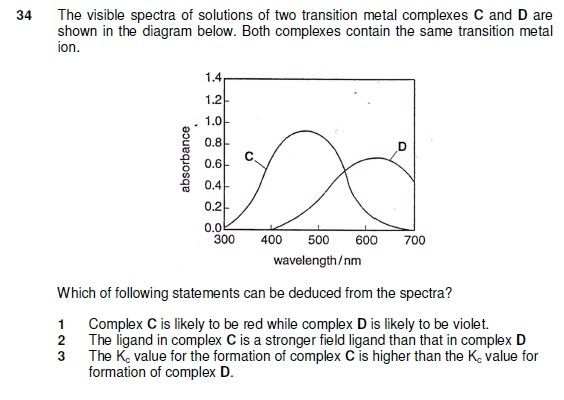
Here is a qn which actually appeared in prelims that leverages
on the knowledge on strong/weak ligands & their wavelength
absorbed, etc.
1 & 2 are logically deducable but how is Kc related to this
question?
Many thanks for any help/advice given! =)
Cheers
