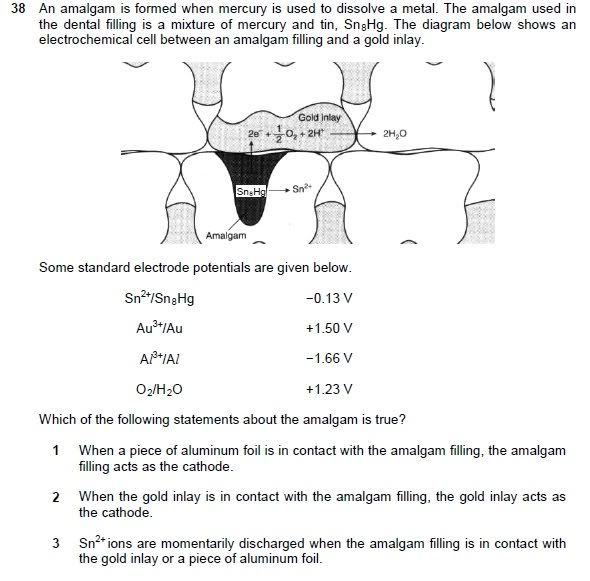
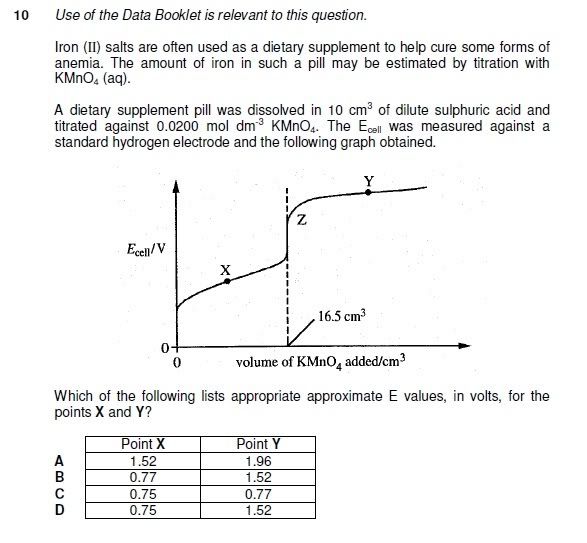
How do you choose what reactions to use, when it involves
water?
From what I know, equations with H+ are chosen when the reaction
occurs in an acidic medium, while equations with OH- are chosen
when it occurs in an alkaline medium.
So, in acidic solution, and assuming H2O is oxidised,
H20 -> H2O2 + 2H+ + 2e- and
H2O -> O2 + 4H+ + 4e-
and in alkaline solution, assuming H2O is reduced,
O2 + 2H2O + 4e- ->
4OH- and
2H2O + 2e- -> H2 + 2OH-
What's the basis for selection? Electrode potential such that
Ecell will be maximum/minimum? Thanks in advance.
It is the protons from water which are reduced, and it is the
hydroxide ions from water which is oxidized.
Do not use reactions that generate H2O2, unless you're
specifically told to do so in the question (most usually, H2O2 will
be a reactant, not a product, ie. use the right to left equation
instead of left to right).
Notice that in your equation O2 + 2H2O + 4e- -> 4OH-, it is
not water that is reduced, but molecular dioxygen (ie. O2 gas)
which is reduced.
Again, unless the question specifically dictates molecular
dioxygen (ie. O2 gas) being reduced at the cathode, do not use
that equation. Use the one in which (the protons from) water are
reduced to molecular dihydrogen (ie. H2 gas) instead.
For electrolytic cells, you need not worry about the cell
potential, because the source of the electricity comes from
elsewhere (eg. the wall socket). Therefore, you need not worry
about the feasibility of whether you should use water or
protons as the reactant to be reduced @ cathode, or whether you
should use water or hydroxide ions as the reactants to be oxidized
@ anode. Cambridge will accept either choice of reactants, for
both.