Hi there, I've come across more questions, hope someone could
help me out. Much appreciated! 
Q1
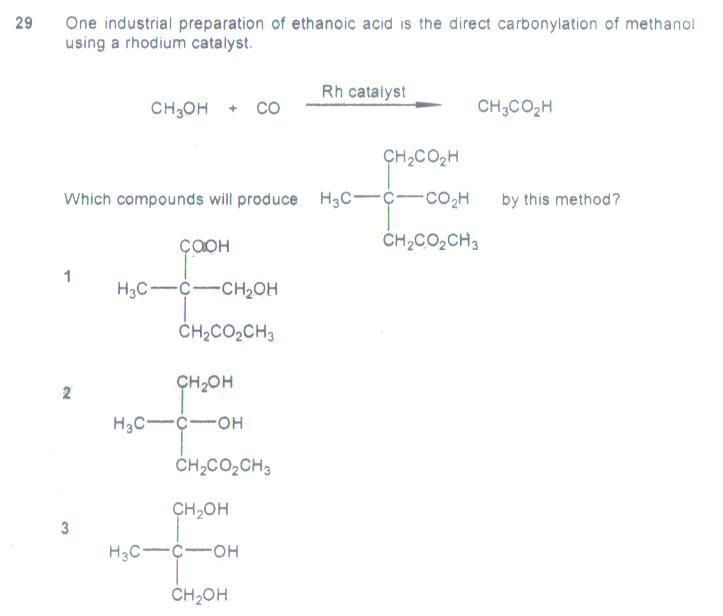
Ans:
1&2
Remark: I
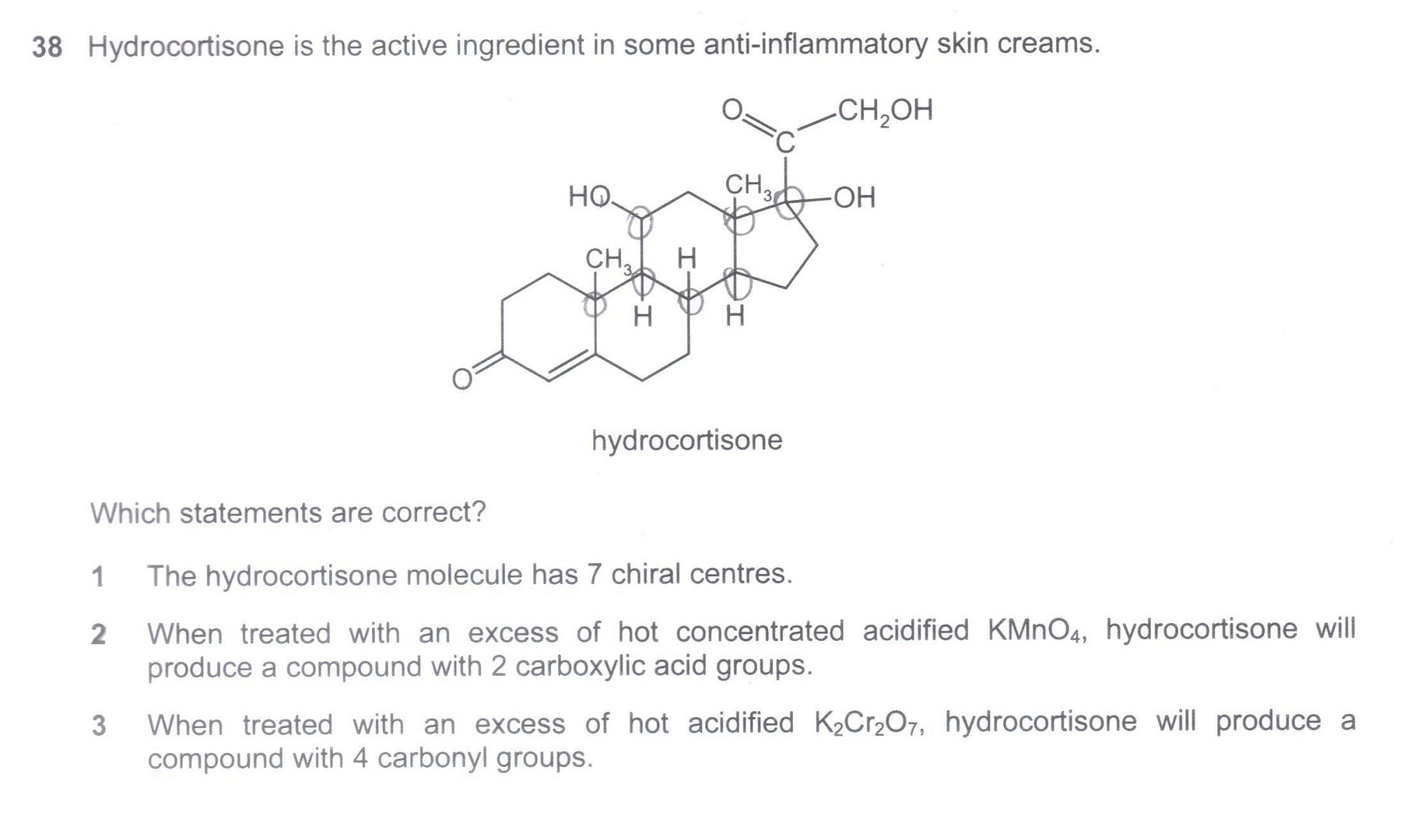
couldn’t fathom how, in choice 1, could the
CH2OH be directly oxidized to COOH, instead of
converting to CH2COOH, which would be analogous to the model. Also,
I could not conclusively discard choice 3 as an option. Choice 2 is
clear-cut.
Q2
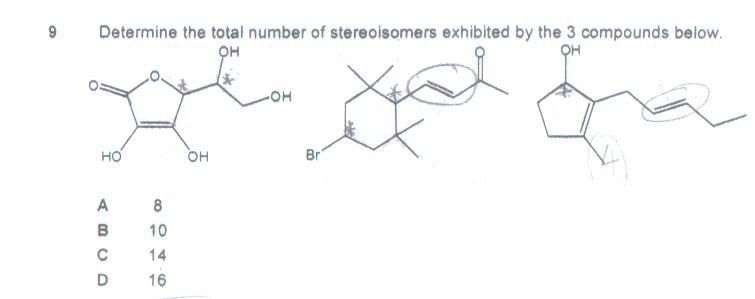
Q3: Which of
the following could act as acidic buffers?
1.
A 1:2 mixture of
HCl and CH3CO2Na
2.
A 1:2 mixture of
NaHCO3 and Na2CO3
3.
A 1:2 mixture of
NaOH and NH4Cl
Ans: 1
only.
Remark: An acidic buffer comprises of a weak acid and its
salt. In choice 1, I will
have CH3CO2Na,
CH3CO2Cl and what? (So where is the weak acid
and its salt?) What actually transpires in choice 2&3?
NaHCO3 seems foreign.
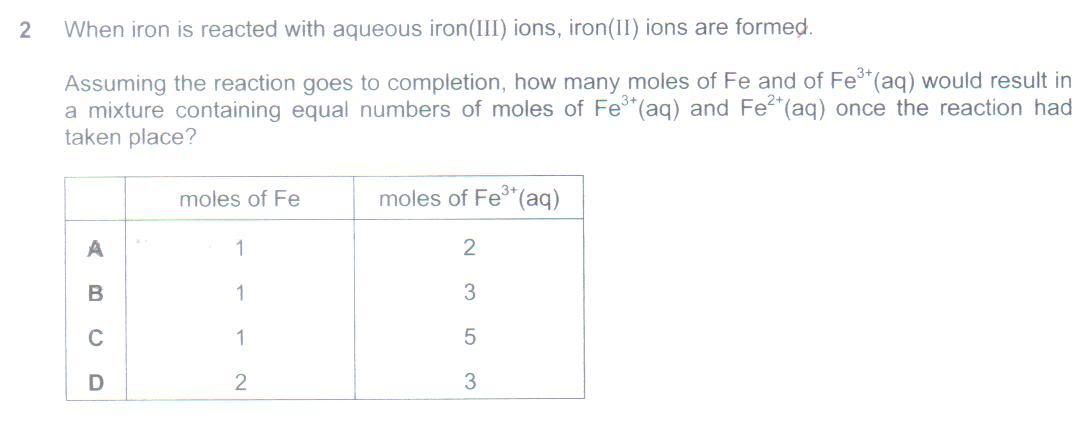
Also, UltimaOnline, sorry to be digging up old questions, but I
don't understand the solution put forth for Q5 on the previous
post. Could you write down the equation of the reaction? And
apparently I don't have the chemistry sense haha, because I don't
see how Fe is limiting and Fe3+ is in excess..
Once again, thank you! :)
-gohby
Yo gohby, why the new nick? 
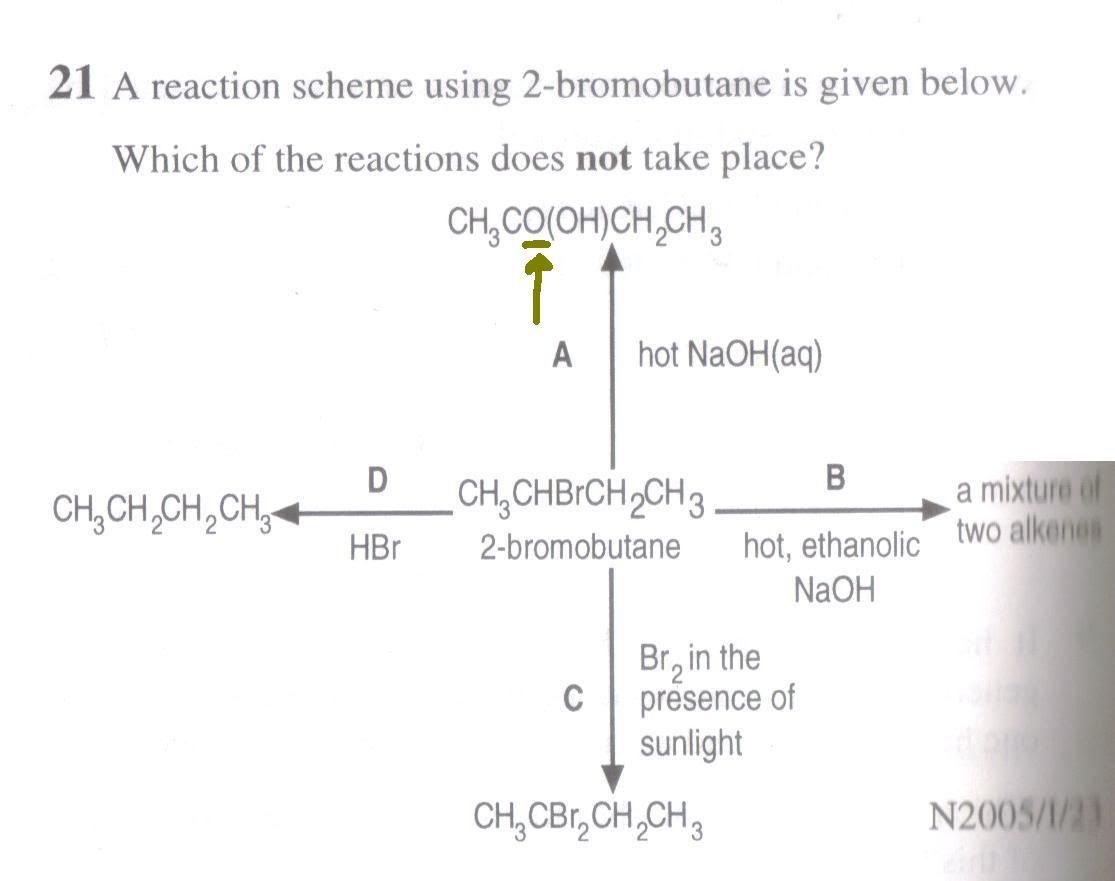
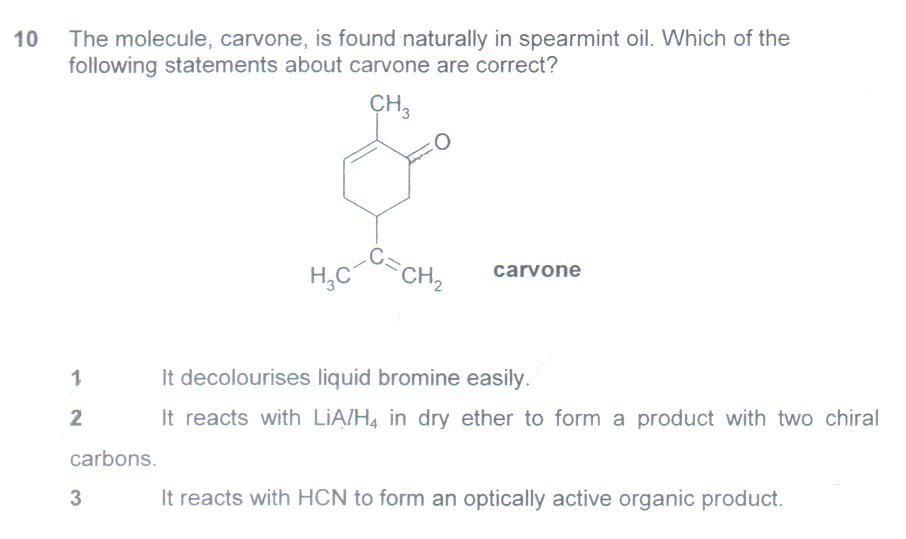
Qn1. Tis a guai-lan trick qn. Recognize that single bonds are
freely rotatable.
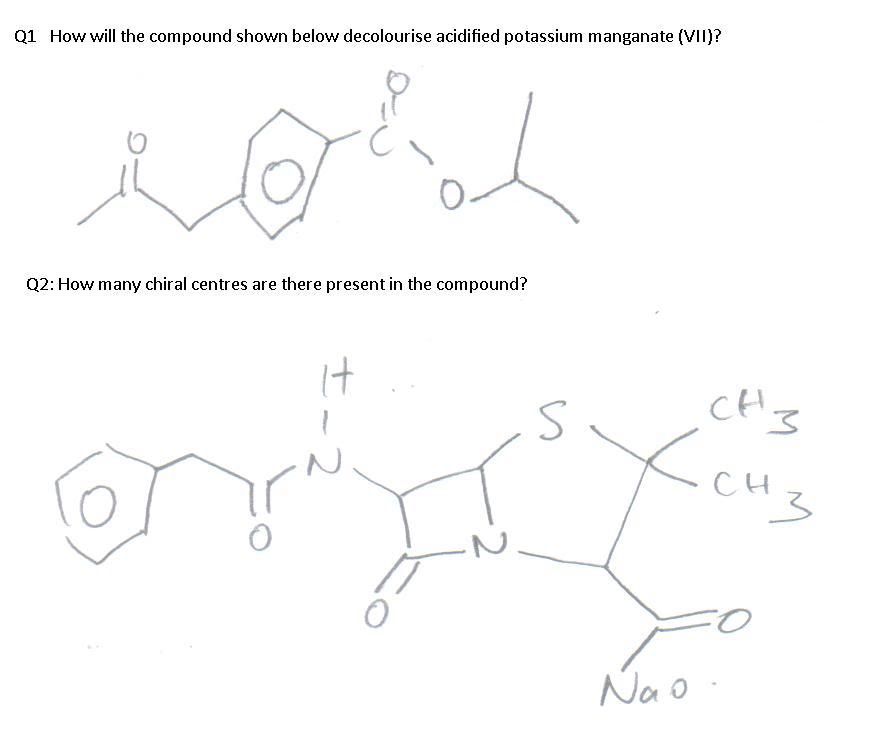
Qn2. The qn is ambiguous (many JCs' prelim exam questions,
and sometimes even Cambridge exam qns, relating to isomerism and
stereoisomerism are often ambiguous), and furthermore all
of the given options are arguably wrong.
Let's look at the 2nd molecule : the two chiral carbons you've
marked out, are actually achiral (ie. not chiral). This is because
2 of the 4 groups bonded to those C atoms, are the same (do a trace
route). However, this cyclocompound does have geometric isomerism
within the ring, because the single bonds of cyclocompounds (as
with alkene double bonds) cannot rotate freely. However, this
isn't taught within the H2 syllabus, so is this a fair qn?
Ignore this question, and in the exams, skip all ambiguous
and/or time-consuming qns first, else you won't have time to
complete the paper.
Qn3. The HCl will be totally used up, leaving equal molarities
of ethanoic acid and sodium ethanoate. This is indeed an acidic
buffer.
For options 2 and 3, these are basic buffers being generated
(because these are primarily a weak base, with its conjugate acid).
Option 2 is the trickiest option, because NaHCO3 can be considered
both a weak acid, and a weak base. However, because Na2CO3 is a
significantly stronger base (than NaHCO3 is either basic or
acidic), thus this is best considered a basic buffer.
For such questions, you'll have to (mentally, or on paper) do an
ICF table : Initial, Change, Final. (This is slightly
different from an ICE table, Initial, Change, Equilibrium). See how
the given Initial reactants react with each other, work out
the Change based on limiting reactant, and see whether the
Final products qualify as buffers.
>>> Also, UltimaOnline, sorry to be digging up old
questions, but I don't understand the solution put forth for Q5 on
the previous post. Could you write down the equation of the
reaction? And apparently I don't have the chemistry sense haha,
because I don't see how Fe is limiting and Fe3+ is in excess..
<<<
Because that question implied that all the Fe is used up at the
end of the experiment, when there are "equal moles of Fe2+ and
Fe3+". Since this is not an equilibria qn, it implies that there
are no more Fe present (or else any Fe still present would be used
up to react with any Fe3+ still remaining to form Fe2+).
Therefore, Fe can be deduced to be the limiting reactant.
Accordingly, do an ICF table, and let the Initial moles of Fe
and Fe3+ be 1 : x. Change will be (according to stoichiometry) -1,
-2, +3. Final will be 0, x-2 and 3. Since x-2 = 3, this implies x =
5, and therefore the answer is 1 Fe : 5 Fe3+.