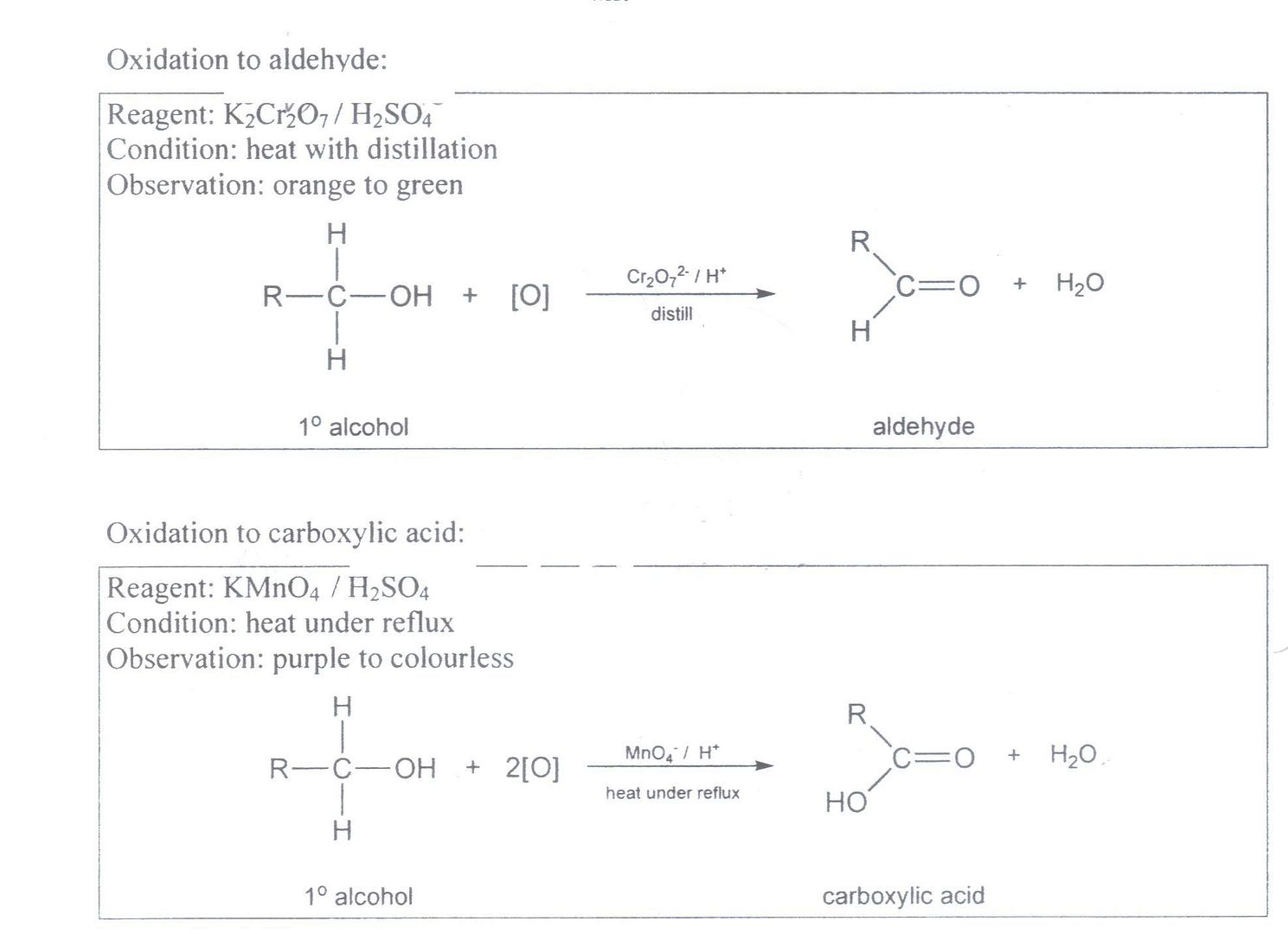
For normal alcohols and aldehydes, yes indeed, carboxylic acids
are the highest level for normal oxidation by both K2Cr2O7 and
KMnO4.
But methanol, methanal, methanoic acid and methanoate ion, as
well as ethan-1,2-diol, ethandial, ethandioc acid, and
ethandioate ions; these 8 compounds are a special category that you
should be aware of, that are able to be oxidized to CO2, by
KMnO4. The reason is their unusually high C to O ratio (compared to
say, ethanol, ethanal and ethanoic acid), which makes them readily
supsceptible to further oxidation to CO2 (but only by KMnO4 and not
K2Cr2O7).
Two other categories of compounds that KMnO4 and K2Cr2O7 behave
differently with, are :
Alkyl benzenes and Alkenes.
For alkyl benzenes, KMnO4 is able to oxidize these to benzoic
acid (provided the C atom of the alkyl group just outside the
benzene ring is directly bonded to at least one H atom).
For alkenes, KMnO4 at low temperatures will oxidize them to
diols, at high temperatures will carry out oxidative cleavage of
the alkene double bond.
Bearing in mind that potassium manganate (VII) is a stronger
oxidising agent than K2Cr2O7, isn't the 'highest' level that those
chemicals that you've mentioned can be oxidised is carboxylic
acid?
As stated in the notes, heating an alcohol with reflux only yields
carboxylic acid (and not further oxidised to carbon dioxide). I'm
not doubting the veracity of your explanation, but I just wanna
reconcile these seemingly contradictory logics, and the chemistry
behind it. :)