Hi gohby, you're totally
welcome. 
By the way, out of curiosity, are you a secondary
school student yourself, a concerned parent of a secondary school
child, or a secondary school tuition teacher (if so, are you a
full time professional tutor, or are you a tertiary student giving
tuition on the side, or a working adult giving tuition on the
side)?
Regarding Qn1 :
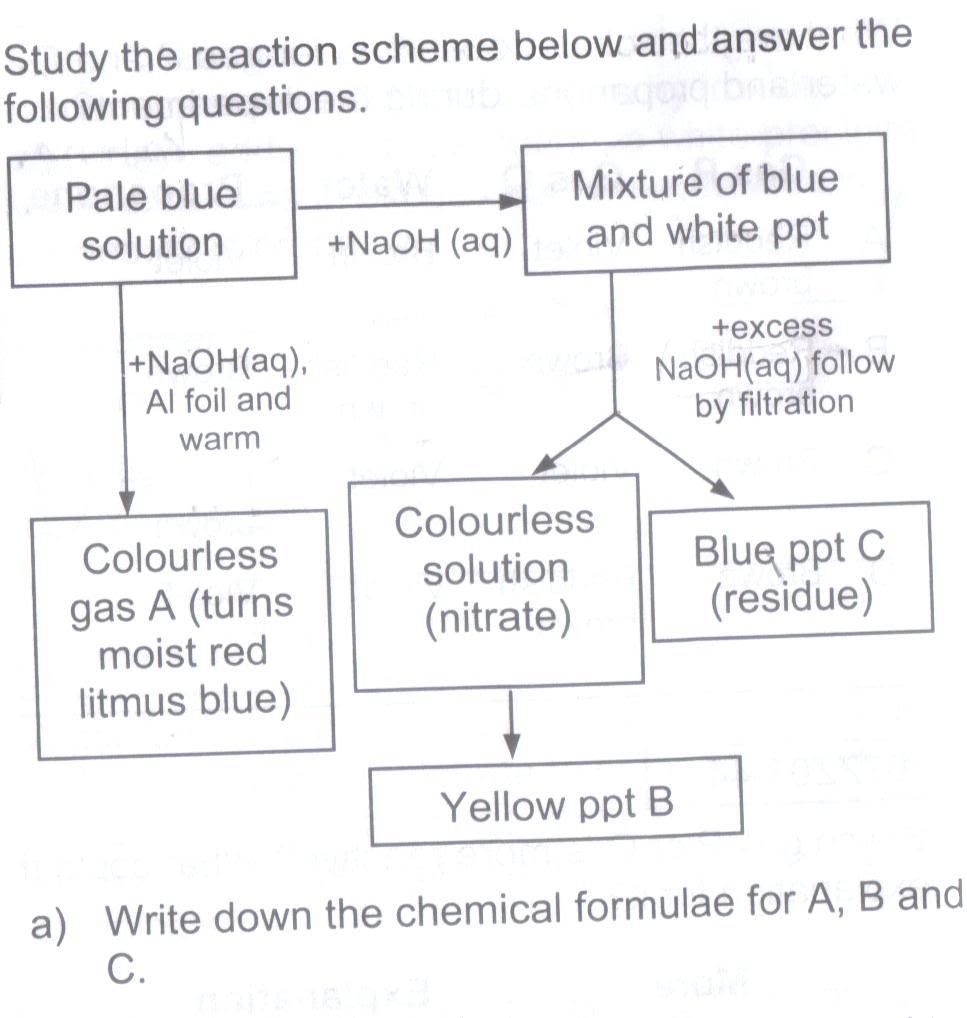
For the O level syllabus, they should be familiar with the QA
test for nitrate(V) ions, which does include aluminium metal and
aqueous sodium hydroxide. Yes, it may be considered one of the more
challenging or discriminating questions at 'O' levels, but it is
nonetheless still a fairly reasonable one that could be asked at in
the actual 'O' levels, for both combined science Chem and pure
Chem.
So even if they have no idea on why it works (ie. my explanation
in my previous post), but they could still correctly answer the
question by recall of the QA test for nitrate(V) ions.
There is a separate point to be made here. You hear the saying
how everywhere around the world, in China, in Korea, in Japan, in
the UK, etc, and certainly in Singapore, more and more people are
getting University degrees, such that soon people would need a
degree to 'sweep roads'. This is a actually a sad state of human
affairs, and isn't just a localized Singaporean problem. (Though
having hundreds of thousands of foreigners coming in every year
competiting with locals, students or working adults, while (the
foreigners themselves are only fellow humans striving for a better
life) not the root of the problem, does exacerbate and accelerate
the pressure-cooker societial problems faced by children students
in the Singapore education system.
All parents want the best for their children. And all children
are getting increasingly desperate to be at the 'top'. You hear
sadly ridiculous stories about how almost every parent whose child
is not above average in academia, gets all upset with the child,
"why are you not above average? Being average means you're a
failure in society!". This attitude is hypocritical and
unethical, because either it means such parents have no idea what
the mathematical definition of "average" is, or (far more likely)
it means such parents look down upon everyone else.
It is the same within the MOE system. Principals (for the sake
of their own promotion) put pressure on HODs, who (for the sake of
their own promotion) in turn put pressure on teachers. "Our school
results *must* be better than the national average! If not,
something is *wrong*, and heads will roll!" So if everything is
'right' as it 'should be', then *everyone* would be scoring 'above
average', which is a mathematical, logical impossible fallacy. Or
more to the point, reeks of elistist, anti-ethical,
anti-compassionate, separatist, ruinous attitudes.
This dog-eat-dog survival-of-the-fittest unethical behaviour, is
to the detriment of mankind. Humanity risks destroying itself,
if technological advancement is not accompanied by compassion,
empathy, ethical and consciential evolution.
So every year, the number of students seeking to enter
University increases; every year the number of students
working and studying harder and desperately, increases; every
year the number of students who obtain good results and apply into
University increases; but yet the number of available University
courses are not commensurate with demand. (And not forgetting
competition from increasing number of foreign students for limited
places in local University courses. The foreigners are not the
problem, the system is. The world financial system is unethical and
flawed. Humanity is heading towards trouble.).
Every year we have many thousands of medical doctors from China,
India, etc being imported into Singapore, because the government
says "We don't have enough doctors". And yet every year
many thousands of local JC & Poly students who score all
perfects A's, apply for Medical school but are rejected, due
to the very small number of places available; the families of these
students then spend hundreds of thousands of dollars to send them
overseas for Medical school, incurring not just financial debt but
emotional bitterness.
Regarding Qn 3 :
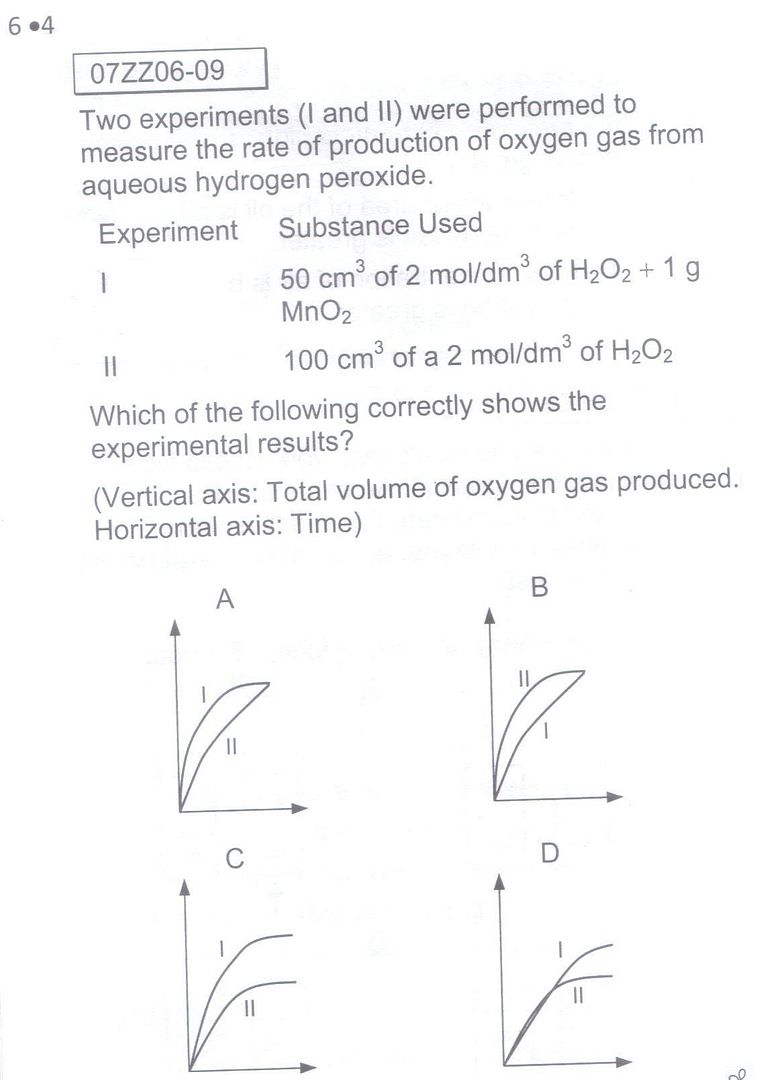
Exp I would indeed be faster (a lot faster actually, the shape
of the graphs are grossly inaccurate) due to the presence of a
catalyst, the manganese dioxide. As to the truncation, it is
arguable as to whether it is a fair question or not. I would be
inclined to agree with you on this, but the fact is exams (both
internal and national level) are increasingly relying on such
'despicably' tricky questions, in a bid to decrease the number of A
grades, to steepen the bell-curve, to make examinations tougher
year-on-year.
Because more and more parents and students are getting desperate
with the increasing costs of living and increasing competition from
foreigners, so more and more students are working harder and
getting better grades. And more and more people are getting
University degrees (something like 80% of Uni grads in
China/Korea/etc are unemployed).
The exam setters are getting alarmed at how more and more
students are doing well and getting As. So they feel pressured that
they've to set tougher and tougher questions; just as year-on-year,
every next generation of students feel increasingly pressured that
they've to do better and better than everyone else, to be 'better
than average', for the less-and-less (relative to population
increase) available places in the University, for less-and-less
decent paying jobs (because the rich keep getting richer and the
poor keep getting poorer, the top-down pyramid in the corporate
world keeps getting more and more elitist at top, more and more
poor masses at the bottom; less than 10% of the richest individuals
own more than 90% of the planet, etc. The richer you are,
the more opportunities you have to increase your wealth.
The poorer you are, the less opportunities you have to increase
your wealth. This isn't about Singapore. It's about the divide
between the rich nations and the poor nations, and how corruption
and warmongering (eg. in Africa) worsens suffering within
their own country, and how corruption of other forms within rich
nations like the USA are harming not just themselves, but the world
in general.).
You hear all that 'AdamKhoo' nonsense about "passive
income"? The anti-ethical flawed idea goes, "if you're an
intelligent, successful person in today's society, it means
you would start multiple passive-income streams, which should
eventually overtake your active income. Then you can retire, and
your money will just grow without you having to work!" Sure, sounds
great. But wait, if this works for everyone, that means everyone
will no longer need to work! But wait a min, if everyone's a
millionaire and nobody needs to work (because of this wonderful
'passive income'), then who will work to grow food to feed
humanity? Who will work to improve technology and the lives of
others on the planet?
This entire idea (actually, the entire financial system employed
by humanity) is flawed at best, and downright selfish and unethical
at worst, because some people would say, "Oh, you're right that
passive income can't work if everyone succeeds in using it. But
here's the thing : I don't want everyone to succeed in using it. I
just want myself to succeed in using it. Everyone else can go on
doing whatever hard labour work needs to be done on the
planet, on my behalf. As long as I'm not at the bottom, as
long as I'm on top of the pack, everything is ok, everything
is all correct. I'm cool with survival-of-the-fittest system,
as long as I'm the fittest. Screw everyone else to hell. This
is how it should be. Heehee!."
Okaaaaay. Here's the thing : it's clear to
me that humanity and planet Earth could be a lot more, a lot
better, than how it currently is. Maybe it still could be, someday.
It's all a matter of choice, individual and collective.
But to be fair, things are certainly not all that bad. I just
wanted to get the above off my chest. There is hope for change
(Obama isn't a world saviour, but he's a decent human being doing
his darnest best in a near-hopeless international political
quagmire, a cesspool of corruption...) oops, as I was saying,
things are not all bad. There are certainly many ethical,
helpful, evolving people everywhere on the planet, just about as
many as there are unethical, selfish, decadent people everywhere on
the planet. So it's a collective game, a collective tug-of-war, a
collective party on Earth. Each side, each individual, each
group, harbouring and working out their own agenda (Bilderberg
Group, anyone?), whether it be ethical or unethical, religious or
secular, world-domination or world-assistantiality.
While tis not exactly a fun-and-games place to be on,
planet Earth. But it is a powerful place to be, a powerful
time to live in. With great power, lies great opportunities for
great good or great harm. With currently accelerating
technological progress, there can be much possibilites for the
future. The future of our planet, the future of
humanity.
Regarding Qn 4 :
Yes, while it's true what you say that because the molarity of
the protons or the acids are not given, it's technically not a fair
question (since theoretically, a concentrated solution of a weak
acid can indeed have a lower pH than a dilute solution of a strong
acid).
However, such questions do indirectly imply (meaning it is fair
enough to expect students to think this way) that the
different acids present (strong versus weak)
are probably of similar molarities, so that the question
can be fairly answered. In other words, the point of the
question, is to test for the students understanding of 'strong'
versus 'weak' acids, assuming similar molarities. This is moreso
the case at 'O' levels, than at 'A' levels.
So for that question 4, the 'correct' O Level answer would be,
in increasing pH :
Nitric acid (stong acid), Vinegar (weak acid), Sugar
Solution (neutral), Limewater (alkaline).
You're welcome again, gohby, always glad to
share the joy of Chemistry around. May you keep enjoying Chemistry
(and Life) and sharing your own joy and love (of Chemistry, of
Life) around, too.
Thanks a lot UltimaOnline - your explanation is really thorough
and informative! :)
The complexity of Question 1 alarmed me actually. How can a sec
sch student, given the materials in the textbook that he/she has
been exposed to, know that Al has a significantly oxidation
potential? A sec sch student would only be cognisant of the scale
of reactivity of metals, and even so, there isn't any clear
"cut-off" point to say which metals will oxidise with ease. They
will not understand what is oxidation potential, or have access to
A Level Chemistry Formulae Booklet either. Besides, they are
supposed to conjure that the electrons expelled from the oxidation
of aluminium are used to thoroughly reduce NO3- right up to NH4+,
even without the presence of a known reducing agent. (I know
metals are reducing agents, but what I'm referring to are "special"
reducing agents like potassium iodide, etc). What I am more
concerned is how the student is able to obtain the answer by
establishing the link between whatever that is expressedly taught
in the syllabus to the question - in this case, the link, for sec
sch students, imo, is very difficult to establish. Is there another
way of looking at this question from a perspective of a sec sch
student by relating to the stuff in the textbook such that this
question doesn't seem so out-of-the-world and chim?
For question 3, since the concentration of hydrogen peroxide in
Expt I & II are the same, shouldn't the rate of reaction be the
same? In that case, even option A would not be a right choice as it
shows the rate of reaction for Expt I is greater than that of Expt
II.. Besides, I think it's not very fair for the students if the
setter were to truncate the graphs expressing any hints that it's
truncated in the qn.. I'm of the opinion that this question is void
and there isn't a valid answer though.. Would you agree?
Oh yes, for question 4, given the fact that pH=-lg[H+], can I
say it's not possible to compare the pH of vinegar (which is made
up of acetic acid/ethanoic acid) and the pH of nitric acid since
the concentration of H+ ions is not stated?
Thanks a lot once again!