Hi, I have some bio questions that I'm not sure how to do. I
have attempted the questions and I just need to check if my answers
are acceptable. Thanks :)
DNA and GENOMICS
Knowing that the genetic code is almost universal, a scientist uses
molecular biological methods to insert the human β-globin gene into
bacterial cells, hoping the cells will express it and synthesize
functional β-globin protein. Instead, the protein produced is
non-functional and is found to contain many fewer amino acids than
does the β-globin made by an eukaryotic cell. Explain why.
My answer: Prokaryotes do not have RNA splicing. The introns are
transcribed by the bacteria in the mRNA strand. The intron could
have a stop codon within it sequences. Thus when translated by the
bacteria ribosome it could lead to a non-functional, truncated
protein.
VIRUSES
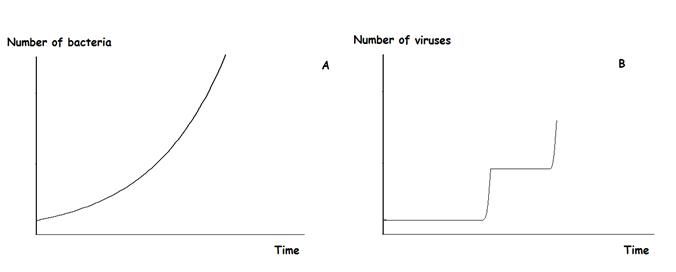
When bacteria infect an animal, the number of bacteria in the body
increases in an exponential fashion (graph A). After the infection
by a virulent animal virus with a lytic reproductive cycle, there
is no evidence of infection for a while. Then, the number of
viruses rises suddenly and subsequently increases in a series of
step (graph B). Explain the difference in the curves
My answer: Graph A shows an exponential increase in the number of
bacteria as time increases while graph B shows a plateau followed
by a sudden, sharp increase with time. Graph A increases smoothly,
without any plateaus because bacteria multiply by binary fission
very quickly (about 20 minutes). However graph B has its shape
because it takes time for viruses to infect their host animal cells
(accounting for the initial plateau) and time for it to replicate
the viral genome and proteins before it lyses the cell, releasing
virions outside the cell (accounting for the sharp sudden
increase).
The time on the x-axis is ambiguous? If the time on the x-axis is
long, then the explanation for the plateau is that it the virus can
remain latent?