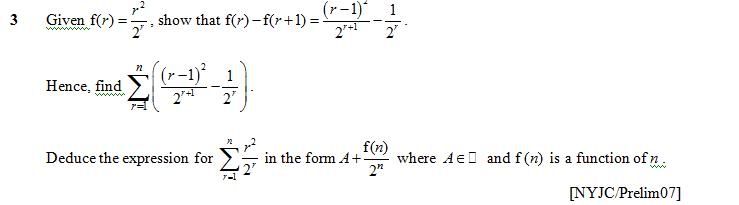
Hi, I was doing my revision questions and bump into some
problems on summation.
 ^Im not sure how to prove the second part.
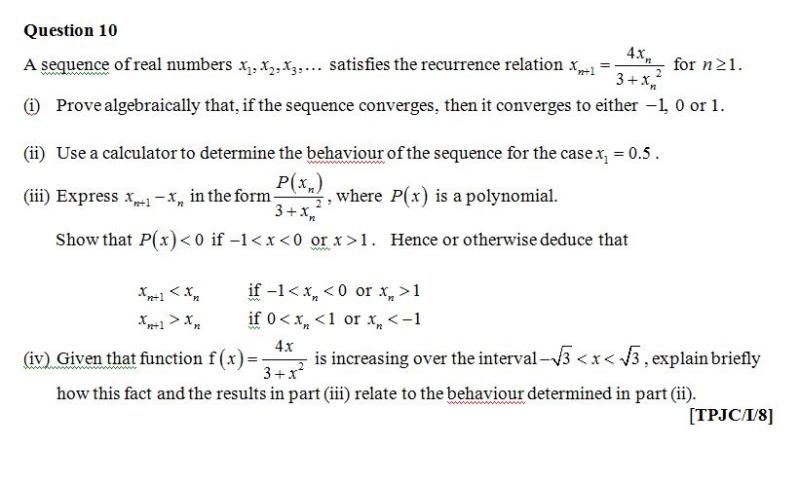 ^ Not sure how to explain (iv)
Thanks.
For the 1st one, I will type it out in words.
Since the 1st part has been proven,
Summation 1/ ( Square root r + square root (r-1) ) = square root
n
One thing you must realise is that the bigger the denominator,
the smaller the value.
Since ( 2 square root r ) is bigger than ( square root r +
square root (r-1) ), the summation of 1/ (2 square root r ) must be
smaller than the summation
of
1/ ( Square root r + square root (r-1) ), hence the summation of 1/
(2 square root r ) must be less than square root n.
For the 2nd one, (iii) shown that when x is between 0 and 1, the
next number in sequence will be larger than the previous one. (iv)
also shown that f(x) is increasing between - (square root 3) and
(square root 3).
Hence, this shown that x = 0.5, which is in (ii), will increase
( even if you do not calculate it out ), as 0.5 lies well within
the requirements shown in (iii) and (iv).
In short, (iii) and (iv) shown what will happen in (ii).
I have always been lousy when it comes to putting such stuffs
into proper sentences, so you will have to think about it for a
while.