1. The diagram shows a transverse wave on a rope. The wave is
travelling from left to right. At this instant shown, the points P
and Q on the rope have zero displacement and maximum displacement
respectively.
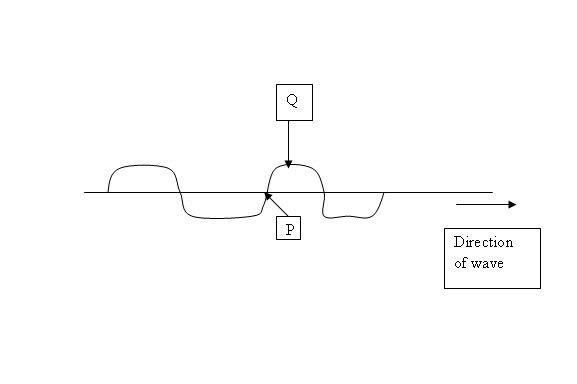
What is the direction of motion of points P and Q at this
instant? (eg. Downwards, upwards, stationary)
For P, I think it's upwards while Q is stationary.
For wave questions,
think about which direction will the wave move, and as the wave
move, the particles need to move up and down to complete the
"motion", therefore, P should move up and Q should move
down
2. Two solenoids, X and Y , are connected in series as shown and
are suspended near each other. When X and Y are connected to an
a.c. supply, they will
A repel each other
B Attract each other
COscillate towards and away from each other
D Oscillate upwards and downwards.
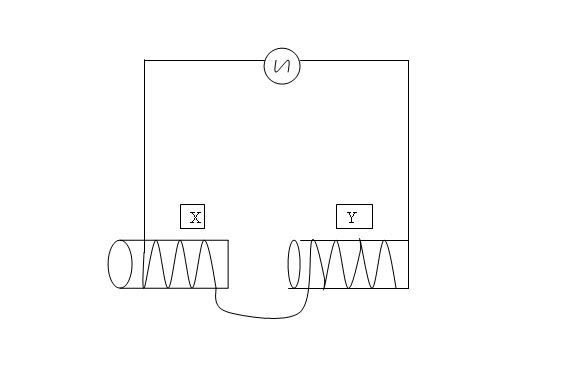
Assuming your
directions of circuit is correct. Y and X will have the same
induced north pole pointing right, so they will tend to attract
each other, but according to , i think , Lenz laws, they will tend
to repel the motion of attraction. Answer: A
3. A 12 V lamp is connected to a 12 V supply with very long
leads as shown
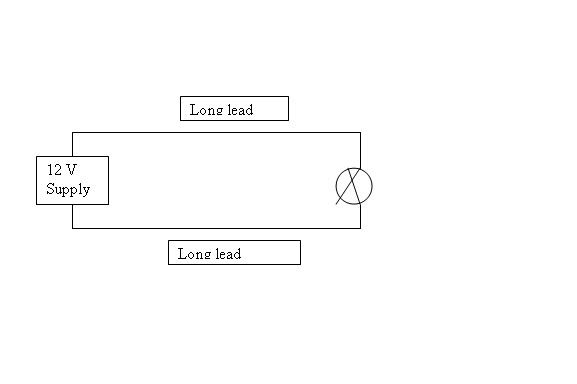
Why does lamp glow dimly?
A. Current through lamp is less than current from supply
B P.D across each lead will be half the supply voltage
C Lamp connected wrong way round (Clearly not possible, yes)
D Electrical energy coverted to internal energy in long leads.
(conductor, should not
be)
Eliminated C since it's totally impossible. I also ruled out D
as internal energy changes when there is a change in either kinetic
OR potential energy. Now left with A and B. B sounds right but I'm
not sure... if yes, can someone explain why P.D across each lead
will be half the supply voltage? If no, then please explain to me
why it is the other answer, etc.
The long leads will increase
resistance using resistance formulae, therefore, using V=IR,
increase R, V constant, therefore I decrease. So answer is
A, volatage is the amount of work
across a certain section of wire or any item with resistance by 1 C
of charge, so although the resistance wire (Lead), will cause some
work to be done, but it is not across the bulb, so V stays
constant.
4.To an observer at X, in which direction does coil move?
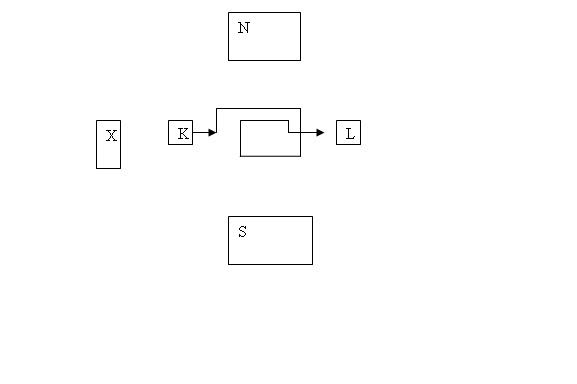
A From L to K
B Out of paper (OUT OF CONTEXT,
is see bu X not you)
C Turns clockwise about axis KL
D Turns anti-clockwise about axis KL
I understand that force is downwards so I thought answer could
be A or D. I think if you visualise it 3D, it will turn
anti-clockwise about axis KL (moving down). Not sure if it's
correct.
current not given,
question is ambiguous, however, if i use DC current from K to L, it
will move right, which is neither the options, and AC curent cannot
do.... Is this DC or AC system?
5. If you have 2 conducting plates
S_________N_______________ +V
R_________M_______________0
placed parallel at a fixed distance apart, what is the
magnituude of the electric form experienced by a point charge as it
moves along MN?
It's the same yeah? Since it's a uniform parallel conducting
plate.
(SEE EAGLE SOLN)
Thanks for reading and clarifying my doubts!