Hi,
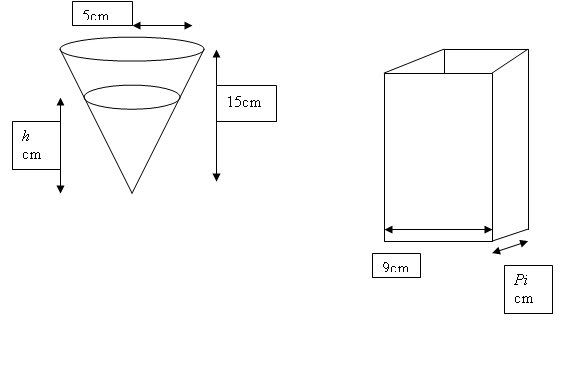
In (a), the expression that is to be shown involves the
variable h yes?
Given dV/dt = -20. We can infer that dV'/dt = 20, where
V' represents the volume of liquid in the cuboid, since water leaks
from cone into cuboid.
In the case of the inverted cone, consider dh/dt =
(dV/dt) (dh/dV) = -180 / (pi h^2).
For the cuboid, volume V' = 9 pi h'.
Consider dh'/dt = (dV'/dt) (dh'/dV') = 20 / (9 pi).
Since both rates are the same in terms of magnitude,
180 / (pi h^2) = 20 / (9 pi)
So h = ???
With h found, use similarity to find r (radius of the
uppermost surface of the liquid in the cone).
Then find area of this surface and compare it with 9 pi,
which will be the same.
Thanks!
Cheers,
Wen Shih
Eh, may I know the explanation to part (a)? I followed the steps
given but it seems like they only lead to the solution the the
second part of the question Thank you. (: