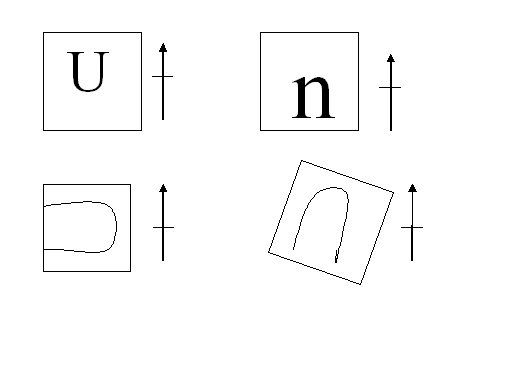
1. A permanent magnet hangs freely from a cotton thread. In
which compass direction does the N-pole of the magnet point?
I wrote the "North of the compass". But my bro says it is the
opposite because the earth's south would attract the magnet's
north. I think it's wrong. I looked at diagrams in my notes and all
the compass points north correspond to the magnet's north.
N-pole of the magnet will point towards the Earth's North pole.
That's how compasses work
2. Making a bar magnet: a metal bar is placed inside solenoid
and current is switched on. With the current in the coil, the metal
bar is slowly withdrawn. Explain whether metal bar is still a
magnet when out of the coil.
My answer: No. As we remove metal bar from solenoid, the south
pole of bar (towards right side is the S-pole) would become N-pole
because current is still flowing and following corkscrew's rule, I
managed to determine left side is N-pole. So as S-pole moves
towards N-pole, it also loses its magnetism. Thus, bar is no longer
magnet. (something like that, I think)
depends
Is the current an a.c. current or a d.c. current?
Is the metal bar made of iron or steel?
3. Just to check, energy changes from electric bell are as
follows:
chemical energy -> electrical energy -> magnetic
energy -> kinetic energy -> sound energy
sounds correct and reasonable except for bolded one
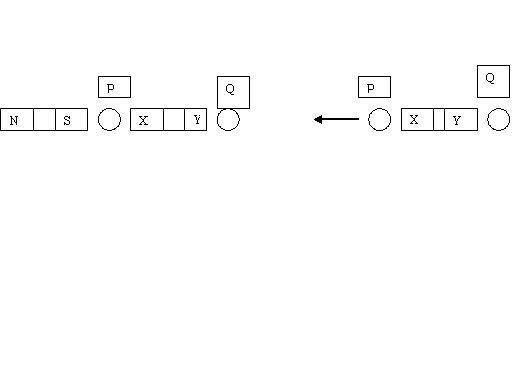
4. A metal bar P-Q hung by a thin thread alwats comes to rest
with end P pointing North. Another bar X-Y of the same metal
settles in no definite direction. What happens when metal bar P-Q
is brought closer to the other bar?
I wrote End P neither attract nor repel end X. I do not know the
rationale behind this really. Or is it end P and end Q BOTH attract
end X?
It means metal bar P-Q is a magnet, whereas bar X-Y is not, but
is of magnetic material since it is of the same metal as P-Q
Thus, both end P and end Q will attract end X.