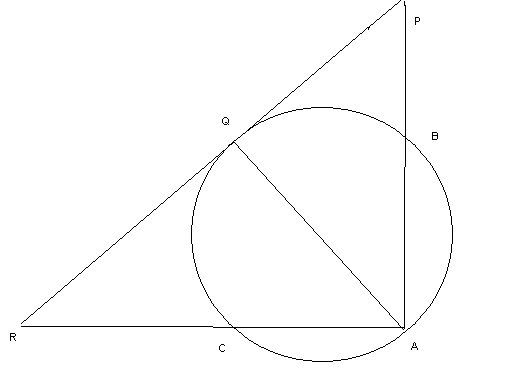
I dunno what is that tan-sec theorem, but ABQ and AQP are
similar triangles due to AA(!)....so in fact part (a) is really
simple. AQ/AP = AB/AQ
That's a good way also, but you have to state explicitly why the
angles are equal...
Will include in Examworld
For everyone else's info, this was his solution
Angle BAQ = angle QAP (obvious)
Angle AQP = 90 degrees (tangent)
Angle ABQ = 90 degrees (angle at semi circle, E maths)
Hence, angle AQP = angle ABQ
Thus, the triangles AQP and ABQ are similar
Which gives us AQ/AP = AB/AQ
And we will end up with AQ² = AP * AB (shown)
A wee bit longer, but a very nice and elegant solution.
In fact, by observation, we could even prove the tangent secant
theorem by working backwards from here onwards through my previous
solution... i.e.
AQ² = AP * AB
AQ² = AP * (AP - BP)
AQ² = AP² - (AP * BP)
But AQ² = AP² - PQ² by pythagoras theorem
PQ² = PA * PB
Tangent secant theorem proved(but only for the case where AQ is
the diameter...)