last question! it was on transition metals.
if i remembered correctly, they gave CuCl2 as the first
compound. reacting with conc. HCl gives D which is a yellow-green
solution/ppt(i forgot) and heating with Cu and conc. HCl gives E, a
colourless solution and adding SO2 to D and water to E gives F, a
white compound made up of chlorine and copper only.
i) suggest a balanced equation for reactions of CuCl2 which
gives D and E
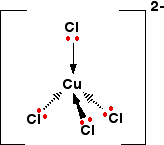
ii) suggest the complex ions in D and E
iii) wad type of reaction is taking place from D to F?
iv) wad type of reaction is taking place from D to F?
v) suggest the compound for F and give its oxidation number.
vi) wad is the shape of the complex ion D? (or E)
yeah. thats about it. the questions are a little jumbled up and
based on my memory. maybe someone can correct me. haha. i think
there're more questions also.
>>> last question! it was on transition
metals.
if i remembered correctly, they gave CuCl2 as the first
compound. reacting with conc. HCl gives D which is a yellow-green
solution/ppt(i forgot) and heating with Cu and conc. HCl gives E, a
colourless solution and adding SO2 to D and water to E gives F, a
white compound made up of chlorine and copper only.
i) suggest a balanced equation for reactions of CuCl2 which
gives D and E
ii) suggest the complex ions in D and E
iii) wad type of reaction is taking place from D to F?
iv) wad type of reaction is taking place from D to F?
v) suggest the compound for F and give its oxidation number.
vi) wad is the shape of the complex ion D? (or E)
<<<
To obtain tetrachlorocopper(II) complex ion :
[Cu(H2O)6]2+ + 4Cl- --> [CuCl4]2- + 6H2O
The VSEPR geometry of this complex ion is tetrahedral. (Cl-
ligands are too huge, so you don't get hexachlorocopper(II) ion,
which would be octahedral).
SO2 is a reducing agent, and reduces Cu2+ to Cu+, so you get
CuCl(s), a white compound. Oxidation state (O.S.) of Cu in
CuCl is +1; O.S. of Cl in CuCl is -1.
The reactions involved are redox and ligand displacement
reactions.