Interest and cmpd interest!
Found this from wiki
http://en.wikipedia.org/wiki/Compound_interest
Formulae are presented in greater detail at time value of
money.
In the formula below, i or r are the interest
rate, expressed as a true percentage (i.e. 10% = 10/100 = 0.10).
FV and PV represent the future and present value
of a sum. n represents the number of periods.
These are the most basic formulae:
The above calculates the future value of FV of an
investment's present value of PV accruing at a fixed
interest rate of i for n periods.
The above calculates what present value of PV would be
needed to produce a certain future value of FV if interest
of i accrues for n periods.
The above two formulae are the same and calculate the compound
interest rate achieved if an initial investment of PV
returns a value of FV after n accrual
periods.
The above formula calculates the number of periods required to
get FV given the PV and the interest rate
i. The log function can be in any base, e.g. natural log
(ln)
Formula for calculating compound interest:
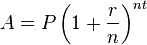
Where,
Example usage: An amount of $1,500.00 is deposited in a bank
paying an annual interest rate of 4.3%, compounded quarterly. Find
the balance after 6 years.
A. Using the formula above, with P = 1500, r = 4.3/100 = 0.043,
n = 4, and t = 6:

So, the balance after 6 years is approximately $1,938.84.