Alright. There are a few things to take note first and several
questions that needs to answer.
Let us see the question again. "Explain the relationship between the ADH and
the response to water and NaCl solution using data
provided."
The infromation provided by the question is important.
"A person's normal kidney output
was measured and was 4 cm3 min-1. The effect of water, sodium
chloride and anti-diuretic hormone (ADH) was investigated in the
following 3 separate experiments"
Note:
1) Normal kidney output 4cm3 min-1.
2) Effects of water, ADH, and NaCl solution was investigated in 3
separate experiments.
Analyzing the data:
At 0 minute, the kidney's output were relatively around 4cm3. This
is true as stated by the given information.
Next step is to roughly draw the graphs.
For the subject given just water experiment, the
graphs would look like a bell if you were to draw it out. Kidney's
output of water will increase over time untill it reaches peak(due
to the water drank) at time 60min at 10.1cm3min-1, and slowly the
output decreases.
For the subject injected with a little ADH. The graph will look
like a 'U' shape, bottoming at Time 10minute. From 4.2cm3min-1 at
time 0min to 0.4cm3min-1 at time 10min, this is a very rapid
decrease in kidney's output at a very short time. After 10minutes,
the kidney's output gradually increases its output. And by time
20min, output of the kidneys remains relatively normal
(4cm3min-1).
For the subject injected with 15cm3 of 2% NaCl solution. The
graph will also look like a 'U' shape, bottoming at time 10min at
0.5cm3min-1. Then after some time, the kidney's output starts to
increase.
A rough idea of how the graph looked like.
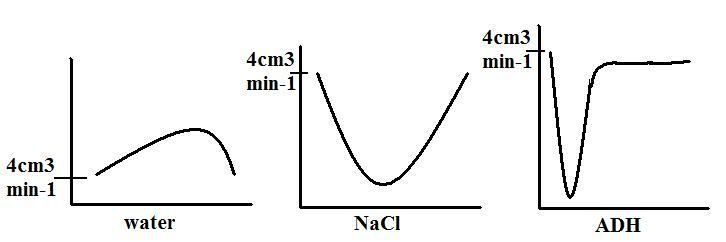
If you observed carefully, you will see that ADH have a more faster
response as compared to NaCl and water (looking at the gradient of
the graph). ADH response in a hormonal response.
How does ADH helps in reducing the kidney's
output?
ADH triggers an increase in water permeability in the membrane of
duct cells. ADH is secreted by the hypothalamus. When it reached
the kidney in the blood, it'll attach to the receptor protein on
the duct cell membranes.
It triggers the enzyme that catalyzes the production of cAMP.
cAMP activates another enzyme, the enzyme will alter the structural
of cell protein that forms a sort of microskeleton. The cell
protein changed their shape. This allows vesicles containing the
water permeable pore protein to move towards the cell membrane. The
vesicles fused with the membrane, adding the pore protein. This
makes the membrane more permeable to water and diffuse towards the
low water potential in the medulla tissue fluid.