Hello Darkness_hacker99 
1a)
Based on the Lewis structure given, which is a single resonance
contributor, clearly the double bond will have a smaller bond
length than the single bond. However, in the actual structure
(ie. taking in consideration all possible resonance contributors),
each bond is one and a half, or partial double bond character, and
are equivalent. Hence, the distance between oxygen atom 'a' and
oxygen atom 'b' is EXACTLY the same as the distance between
oxygen atom 'b' and oxygen atom 'c'.
Q1b)
The structure or molecular geometry of ozone is bent or
v-shape or non-linear. The central atom forms an sp2 hybridization
with one lone pair. (Since there are 3 electron clouds (in which
the double bond is considered a single electron cloud), the
electron geometry is trigonal planar, hence it is sp2 hybridized.
The molecular geometry (in which we distinguish between lone pairs
and bond pairs, is bent or v-shape or non-linear). The actual O-O-O
angle has been shown by experimental evidence to be 116.78°.
Q1c)
Based on my explanation above in 1b), ie. considering the
electron geometries, we see that :
a - tetrahedral, sp3 hybridized.
b - trigonal planar, sp2 hybridized.
c - trigonal planar, sp2 hybridized.
Again, be aware that this is just a single resonance
contributor, and not the actual or real structure,
hybridization or geometry.
Q2)
This question is worth 5 marks, which is odd (not odd number
odd, but wierd odd). The question doesn't specify clearly what it
requires of the student, but merely a "describe and explain" which
is a generic instruction usually not worth 5 marks.
Anyways, iodine exists as in equilibrium between its solid and
gas phases. What is little known is that iodine can and does exist
in the liquid state (it's melting point is 386.85 K and its boiling
point is 457.4 K), but indeed as the question correctly states,
iodine will naturally sublimate at rtp (just as some water
molecules would also sublimate from ice to gaseous water vapour,
although most would transit into the liquid state; the difference
between the behavour of iodine vs water is
simply because the magnitude difference between the mp and bp
of iodine is much smaller than for water).
I2 (s) ---> I2 (g)
Left untouched and over a long period of time in a closed system
(ie. sealed air-tight container), some of the I2(s) would sublimate
into I2(g). But since we're talking about equilibrium, and at
r.t.p, you would still observe some solid iodine crystals (ie. not
all of the solid would sublimate into gaseous iodine), no matter
how long you wait. In other words, once equilibrium is reached
between the solid and gaseous states, you will get a fixed,
specific ratio of products (ie. gaseous iodine) to reactants (ie.
solid iodine).
If it were an open system (ie. unsealed, open container), the
solid crystals gradually disappear, and eventually so does the
purple iodine vapour.
In this closed system (ie. airtight sealed container) an
equilibrium has established. The equilibrium is between the iodine
solid and the iodine vapour. It is called dynamic equilibrium
because it is not static, both foward and backward reactions are
occurring simultaneously, but at the same rate. What is happening
is that I2 molecules are leaving the solid and entering the vapour
phase at the same rate as they are leaving the vapour and entering
the solid state. The forward and reverse rates have become the same
and the system is at equilibrium. However, this is not a chemical
equilibrium but a physical phase equilibrium.
Q3.
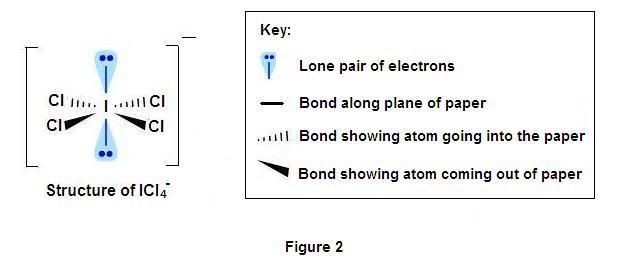
It has to do with the different (electronic and
thermodynamic) stabilities of the various configurations or
structures. Recall that lone pair - lone pair repulsion is greater
than lone pair - bond pair repulsion is greater than bond pair -
bond pair repulsion.
In structures A and B, the lone pairs are placed beside each
other, which leads to structural instability due to a disparity in
electron pair repulsions (ie. the lone pairs have greatest
repulsion against each other and want to be placed or
directed as far away from each other as possible). The most
stable structure, both theoretically and from experimental
evidence, would be the the square planar geometry as shown in
Figure 2.