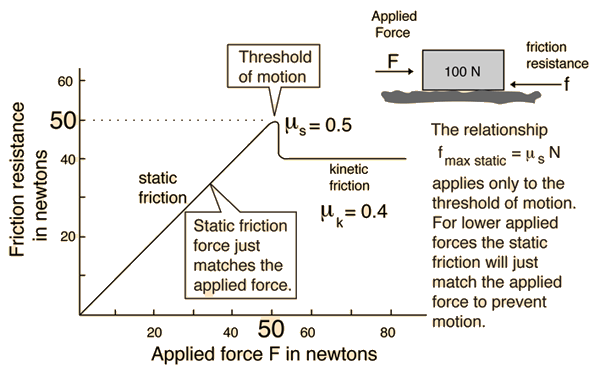
Okay thanks. If that's the case, it brings me to another
possible occurrence. Lets say we have a wooden block with a mass of
2kg being pulled with a force of 2N on a rough surface. The wooden
block doesn't move becasue of friction.
We can thus safely assume that frictional force is 2N because it
balances up and result in onject staying stationary.
but when the wooden block is pulled with a force of 5 N, the
block moves with CONSTANT SPEED.
Now, what is the net force acting on the wooden block?
Should it be 0 N or 3 N? because like you just mentioned,
friction remains the same in all circumstances. so i got 3 N by
subtracting 2N from 5N. but i think the correct answer is 5 N.
and what is the frictional force exerted on the wooden block
now?
5N or 2 N?