No full solutions but I shall give you guide to solving the
question:
A -> enthalpy change of the reaction = enthalpy change per
'mole' of reaction
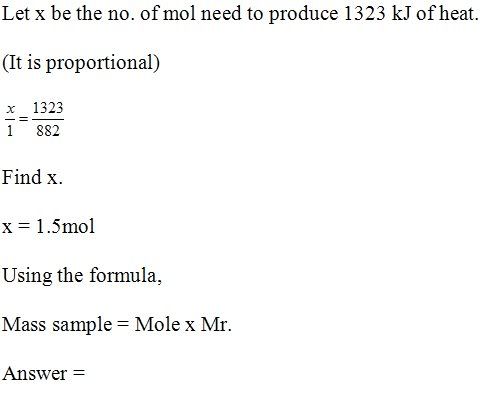
Therefore, 66g of CO2 = how many moles of CO2? Let this answer be
A1
From A1, you calculate the no. of 'moles' of the reaction (A2). A2
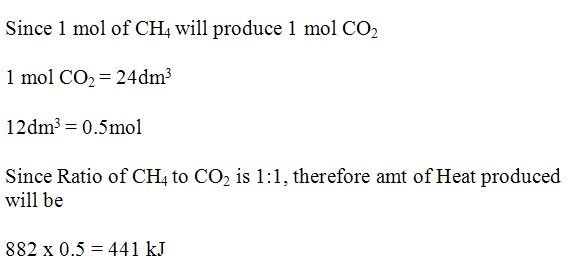
moles of reaction gives off 1109.5 KJ of heat, so 1 mole of
reaction gives of? (1/A2 x 1109.5 KJ)
Ans: -2219 KJ per mole (3sf)
B-> As per question A. 80g of Br2 = how many moles of Br2?
(B1).
From B1, you can thus calculate the no. of 'moles' of reaction
(B2).
Ok next, the net enthalpy change of the reaction = bonds formed -
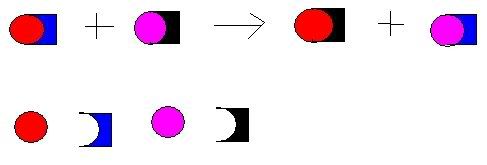
bonds broken. In this case, you form B2 amounts of H-H and B-B
bonds when you break 2 x B2 amounts of H-Br bonds.
For your info, B.E. of H-H = 436 kj per mole, B.E. of Br-Br = 193
kj per mole.
Therefore, enthalpy change = BE[H-H] + BE[Br-Br] - 2xBE[H-Br]
Rearranging, 2xBE[H-Br] = BE[H-H] + BE[Br-Br] - enthalpy
change
So in this case, 2 x B2 x BE[H-Br] = B2 x BE[H-H] + B2 x BE[Br-Br]
- (+51.5 kj per mole)
Sub in the values of B2 and manipulate to get your answer.
Answer: +263 kj per mole (differs from the data booklet value of
+366 kj per mole though)