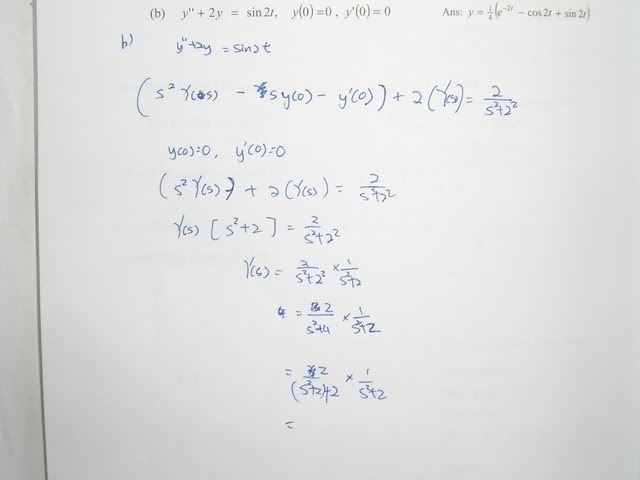
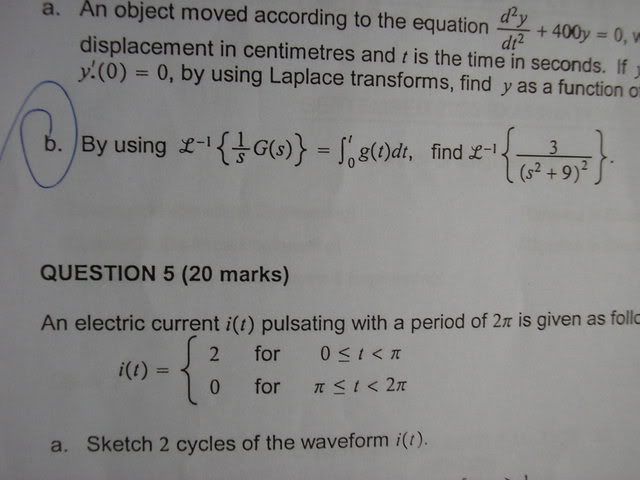
Dont blur...
laplace transform just apply fomular only....
Probably, the difficult part is factorising ....
Just follow the examples as below lor :
1/(s)(s+1) = A/s + B/(s+1) Find A and B
1/(s)(s+1)^2 = A/s + B/(s+1) + C/(s+1)^2 Find A, B and C
1/(s)(s^2+1) = A/s + (Bs+C)/(s^2+1) Find A,B and C
1/(s)(s^3+1) = A/s +(Bs^2 + Cs + D)/(s^3+1) Find A,B,C and D
Just remember the numerator must contain expression of order one
less than the denominator....
On factorising ... got 2 methods
example : 1/(s+2)(s+1) = A/(s+2) + B/(s+1)
1st method ---- lazy
method--->residue therom
A = 1/(s+1) |s=-2
= -1
B = 1/(s+2) |s=-1
= 1
Thus 1/(s+2)(s+1) = -1/(s+2) + 1/(s+1)
2rd method -----
comparision
1/(s+2)(s+1) = A/(s+2) + B(s+1)
1/(s+2)(s+1) = [A(s+1) + B(s+2)] / (s+2)(s+1)
Compare the numerator since demonator is the same :
1 = A(s+1) + B(s+2)
Compare the s order term :
0s = As + Bs
A = -B ----- Equ 1
Compare the constant term :
1 = A +2B ------ Equ 2
sub 1 into 2,
B =1
And, A = -1
Thus, 1/(s+2)(s+1) = -1/(s+2) + 1/(s+1)