No
Parking Anytime: How a white New Yorker became a Buddhist
minister
A spiritual journey
recounted
Seattle, WA (USA) -- The new minister at the
Seattle Nichiren Buddhist Church was cleaning out the 80-year-old
brick building in the International District just after he arrived
a couple of months ago, when he found the building's secrets inside
its walls.
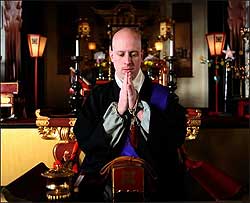 << The Rev. Kanjin Cederman
is the new Buddhist minister at Seattle Nichiren Church
Hidden in a crawl space, he discovered Japanese flags -- dusty
and apparently untouched since the early days of the U.S. entry
into World War II.
Soon after, when electricians doing repairs broke through
another wall, they uncovered old Buddhist texts bound in brown
leather.
Sixty years later, he can only guess.
The books make reference to Japan's emperor, and the Rev. Kanjin
Cederman, 33, thinks the congregation must have feared appearing
too closely aligned with their homeland after the Japanese attack
on Pearl Harbor.
The minister understands the fear of persecution, he said.
Cederman, born Michael Cederman, grew up Jewish.
Seated in his office one afternoon last week, Cederman wore
white socks and sandals and a black robe -- garb he replaces with a
Shriner hat and Western clothes when he goes to his Masonic
meetings.
Outside the temple, he has an affinity for wearing bowlers.
He has a particular style of speech -- his accent usually all
New York -- like when he explains that he wears the robe at
Buddhist ceremonies "to make people feel comfortable."
"Not that I should look pretty," he says.
But at times, he lapses into broken English.
"The scrolls I find in back," he says of the hand-painted
lithographs that now hang next to a gold-colored shrine where he
leads the practitioners in chant. The lithographs, imported from
Japan when the church was founded, depict 13th century Japanese
philosopher Nichiren, on whose teachings the branch of Buddhism
Cederman practices is based.
"I think that (style of speech) is from my sensei," he says of his
Buddhist teacher in Toronto. "He was Japanese, and sometimes it was
hard to understand his English until you learned he was speaking
his own kind of English. I think I go back into that when I'm in
the mindset of what he taught me."
Like many spiritual journeys, his was roundabout -- with no clear
explanation for what brought him to Seattle. He grew up in Buffalo.
His father was Jewish, his mom Catholic, and Cederman said he
wasn't raised with any faith in particular.
Still, as a youth, he found himself questioning the religious
beliefs around him. "I remember thinking: If we were the chosen
people, then how about everybody else?"
He wasn't particularly religious, but Cederman was into Aikido, and
at 16 traveled to Japan to study the martial art with a Buddhist
monk.
"The day I graduated from high school, I thought, 'I have to decide
what kind of a person I'm going to be.' I thought of all the good
people I'd known."
He thought of the monk and decided to go to China to become one as
well.
After a couple of years, he converted to the Nichiren-shu branch of
Buddhism, and studied in Toronto and Japan, before returning to
Buffalo to start a small temple.
He was working on a graduate degree in English literature at the
University of Buffalo, when he was offered the job of turning
around a Seattle temple with an aging congregation.
His first step was fixing the building to invite back families who
only visit for special events, but not services. That was how a
Buddhist minister named Cederman came to revive an aspect of the
temple's history.
The Japanese who hid the artifacts worried about fitting into their
new country.
They called it a church, instead of a temple. And the minister
there was always "reverend," he said, instead of the more
traditional, shomin.
The building is a simple two-story brick with a long flight of
stairs in front. "What does this building look like?" he said.
"Does it remind you of a certain style? It's Masonic," he said.
Members, who are largely Japanese, have come to accept the white
man from New York, said Kimie Kuramoto, head of the temple's
women's group.
He has put the lithographs that used to hang next to the
gold-colored shrine before World War II back up.
Kuramoto said, "We laugh -- it's like (Barack) Obama, 'Change,
change, change.' "
(Source: The Buddhist Channel http://www.buddhistchannel.tv/index.php?id=65,7561,0,0,1,0
)
new era for Buddhism