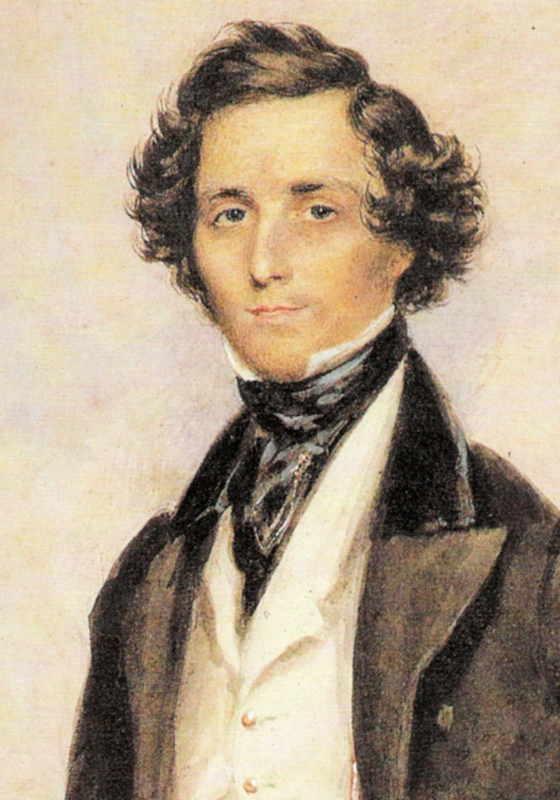
Felix Mendelssohn
From Wikipedia, the free encyclopedia
Jump to: navigation, search
Felix Mendelssohn Bartholdy at the age of thirtyJakob Ludwig Felix
Mendelssohn Bartholdy, born and known generally as Felix
Mendelssohn (February 3, 1809 November 4, 1847) was a German
composer and conductor of Jewish parentage of the early Romantic
period. His work includes symphonies, concertos, oratorios, piano
and chamber music. After a long period of relative denigration due
to changing musical tastes in the late 19th century, his creative
originality is now being recognised and re-evaluated, and he is now
amongst the most popular composers of the Romantic era.
Contents [hide]
1 Life
2 Revival of Bach's and Schubert's music
3 Contemporaries
4 Reputation
5 Works
5.1 Juvenilia and early works
5.2 Symphonies
5.3 Other orchestral music
5.4 Opera
5.5 Concertos
5.6 Chamber Music
5.7 Choral
5.8 Piano
5.9 Organ
6 Media
7 See also
8 Notes
9 References and further reading
9.1 External links
[edit]
Life
Mendelssohn was born in Hamburg, the son of a banker, Abraham, who
was himself the son of the famous Jewish philosopher, Moses
Mendelssohn, and of Lea Salomon, a member of the Itzig
family.
Abraham sought to renounce the Jewish religion; his children were
first brought up without religious education, and were baptised as
Lutherans in 1816 (at which time Felix took the additional names
Jakob Ludwig). (Abraham and his wife were not themselves baptised
until 1822). The name Bartholdy was assumed at the suggestion of
Lea's brother, Jakob, who had purchased a property of this name and
adopted it as his own surname. Abraham was later to explain this
decision in a letter to Felix as a means of showing a decisive
break with the traditions of his father Moses: 'There can no more
be a Christian Mendelssohn than there can be a Jewish Confucius'.
Although Felix continued to sign his letters as 'Mendelssohn
Bartholdy' in obedience to his father's injunctions, he seems not
to have objected to the use of 'Mendelssohn' alone. [1]
Mendelssohn's music room in LeipzigThe family moved to Berlin in
1812. Abraham and Lea Mendelssohn sought to give Felix, his brother
Paul, and sisters Fanny and Rebecka (who later married the
mathematician Lejeune Dirichlet), the best education possible. His
sister Fanny Mendelssohn (later Fanny Hensel), became a well-known
pianist and amateur composer; originally Abraham had thought that
she, rather than her brother, might be the more musical. However,
at that time, it was not considered proper for a woman to have a
career in music, so Fanny remained an amateur musician.
Mendelssohn is often regarded as the greatest musical child prodigy
after Wolfgang Amadeus Mozart. He began taking piano lessons from
his mother when he was six, and at seven was tutored by Marie Bigot
in Paris. From 1817 he studied composition with Carl Friedrich
Zelter in Berlin. He probably made his first public concert
appearance at the age of nine, when he participated in a chamber
music concert. He was also a prolific composer as a child, and
wrote his first published work, a piano quartet, by the time he was
thirteen. Zelter introduced Mendelssohn to his friend and
correspondent, the elderly Goethe. He later took lessons from the
composer and piano virtuoso Ignaz Moscheles who however confessed
in his diaries [2] that he had little to teach him. Moscheles
became a close colleague and lifelong friend.
Besides music, Mendelssohn's education included art, literature,
languages, and philosophy. He was a skilled artist in pencil and
watercolour, he could speak English, Italian, and Latin, and he had
an interest in classical literature