Franz Liszt
From Wikipedia, the free encyclopedia
Jump to: navigation, search
Franz Liszt (Hungarian: Liszt Ferenc) (October 22, 1811 July 31,
1886) was a Hungarian virtuoso pianist and composer. He was a
renowned performer throughout Europe during the 19th century, noted
especially for his showmanship and great skill with the keyboard.
Today, he is generally considered to be one of the greatest
pianists who ever lived. Liszt also contributed greatly towards the
Romantic idiom; he is credited with the invention of the symphonic
poem.
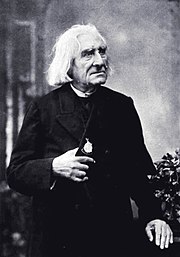
A photo of Franz Liszt late in life, by Nadar.Liszt studied and
played at Vienna and Paris and for most of his early adulthood
toured throughout Europe giving concerts. He is credited with
inventing the modern piano recital, where his virtuosity won him
approval by composers and performers alike. His great generosity
with both time and money benefited the lives of many people:
victims of disasters, orphans and the many students he taught for
free. He also contributed to the Beethoven memorial fund.
His piano compositions include works such as his Piano Sonata in B
minor, and two piano concertos, which have entered the standard
repertoire. He also made many exuberant piano transcriptions of
operas, famous symphonies, Paganini Caprices, and Schubert Lieder.
As would be expected from a pianist-composer of Liszt's virtuosity,
many of his piano compositions are among the most technically
challenging in the repertoire.
His music is well loved in part because of its melodic and
emotional harmonies. He would often add a few pages of flamboyance
to his music to impress the young women. He deeply loved women and
wrote many love songs for them.[1]
Contents [hide]
1 Biography
1.1 Years of Pilgrimage
1.2 Liszt in Weimar
1.3 In retirement
2 Musical style and influence
2.1 Liszt's virtuosity and technical reforms
2.2 Piano recital
3 Noted works
4 Literary Works
5 See also
6 Media
7 References
8 External links
9 Further reading
[edit]
Biography
A statue of the young LisztLiszt was born in the village of
Doborján, near Sopron, Hungary, in what was then the Austrian
Empire (Doborján is now Raiding in Austria after the Treaty of
Trianon of 1920). His baptism record is in Latin and lists his
first name as Franciscus. The Hungarian variant Ferenc is often
used, though Liszt never used this himself. His father, Ádám Liszt,
was Hungarian and his mother was Austrian-born Anna Liszt, née
Lager.
Franz was a weak and sickly child, and was surrounded from his
early childhood with music. His father, who worked at the court of
Count Esterházy, was himself a pianist and cellist (he used to play
in Esterházy's summer orchestra in Eisenstadt); he organized
chamber music evenings with amateur musicians from the surrounding
villages, in which his old friends from Eisenstadt occasionally
took part.
Liszt displayed incredible talent at a young age, easily
sight-reading multiple staves at once. His father gave him his
first music lessons when he was six years old. Local aristocrats
noticed his talent and enabled him to travel to Vienna and later to
Paris with his family. As a result, Liszt never fully learned
Hungarian; his later letters and diaries show that he came to
regret this deeply. One letter to his mother begins in faltering
Hungarian, and after an apology continues in French (his preferred
language).
In Vienna he was taught by Beethoven's student Carl Czerny, the
only piano teacher Liszt ever had. His father had first taken him
to be taught by Johann Nepomuk Hummel, but Hummel's fees were too
high. Antonio Salieri taught him the technique of composition and
fostered the young Liszt's musical taste.
He formed an early friendship with Frédéric Chopin, but later
fierce competition turned the men into rivals. He was a lifelong
friend of Camille Saint-Saëns, and the latter dedicated his
Symphony #3 in C Minor to Liszt.
On April 13, 1823, Liszt gave a concert, and it is often said that
the 53-year-old Ludwig van Beethoven gave him a kiss for his
marvelous playing. An account of the episode can be found in the
separate article Liszt and Beethoven.