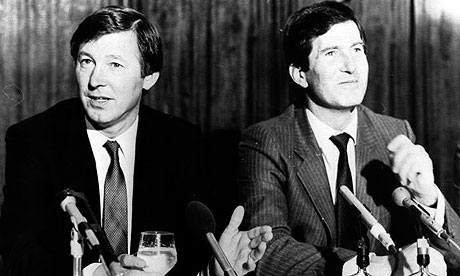
Alex Ferguson at his Manchester United unveiling alongside
Martin Edwards in 1986. Photograph: PA
1967: the summer of love. The sun, moon and stars align for
Dunfermline striker Alex Ferguson, whose dreams come true after 66
goals in 89 appearances for the Pars win him a move to Rangers, the
club that stole his heart as a young lad in Govan. But just as the
idealism of the summer of love would turn sour by 1968, so things
would quickly go pear shaped for the 25-year-old Ferguson at
Ibrox.
At the start of November, the manager who signed him – the
legendary Scot Symon – was sacked with his unbeaten team top of the
league, a kneejerk reaction to external pressure applied by Celtic,
who not only had won the last two Scottish titles but were also
reigning European champions. Symon was replaced by Davie White, a
managerial novice whose lack of tactical nous would soon fair put
Ferguson's back up. Still, the team nonetheless kept their momentum
in the league, and by Easter were still ahead of Celtic. And still
unbeaten.
At which point Celtic boss Jock Stein gave up the chase. "'It is
Rangers' title now, unless they throw it away' was the gist of his
statement," recalled Ferguson in his autobiography Managing My
Life. "Somehow the onus he put on us proved unnerving and we went
into freefall ... I shall never forget those headlines Jock
instigated. The trick was instantly lodged in my memory."
Rangers did remain unbeaten up until their last match, but had
started to draw games,
allowing Celtic to overtake
them. They were still in with a shout on the last day,
but it proved a hurdle too far: despite Ferguson putting Rangers
2-1 up early in the second half at Ibrox against Aberdeen, the
Light Blues crashed to a 3-2 defeat. It meant Celtic, who had a
much superior goal average, only had to avoid losing at Dunfermline
in their last game by 16 goals to retain their title.
Ferguson was Rangers' leading scorer in that season, with 23
goals, but came away with nothing. He would be drummed out of the
club by White a year later, after being blamed for conceding the
opening goal of the Scottish Cup final against Celtic, a game
Stein's side won 4-0. White, who according to Ferguson had made a
tactical dug's dinner of that game, lasted only a few months
longer, becoming the first Rangers manager never to win a trophy.
Ferguson, his Ibrox dream turned sour, would have to make do with a
valuable life lesson from Stein, one that would stand him in fairly
good stead down the years.
In 1976, Ferguson took his St Mirren team to the Caribbean for a
three-week tour, to play matches in Barbados, Trinidad, Guyana and
Surinam. The high point of the tour was a 4-0 win for the Buddies
over the national team of Surinam. The low point had come a week
earlier, when facing the Guyanese national side.
Guyana were treating the game as sharpening-up exercise for an
upcoming World Cup qualifier, and as a result were putting
themselves about. On the touchline, Ferguson became increasingly
agitated at the treatment being meted out to the young St Mirren
striker Bobby Torrance by one of Guyana's big central defenders. At
half-time, Ferguson complained to the referee, but to no avail. Not
for the first time in his life, and certainly not for the last, the
red mist descended. "That's it," he told his assistant Davie
Provan. "I'm going on. That big bastard is taking liberties."
Provan attempted to persuade Ferguson to calm down, but his
efforts were predictably futile. Years later, Ferguson recalled the
incident in Managing My Life. "In the first contest for a cross,"
he wrote, "I exacted a bit of revenge on the centre half, whose
squeals caused the referee to point at me ominously. The
confrontation became fierce until I nailed Torrance's abuser
perfectly. As he rolled about like a dying man, the referee sent me
off."
The confrontation became fierce until he nailed Torrance's
abuser perfectly! After the match, a contrite Ferguson apologised
to every one of his players for his outrageous performance. Oh all
right, no he didn't, he pointed ominously at each player in turn,
explaining via the medium of low hiss that it would be beneficial
to their health if nobody back home heard about his wee on-pitch
jaunt and subsequent banishment. "They never did tell the tale,"
confirmed Fergie in his book, as if you really needed to be
told.
Ferguson's time at St Mirren was quite the rollercoaster ride.
Until Manchester City gave his Manchester United side a 6-1 beating
at Old Trafford last month, two of his joint worst defeats as
manager came as Buddies boss: a 5-0 hammering at Partick Thistle in
1978, and a 5-0 skelping by East Stirlingshire in 1975. The latter
was particularly hurtful, as it came in his first season after
leaving East Stirling for Love Street. East Stirling had also put
St Mirren out of the Scottish Cup that year, with a 2-1 win that
Ferguson admitted "might have been tripled".
But unlike East Stirling, St Mirren finished in the top six of
the old Scottish Second Division in 1974-75, ensuring the Paisley
club would grab the last place in the First (i.e. second) Division
of the following season's modernised Scottish League. After a
season of consolidation, St Mirren won the First Division
championship in 1977, and with it promotion to the Premier
Division. Ferguson's joy at his first-ever managerial title was
enhanced by the results of the three league games against Dundee:
4-0 and 3-1 wins at home, and a 4-0 win at Dens Park which clinched
the title. Dundee, it should be pointed out, was managed by Davie
White, not that Fergie was one to hold a grudge, or anything.
St Mirren's first season in the new Premier Division was a
constant battle against relegation. Ferguson's team stayed up
comfortably enough in the end – by six points – but the manager had
fallen out with chairman Willie Todd, and just before he could
resign to take over at Aberdeen, he was sacked at the end of the
1977-78 season. St Mirren claimed Ferguson had broken his contract
on 15 instances, the rap sheet including approaching staff with a
view to taking them to Pittodrie, swearing at a secretary, advising
a bookie that St Mirren would beat Ayr, and lending the groundsman
his car so he could get to the European Cup final between Liverpool
and Bruges at Wembley.
A piqued Ferguson took the club to an industrial tribunal, but
was roundly trounced, the report stating that he was "petty" and
"immature", and "it shows him as one possessing, neither by
experience nor talent, any managerial ability at all". Now there's
a judgement right up there with Decca Records talent spotter Dick
Rowe's "Guitar bands are on their way out, Mr Epstein." It doesn't
take a genius to work out which party was the real winner there.
(We're referring to Ferguson and Aberdeen, not the Beatles, though
the point stands.)
Aberdeen won the first leg of their 1983 Cup Winners Cup semi
final against Belgian side Waterschei 5-1 at Pittodrie. The result
meant the second leg was a formality, but despite negotiating it
with ease – they lost 1-0 to book their place in the Gothenburg
final – there would be a terrible cost, right back Stuart Kennedy
shredding his knee in a freak accident after his studs caught in
some wooden kerbing around the pitch. He would miss the final – in
fact, he would never play football again – but there would be one
last bittersweet hurrah. Ferguson named Kennedy as one of his five
substitutes in Gothenburg, knowing full well the player couldn't
contribute. "Naming somebody who couldn't play was a risk, but
Stuart deserved no less," said Fergie years later, of a decision he
ranks as "one of my best ever in management".
Not quite so clever was his decision, ten days later, to criticise his heroic side live on BBC
television for winning the Scottish Cup final
against Rangers at Hampden. After a poor game was settled four
minutes from the end of extra time by Eric Black, Ferguson told the
nation, as his players cavorted with the cup in the background,
that "it was a disgraceful performance". Willie Miller and Alex
McLeish were spared the pelters: "They won the cup for us as they
played Rangers by themselves ... If the Aberdeen players think I am
going to accept that standard then I will be looking for new
players next season." Ferguson later went into the changing room
and, according to Peter Weir, "went crazy. He shouted for us all to
sit down and then went ballistic. He did apologise to us the day
after, but by that time it was too much for some of our players,
and I know a few I could name who never ever spoke to him again
after that."
Upon joining Manchester United in late 1986, Ferguson quickly
implemented a zero-tolerance approach to hedonism. His breaking up
of a soiree at Lee Sharpe's house in 1992 may have gone down in
history as his most famous act of party pooping, but the most
amusing was this effort from his early days at Old Trafford.
United had travelled to Bahrain for an exhibition match, which
was won 1-0. The team and their new manager stayed there for a
couple of days after the game, allowing Ferguson some time to go
out shopping. In lieu of anything to do, the United squad drained a
few beers. Upon getting back to the hotel, and discovering his
charges all souped up on booze, Ferguson dragged them into his
hotel bedroom and informed them en masse that they were "a disgrace
to the club and yourselves", his rant culminating in the glorious
payoff: "You're an absolute irresponsible bloody nightmare!"
Upon leaving Ferguson's room, barrack-room lawyer Norman
Whiteside turned to Bryan Robson and pointed out that, while the
general theme of the tirade had been unambiguous, the manager had
nevertheless failed to specifically ban them from going out again
and continuing their bender. The pair accordingly departed for a
nearby bar, before going onto a nightclub, assuming they were well
off Ferguson's radar. They were sadly mistaken; United chairman
Martin Edwards was in the club fluting champers, and quickly
shopped the pair to his new manager.
"We knew we'd been busted and that he'd be on the phone to the
boss but boozy bravado took over and we quickly ordered another
round before the inevitable happened," recalled Whiteside in his
autobiography
Determined. "Sure enough,
fifteen minutes later the manager and his assistant, Archie Knox,
careered through the doors as if they were raiding a Wild West
saloon, grabbed the pair of us and dragged us out. Outside the club
the boss let us have it. 'I've only been in the job a couple of
weeks,' he bellowed. 'I haven't even signed my contract yet and
here we are with my two best players behaving like this. Look at
the bloody state of you!' I apologised immediately and said,
'C'mon, boss. We're really sorry. Let's get a taxi back to the
hotel.' That was the red rag that set him off again. 'Effin' taxi?'
he cried. 'Bollocks! You can walk.' And he marched us the three
miles back to the hotel with me and Robbo swaying from side to
side."
Whiteside spent the journey home repeatedly apologising to
Ferguson, offering to give up a week's wages as a fine. His genuine
contrition did not go down well with his team-mate. "Bryan, a
person, shall we say, who is rather more careful with his pennies,
was having none of it. 'Shut up, you,' he hissed. 'No one's effin'
fining me a week's wages!'"
"We want to get away from the pie and Bovril image and start
catering properly for families, but you need the right atmosphere.
In America I saw three games and didn't hear a single swear word. I
think the fact that the stadiums are comfortable and all seated has
a lot to do with it" – after a factfinding mission to the
North American Soccer League in 1979 with Aberdeen.
"Youse are all fuckin' idiots" – after the press
questioned the form of £28m Juan Sebastian Veron.
"Football? Bloody hell" – after
winning the 1999 Champions League.