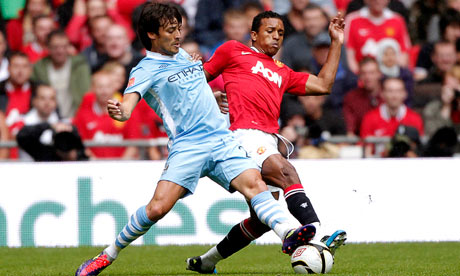
Manchester United's Nani tussles for the ball with
Manchester City's David Silva, left, during the 2011 FA Community
Shield. Photograph: Kerim Okten/EPA
We begin, like so many of Manchester City's goals, with David
Silva. The ability to play a pass has always been the barometer of
a midfielder's gifts.
And, boy, can Silva play a pass. It is a rare form of
talent: the vision, knowing where the ball should go, at the exact
angle and with the precise weight, and making it look so damn
easy.
Sir Alex Ferguson once said that the greatest quality he sees in
a footballer is penetration – "and Eric Cantona brought the
can-opener" – and he could be forgiven sometimes if he looks at
Silva, a player he watched many times for Valencia, and sees
someone who would have been an ideal wearer of Manchester United's colours.
United did speak to Valencia at one stage and, if there are
regrets, they will certainly not be eased by the last transfer
window when Ferguson identified Samir Nasri to play the same kind
of role only for City to ambush the deal. Nasri and Silva are one
and two in the table that tells us which midfield players have
created the most chances in the Premier League this season. Nasri
has provided one every 15 minutes and set up six goals. Silva has
five and has undeniably been the star player for Roberto Mancini in
the first two months of this season. "I wanted to sign this guy
five years ago for Inter," the manager says. "He kept me waiting
but, you know, it was worth it. What a player."
United's inability to bring in this kind of category-A
midfielder in the summer was a source of intense disappointment for
supporters, which was only partly diluted by the arrival of Ashley
Young, to play on the left wing. Trying to recruit someone for the
role once occupied by Paul Scholes, the club also missed out on
Wesley Sneijder, from Internazionale, and not everyone was entirely
convinced when Ferguson talked of being unconcerned because of the
emergence of players such as Tom Cleverley and the French teenager
Paul Pogba.
The complaints could conceivably resurface later in the season
because, however you shuffle the names, it is difficult to come up
with any quartet from United's midfield that consolidate Ferguson's
argument earlier this week that they are closing the gap on
Barcelona. Yet the players in question, to give them their due,
have played well enough to remove a lot of the disappointment.
United have emerged unscathed from a difficult opening run of
fixtures, playing bursts of illuminating and sometimes riotous
football, and Cleverley was at the heart of it until the ankle
injury he suffered courtesy of Kevin Davies last month.
Anderson, too, has been impressive, even if he has not been able
to sustain his early-season excellence. Darren Fletcher is back in
the groove after a long, unspecified illness while Ryan Giggs
always offers flashes of greatness however sparingly he is used,
and Michael Carrick is a useful man to have in reserve, regardless
of the argument that he withholds too much of his talent too often.
Above all, Nani continues to play with distinction and Young, for
the most part, has flourished.
United, like City, usually operate with two reasonably
deep-lying midfielders. However, there is far greater emphasis at
City for these players to remain in position, closing down the
ball, anticipating danger, playing the quick, incisive pass to the
players with the more creative edge. Nigel de Jong is now probably
the most accomplished exponent of this role in the league and it is
here, too, where Owen Hargreaves will play if his knees hold
up.
City are particularly strong in this department because, while
Gareth Barry lacks pace and a sprinkling of stardust, he has the
discipline and football intelligence to make himself a favourite of
Mancini's. James Milner can also fill the role and the same applies
to Yaya Touré, even if his ability to drive forward and play the
killer pass suits a more advanced position.
United's central midfielders usually work to the system that one
goes forward and the other covers. The team, however, has not had
an orthodox holding player, bar Hargreaves's brief spells free of
injury, since Roy Keane's departure in 2005. It is a slightly
unorthodox view – the majority of Premier League teams operate with
at least one defence-minded midfielder and Mancini considers it
vital – but Ferguson's trophy count over the past six years
suggests he is not being unduly reckless.
There is less structure to United's midfield and more freedom,
plus a greater reliance on width, with 183 crosses this season
compared to City's 157. Nani set up 18 goals last season and scored
nine, and that form has continued this season. "Nobody at our club
thinks he is in Cristiano Ronaldo's shadow," Ferguson says. "He's
his own player. And the great thing is, we're going to get the best
years out of him."
City, in contrast, do not operate with orthodox wingers, often
starting with a left-footed player such as Silva or Adam Johnson on
the right, and the right-footed Nasri or Mario Balotelli on the
left. It is a narrow system and the tendency is for the wide
players to come inside on to their stronger foot. It is the same
for Young in the United team but more pronounced at City because it
happens on both wings.
City also have the more physical midfielders, so much so that
Ferguson said this was his reason for not starting the small but
wiry Cleverley when the sides met in the Community Shield. As it
turned out, the concerns were misplaced and Cleverley's
introduction at half-time turned the match in United's favour.
He is now recovered from injury and it will be interesting to
see if Ferguson puts him back into the team. Fletcher seems a safer
bet because Touré, De Jong and Barry bring a presence to City's
midfield that the home side will need to combat. But it is Silva,
almost certainly, who will trouble Ferguson the most. As Mancini
says: "He could play for any team in the world."
