David de Gea's introduction to English football has been
challenging for everyone concerned and, in the worst moments,
fairly harrowing for a young man in a new country, stepping into an
environment that is notoriously knee-jerk and unforgiving when a
new player with a large price tag has any form of teething
problem.
De Gea's sympathisers have argued long and hard that it was
perfectly normal that a goalkeeper of 20 years of age, playing in a
foreign city, with little grasp of the language, would inevitably
be vulnerable to the mistakes that briefly threatened to engulf him
a couple of months ago. It is a reasonable line of defence and it
is probably only fair to note that many of those praising
De Gea for his recent performances were the ones in the
stampede to judge him in those difficult moments when he was
costing his team potentially crucial goals.
Yet Sir Alex Ferguson has admitted himself he did not expect
De Gea to be quite so vulnerable. Nobody sensible has ever
said De Gea would never make it and back in August, when he
was dangerously close to being a liability, a clear and legitimate
debate did exist about whether Ferguson could continue to play
someone who looked so raw and nervous when United had assignments
against their five main rivals in the first nine games. As it has
turned out, Ferguson reiterated his trust in his new signing and
has been rewarded in full as the concerns surrounding De Gea's
form and state of mind have made way for something considerably
more in his favour.
De Gea has got it out of his system and turned down the volume
on the gloating cries of "dodgy keeper" that accompanied him
throughout his first excursions in United colours. Sometimes in
football there is no substitute for guts and De Gea was
United's outstanding player at Liverpool last weekend, as if immune
to the pressures of wearing that little red devil and his trident
in front of the Kop. He has, in short, emerged with distinction and
deserves a high form of praise for his resolve and mental
fortitude, because without those qualities he could easily have
suffered a serious loss of nerve.
The Spaniard is still unusually slight for a goalkeeper and the
truth is he does not always exude the sense he is in total control
of his penalty area. But he has other attributes and there have
been enough illuminating moments to soothe the memories of those
errors in the Community Shield and the opening weekend of the
season at West Bromwich Albion.
De Gea looks more confident and, in turn, his team-mates seem
more confident in him. De Gea has shown he has the agility of
a gymnast, but a top goalkeeper also needs resilience and unlimited
courage. Above all, he must have confidence because, without it, he
is finished. De Gea is starting to show he has all of the
above. "He knows that to play in this shirt, first of all you need
to enjoy it," Javier Hernández says. "But also he is aware that it
is a big responsibility. He is really handling it well."
Joe Hart is four years older, firmly
established as England's first choice, and plays with the calm and
assurance that comes from being old ahead of his years. He is the
taller man, at 6ft 4in, whereas De Gea's official height,
6ft 3in, can look a misprint sometimes. Hart has a penalty-box
presence his rival sometimes lacks and is now so consistently
reliable, particularly when it comes to high balls, crosses and
claiming his territory, he can be taken for granted sometimes and
probably does not get the praise he deserves.
De Gea is learning fast and can develop that part of his
game – "He will tell you himself he has loads of things to learn,"
Rio Ferdinand says – but it would be unrealistic to think the
mistakes are over because they are probably not. Hart was the same
at 20, showing rich promise but very much a work in progress, and
it is only the last couple of seasons, under Roberto Mancini, that
he has truly made the position his own.
Mark Hughes, Mancini's predecessor, signed Shay Given on the
basis that he thought Hart made good saves but not outstanding
saves. Hart was moved to Birmingham City, where he quickly set
about showing that was a fallacy, winning the club's player of the
year award and earning a place in the PFA team.
At 24, he is now a mandatory first-team pick for England while
young enough to be regarded as someone who can still improve.
Mancini, for example, has stopped more than one training session to
address Hart about the importance of quick distribution, turning
defence into attack, and understanding that when he gets the ball
in a congested penalty area it is a time when the opposition can be
vulnerable.
De Gea already has that in his artillery and is unusually
precise with his kicking and accomplished enough with his feet to
challenge Ruud Gullit's theory that "a goalkeeper is a goalkeeper
because he can't play football".
Hart, though, now ranks as "one of the top five goalkeepers in
Europe" according to Mancini, and even the slightest lapse, such as
Villarreal's goal at the Etihad Stadium on Tuesday, is rare. Costel
Pantilimon, the Romania international, was signed on loan from
Timisoara in August, but as backup rather than serious competition.
Stuart Taylor, now third in line, has one of football's more
unorthodox roles, particularly as City do not operate a reserve
team. Taylor's last game was 21 months ago.
Ferguson's policy has been slightly different, with De Gea
occasionally making way for Anders Lindegaard or Ben Amos. As
always with United, the boundaries are blurred when it comes to
whether this is a case of being rested or dropped. Ferguson,
however, would almost certainly say the former. De Gea has
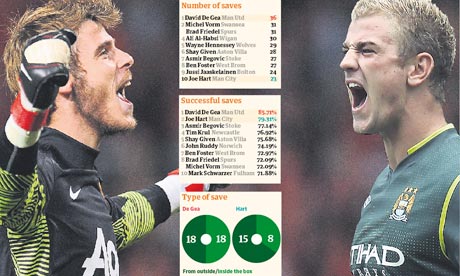
made more saves than any other Premier League goalkeeper so far and
has the best save-percentage (85.7%), ahead of Hart (79.3%).
Hart remains the safer pair of hands but United are no longer
yearning for Edwin van der Sar's calm and that in itself
is a triumph for the young Madrileño, three weeks shy of his 21st
birthday.

