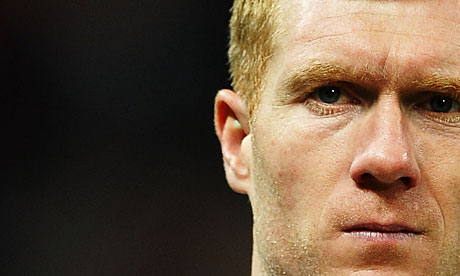
Paul Scholes has highlighted four stars of the future at
Manchester United. Photograph: Laurence Griffiths/Getty Images
The next day Paul Scholes's 85-year-old agent,
Harry Swales, picks up the phone to discuss his client's enduring
appeal. Swales, who wears extravagant mutton chop whiskers and is
known as an "old-school" representative, has enjoyed a quiet life
with the deal-phobic Scholes but wouldn't want it any other
way.
"He's always been a player who wanted to play and train hard and
when he'd finished go home to his family," said Swales, the day
after Scholes had launched his memoirs, at Old Trafford. "All he
wanted to do was what he did. He just wanted to pick up his kids
from school. His satisfaction came from training and being
associated with great players and a great manager. The book is the
first thing he really did and he's enjoying it because he can
express himself. It's not an autobiography, it's a picture story
and he likes it that way."
So no commercial tie-ups at all, then? "The offers didn't come
because they knew it was Paul."
Just when he thought he was safe, along came a scandal, a
talking point Scholes was obliged to comment on. By a cosmic twist
the shyest of all great English players ("my hero", Sir Bobby
Charlton calls him) is forced to recall the day he refused to play
in a Carling Cup game at Arsenal in a brief fit of pique at Sir
Alex Ferguson. The context was Carlos Tevez's wildcat industrial
action during the Bayern Munich-Manchester City Champions League
fixture on Tuesday night.
Scholes says: "As soon as this came up with Tevez I thought: 'Oh
shit. It's not that I thought I was going to get asked about it,
it's just something I regret doing.'"
But more of that later. Scholes is now two weeks into a loose
coaching role with the Manchester United reserves and has
news to impart. In a BBC interview last week Ferguson picked out
Paul Pogba, Ryan Tunnicliffe and Will Keane as United starlets.
Scholes endorses those picks and adds a fourth. "Three excellent
players who you'd hope will get a chance in the first team," he
says of the manager's selections. "Tunnicliffe's gone down to
Peterborough [on loan] and has done OK down there. Pogba has got
amazing talent. He's such a big lad for his age. The physique he's
got is unbelievable.
"I think Will Keane has the capability to be a top-class
centre-forward. He's one of the lads I've been working with. He was
always someone I liked when I was watching the youth teams. He's
just got a presence about him, he's a strong lad and has great feet
– the ability to strike a ball. The kind of things [Ruud] Van
Nistelrooy had. The first time I saw him I thought 'Jesus Christ'
because he was smashing balls in from anywhere. Keane has the
potential to do that.
"Any others? Larnell Cole. He looks a great prospect. He's very
small but he's a very clever footballer. He's similar to Shaun
Wright-Phillips but a player who can play inside a bit better than
Shaun. Shaun's an out and out wide man but Larnell can play in a
three in midfield."
For United's youngsters there could be no greater stimulus than
being coaxed by the ginger embodiment of the club's ethos. But
there is no guarantee he will keep the tracksuit, the warm coat for
cold midweek nights at Rochdale and Bury. "There's no particular
job I'm doing, I'm just helping out here and there," Scholes says.
"I haven't really done any coaching as such, I've just been having
individual words with players and going to the reserve games,
Warren Joyce [the reserve team coach] is helping me a lot. We've
had two games and two wins so I can't complain.
"I'm not sure yet. I want to find out whether I really have the
desire to do it. It might be three or four months before I know. If
I go into something I want to be good at it. I don't want to be a
bit-part in something. It's totally different talking to a group of
players."
For Scholes, not playing has painful undertones. He admits to
struggling in his later years with a cameo role and knew it was
time to escape that torment last May, at 36. Inevitably now he is
adjusting to the life of a spectator. "It took three or four months
for me to miss playing again. I knew I wasn't going to be playing
in the Champions League final [at Wembley, against Barcelona]. You
know it's time to go when you're not even under consideration for
selection, when you'll do well to get on the bench. You want to
think you're good enough to start in a game like that."
Scanning the changes since he, Gary Neville and Edwin van der
Sar stepped back, he says: "The club just rolls on." In this phase,
to a faster, younger, more attacking style than last season, when
United were sometimes more mechanical than the best sides Scholes
graced in 552 games, in which he scored 150 times.
"This is such a young and vibrant, quick team. We look like
we're going to score goals all the time. We look like we'll concede
them a bit too often as well. I like the attitude that we're just
going to score more goals than they do. It's not always great for
your back lads and your keeper but we go through games looking like
we could score five or six. To do that against Arsenal [in the 8-2
game] is just a pleasure to play for a striker or an attacking
midfielder."
Scholes says the impact made by Ashley Young and Phil Jones is
easily explainable: "The biggest thing is that they're playing with
better players – the best in England. We've won the leagues to
prove that. I don't think there's any rocket science to the way we
play, it's just good attacking football. It's not complicated or
difficult to understand. When you get clever players like Ashley or
Phil Jones it's no problem for them to slot into the team."
The hole left by his own retirement is, he says, too often
fussed over and inflated. "I think people are too obsessed with the
idea of a replacement. They always talk about replacing a player
who scored 15 goals a season. For the last five years I was never
that type of player, especially for the last two years, when I was
probably only playing 25-30 games a year."
Nor does he accept that United could still need a specialist
defensive midfielder to support the forward play and protect the
marauding Jones: "It's a position clubs have become obsessed with.
I always feel that if you've got two in midfield and one goes
forward the other one stays, it's as simple as that.
"That's the way we played for a long time. Since [Claude]
Makelele made himself famous in that position everyone wants a
Makelele. To be fair to him he had to do that in that Real Madrid
team because there were five lads who wanted to go forward and he
was the only one who even entertained the thought of staying
back."
There is a warm word, though, for Tom Cleverley, the young
midfielder who has staked the strongest claim to Scholes's jersey:
"Going to Wigan last year helped him a lot. At the start of the
year the manager just gave him his head, his four or five games,
and he's been fantastic, a breath of fresh air. When he came on in
the Community Shield he changed the game and he went on from there.
It's just a shame he got that injury when he did."
The best reason to connect Tevez and Scholes is not to
categorise them both as Bolsheviks but to highlight the one-club
devotion of the more modest of the pair. But Scholes understands
rejection. He says of the Tevez strike: "When you're playing you
think sometimes your manager is messing you about a bit. I got that
feeling then [10 years ago]. Wrongly. The next day I wasn't going
to Arsenal. The manager probably wasn't messing me about. But there
all kinds of things going through your head.
"It was the Liverpool game on the Sunday and we were getting
beat 2-0. In the League Cup I knew we would be playing a younger
team. He [Sir Alex Ferguson] didn't bring me on against Liverpool
until seven or eight minutes to go and I was disappointed not to be
playing in the first place. I just got it in my head, maybe as
Tevez has now, that I was being messed about.
"The thing with Tevez is that [Roberto] Mancini's definitely
messing him about, which, when you're a player, you don't take
kindly to. He's definitely trying to punish him for saying he wants
to leave, because without doubt he was City's best player last
season. To me it looks like he wants to play, but he can't cope
with being sub. When you're a player you get the sense that – he's
messing me about, I maybe have to show him I can't be messed
about."
When it ends the publisher mentions the pictorial nature of the
publication and stresses: "This is the only book. There won't be
another one." Much as there won't be another Paul Scholes.