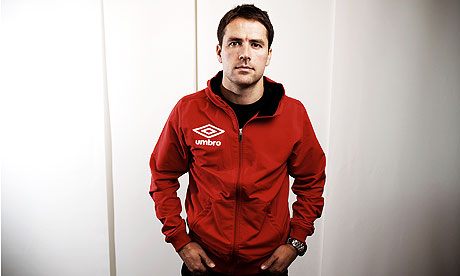
Michael Owen would like to play more but is revelling in his
role as one of Manchester United's elder statesmen. Photograph:
Christopher Thomond for the Observer
For such a private man Michael Owen has fought a lot of
public battles recently, abandoning his natural reserve to confront
widespread condescension. By fighting back, and arguing his case
with words and goals, Owen has developed a new purpose, and placed
a fresh shine on a career that he insists is no slow obituary.
"I was born to score goals, I feel. How I score them – how I get
the ball into the back of the net – might have changed. The actual
ability of what I was born to do will never leave me," he says. "I
used to be able to create a lot for other people, move defences all
over the park, make great diagonal runs into channels, turn and
beat players. I can't do that as much as I used to be able to. But
what I've done is refine my game to be more clever, get into
different positions, be more instinctive around the box."
The less he plays for Manchester United, the more startling
Owen's contributions when his name is called and he reminds us who
he really is.
Two goals – the second, a pearl – at
Leeds on Tuesday night started the first of two debates
about lost England stars. Twenty-four hours after he had scored for
the 11th time in only 12 starts for United since October 2009,
another Owen – Hargreaves – returned from the wilderness with a
redemptive hit for Manchester City.
If both were fit, Hargreaves would be the more likely to catch
Fabio Capello's eye because Owen has been exiled by the England
manager. Stranded on 40 international goals and 89 caps, he says:
"I was in every squad for over a decade and all of a sudden it
stopped one day. I would never turn my back on it, but obviously
there's a scar there that still hurts a bit. But I don't get upset
now when I'm not in the squad, like I used to. If I got a call-up
I'd be there within five minutes.
"Fabio Capello picked his first squad and I was on the bench. I
thought: 'This might be a sign that he doesn't fancy me.' The next
time I wasn't in the squad, and that's just been that. I think he
came to watch me twice in a year when I was at Newcastle, both
times at the Emirates. Arsenal were one of the best teams in the
league. We got tonked, and whoever was the striker for Newcastle
away at Arsenal wasn't going to get too many touches, so I did feel
a bit sorry for myself at that point."
But Owen's immediate priority is to force his way into a
Manchester United side overflowing with attacking talent. At
Liverpool for a time he grappled with Robbie Fowler and Emile
Heskey for a starting shirt and Real Madrid brought new struggles
with Ronaldo and Raúl. Now he laughs at the sheer scale of
competition at United, where Wayne Rooney, Javier Hernández,
Dimitar Berbatov and increasingly Danny Welbeck block his path.
"In many ways that's what harms your chances of a place – the
fact that we are so bloody good. The strikers are just fabulous. No
matter where you look there are world-class players, and they're a
good range of ages, virtually every type of striker. It's one
position where we're particularly well off. Even at 31 I'm enjoying
learning how different people play and how you can play along side
them. That's the positive."
The negative, though, is frustration: battening down the
desperate urge to play more regularly. After the Carling Cup tie at
Leeds, Owen admits he left the pitch not expecting to start against
Stoke on Saturday – in the event he played 80 minutes after
Hernández was injured. Owen says: "You've got to enjoy the good
days, haven't you? It's nice to remind people you're still on this
planet and that you can do it still at this top level."
On Twitter and elsewhere he has quashed the most persistent of
the allegations aimed in his direction. The main claim is that he
joined United for money when he might by now have signed for a
lower-ranked club where he would play every week. This brings out
his best debating skills.
He starts out: "I joined Twitter and you read a lot of the
comments. You're biting your lip and you want to reply but you know
a headline will be made from it and you don't want to give people
the satisfaction. It's obvious I've had a good career and earned
money. The last thing I thought I'd be accused of by going to
Manchester United was doing it for money.
"I could have gone to lots of other clubs and earned more. The
attraction from Man Utd's end was that they could get a free
transfer and use their name and their ability to win trophies and
their kudos to attract players such as me. That's where they've got
an advantage, where they wouldn't have to pay bigger wages.
"At other clubs a wealthy investor might have to pay twice as
much as everyone else because if they don't they won't get the
player. My situation is the opposite. I've been attracted to the
club by the players, by the manager, the ability to win things.
Money is not the motivation. I've had a great career. I've done
really well. My management company [the Wasserman Media Group]
concluded the deal with United in hours. That shows you. I wanted
to play under the manager and in a fantastic team. I just can't
believe how many people think otherwise."
Owen has started 16 times since his free transfer in July 2009
and appeared 33 more times as substitute, scoring on 16 occasions.
Defying expectation, Sir Alex Ferguson renewed the striker's
contract this year, citing his professionalism and influence on
United's younger players. "I can't find him a regular place in the
team at the moment but what I've always said about Michael Owen is
that if you need a goal out of nothing there is no one better, and
I think that is still the case," his manager said. "He's just got a
gift for it. His attitude is excellent. He's a good professional
and a good presence to have around the dressing room." Ferguson
likes to be surrounded by allies and Owen has become an adopted
Paul Scholes or Ryan Giggs though he resists this characterisation:
"Naturally I'm quite laid-back, more shy than outgoing, so I
wouldn't say I'm good at pressing myself on people and taking them
to one side and telling them what to do.
"I'm probably like Scholesy and Giggs in many ways, so I'm
always there if people have got anything to say or ask. We lost a
lot of players of that ilk. We lost Edwin van der Sar and Gary
Neville, Scholes. It's only really Giggsy, me and Rio [Ferdinand]
from that generation. I think I'm the third oldest there, which is
bloody frightening."
He peers down the age scale and sees Hernández, a player in his
own image. "He's a great example to kids. If you just watch him, he
works hard. Speaking perfect English helps. In terms of playing the
game a lot of people compare our styles. I don't think he's like me
when I was young, he's a better version of me now. We're both that
type of predatory player but he's got legs that are 10 years
younger so he can do it faster.
"Chicho does his fair share outside the box but he really comes
alive inside it. Even though I scored a lot in there when I was
younger, the one thing you associate me with is the goal against Argentina [in the
1998 World Cup]. I could get wide, I could run at people, I could
beat players, cross the ball for others. The older I've got the
more I've defined my style and played more as a penalty-box player.
He's a sharper version of me now."
Change is a favourite theme in his autumn years and it's here
that he is at his most insistent: "The way I look at myself, the
biggest achievement in my eyes – forget winning trophies or scoring
in World Cups – is that I'm still at a top club playing at a really
high standard having been almost two different players.
"When you look around, Paul Scholes used to be a centre
midfielder and score goals regularly, bombing in, late runs,
headers, great finishing. Look at him in the last two years of his
career. He was still one of the world's best, but doing a totally
different job. When you lose half a yard of pace you have to refine
your game."
At Elland Road, Ferguson admitted: "He's not getting the games
he deserves and that's unfortunate," and there is no escaping the
sheer strangeness of his predicament, which was the talk of the
industry this week. He wrestles with it too: "At Liverpool for a
while I was one of the first names on the team-sheet, and the same
with England after France 98. There was a bit of a change in Madrid
– though one of my pet hates is people asking why it didn't go well
in Spain.
"People think I never started a game. As it happens I started
about 20 games and came on in 18 and scored a lot of goals, had a
great time out there. Then I came back to Newcastle as the star
signing and was in the team every time again. At Man United it's
just that there's a mass of world-class players."
Which was part of the attraction. "No disrespect to other teams
but when you're training every single day with top, top players
your level doesn't really come down," he says, explaining his
ability to locate scoring form after long spells on the margins.
"For all that people talk about injuries I've been pretty fit at
United. I've had a problem at the end of the first season and
couple of little ones in the second, but I haven't had problems
that have kept me out for months and months. I'm normally always
there and on my toes and training with the lads.
"You've got Rooney and Berbatov and Welbeck's fit now as well.
I'm looking really at the next Carling Cup and Champions League
games. So it's definitely a different mental state, but it doesn't
change wanting to play all the time, having that hunger to play all
the time. That will never change.
"The difficult bit is explaining to people who say: 'You're just
happy to play out your career there,' – that I'm not. I want to
play on, I don't want to drop down leagues but I want to play on
for a few more years. It'd be too much of a waste for me to retire
early. My absolute ideal is to play where I'm playing, because it
doesn't get any better. But I'm not stupid, I know one of the best
players in the world plays up front, with world-class players in
behind. I've got great respect for the manager and I know he
respects me as well. I'd love to stay at the club for a few years
to come and play a big part."
With England and United, you might call him some days an exile
on Main Street, but in word and deed he is still fighting his way
back in.
Michael Owen is represented by the Wasserman Media
Group.
1996-2004 Scored aged 17 on debut at Wimbledon,
to become the club's youngest scorer. European Footballer of the
Year in 2001 after two winning cup finals and England hat-trick in
Munich
High All but single-handedly winning the 2001
FA Cup final against Arsenal
Low Leaving in search of trophies a year before
they won the Champions League
Games 297 Goals 158
Mins/goal 147.8
2004-05 Real Madrid paid £8m – plus Antonio
Núñez – for their annual galáctico, but despite having the
best goals-per-minute ratio in Spain Owen spent much of his season
on the bench
High Scoring his side's final goal in a 4-2 win
over Barcelona
Low Scoring in seven successive games – and
then being dropped back to the bench
Games 45 Goals 16
Mins/goal 151.1
2005-2009 Real doubled their money by selling
Owen for £16m, but several years later the then chairman Freddy
Shepherd rated the move 'the worst deal I did at Newcastle'
High The day 20,000 fans gathered at St James'
Park to welcome the new signing
Low The succession of injuries that restricted
him to 14 games in his first two seasons
Games 79 Goals 30
Mins/goal195.7
2009-present Owen's agents sent a 32-page
brochure to every Premier League club and – after speculation
linking him with Stoke and Hull – United were the surprise
destination
High The injury-time winner in a thrilling 4-3
win over Manchester City in 2009
Low Suffered a season-ending hamstring injury
before half-time of the 2010 Carling Cup final, having scored once
in an impressive start
Games 49 Goals 16
Mins/goal 105.6
1998-2008 Made debut aged 18, seemingly
destined to smash all the goalscoring records. Currently stranded
nine short of Bobby Charlton's 49
High His brilliant goal against Argentina in
the 1998 World Cup
Low Injuring his knee in the first minute of
the game against Sweden at the 2008 World Cup, ending his
tournament
Games 89 Goals 40
Mins/goal 155

