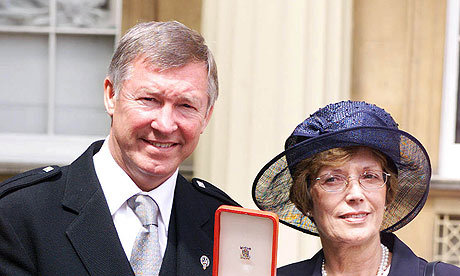
Lady Cathy Ferguson may not know as much about football as her
illustrious husband, yet she appears to have a better understanding
of what is permissible on the pitch.
The Manchester United manager has revealed
that his wife's first reaction, on his return home from the
eventful game at West Ham last Saturday, was to inform him that
Wayne Rooney was likely to be banned.
"She just said: 'They'll do him'," Sir Alex Ferguson said. "I told her
they couldn't possibly do him for celebrating, but it turns out she
was right."
That is because Mrs Ferguson had been following events on
television, rather than being caught up in them at Upton Park. She
knew precisely how ugly and unacceptable Rooney's behaviour had
looked, because it came straight through the camera lens and into
her living room. Others within Manchester United must have reached
the same conclusion fairly quickly, because an apology was
formulated within hours with a view to damage limitation. This was
not just a case of Rooney using industrial language on the pitch,
as he has done countless times before.
Mrs Ferguson appreciated that straight away, which is more than
can be said for many of the player's defenders. This was not even a
case of Rooney moaning swearily at a nearby cameraman as he had
done after a disappointing result with England in South Africa. On
that occasion Rooney was expressing his disappointment at being
booed by his own team's supporters, and whether you agreed with him
or not he was entitled to express his point of view. While there
are certainly better times and places for communicating with your
public than in the immediate aftermath of a poor performance, there
would have been no real justification for disciplining Rooney for
speaking his mind in Cape Town. If the nation was affronted it was
with the football he had produced, not with the reaction
afterwards.
One can hardly expect Ferguson to condemn his own player when
the FA has already done so, yet if the United manager really
thought Rooney was merely "celebrating" then he needs to sit down
in front of some uncensored TV footage. If that is how Rooney
celebrates, goodness knows what sort of trouble he will get into
should he ever become upset about something. The issue the
authorities had to deal with was one of a player spotting a TV
camera, possibly one that had strayed too close or one whose
operator was attempting to choreograph some formulaic celebration,
and reacting with visceral displeasure. Never mind for now the
argument that players ought to get into as much trouble for
verbally abusing a referee as a camera, and ignore for the moment
attention-seeking police officers claiming without much
corroboration that they lock people up for effing and jeffing in
the street. Both those considerations rather miss the point in this
case, which is that the camera is not an inanimate object but a
direct conduit to the millions of viewers in hundreds of countries
that make the Premier League all its money.
Rooney is smart enough to realise that, and for all his talk of
being gutted he seems to have been not far behind Mrs Ferguson in
working out you cannot get away with insulting the audience, but in
the few seconds that mattered at West Ham he found himself in
insufficient control of his temper and his emotions.
While the FA are well aware they would have been damned for
doing nothing, just as they are being criticised now for being
arbitrary and inconsistent, it could usefully take this opportunity
to clarify their position and make sure players understand the
ground rules in future. They could start by refuting Rooney's
disingenuous whinge that he cannot be the first footballer to be
caught swearing on TV.
The interface between pitchside camera and player is a
relatively new one, certainly in terms of the number of cameras in
use and their increasing proximity to protagonists. The fact that
such cameras catch players swearing at each other and at the
referee is neither here nor there; that sort of thing has been
going on since Match of the Day was first broadcast in
grainy black and white. Footballers' vocabulary is emphatically not
what this fuss has all been about.
The FA simply need to make it clear that they have drawn a
distinction between the background noise of a game and what is
said, or shouted, directly and purposely to camera. Maybe the
cameras ought to back off, though it would be better if players
simply behaved themselves. It ought not to be too much to ask, even
for a troubled soul such as Rooney, described by his official
biographer as a polite, respectful, well-brought-up young man.
Hunter Davies was comparing him with another of his subjects, the
unrepentantly oafish and free-swearing Paul Gascoigne. If the two
most notable English players of the past two decades seemed to be
on completely divergent paths just a couple of years ago, they have
a little more in common now, namely a capacity for
self-destruction.
It is too indulgent to excuse Rooney's behaviour on the grounds
that his anger is what make him a great footballer. He has always
been a great footballer, even when he used to celebrate goals with
a cheeky grin. Whatever is going on in his life at the moment is
not feeding his football, it is eating away at him.