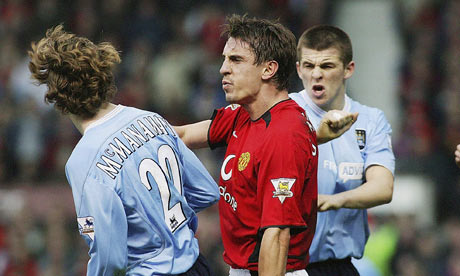
In football nostalgia has always been the
file that smooths rough edges off the good old days.
You listen to the stories now, poke into the history of the
Manchester clubs, and it is easy sometimes to think they were
not always football's equivalent of the Hatfields and McCoys
or Capulets and Montagues …
The night, for example, City clinched the 1968 title and the
victorious team headed for the Cromford Club alongside the United
players they had just condemned to second place. Or the
evening – a lost evening presumably – when City's assistant
manager, Malcolm Allison, threw a housewarming party and the list
of those waking up on the couches and the tiles included several of
Sir Matt Busby's players.
Brian Kidd remembers that on spare weekends United's players
would go to watch City, and vice versa. At 61, Kidd still refers to
"the Reds" and "the Blues" and, when raconteurs of this generation
start to reminisce, it is easy to think everything was once so much
more innocent. "You'd show your player pass and stand at the back
of the stand," Kidd says. "It was great to watch. Wonderful
times."
Yet there are plenty of other stories to remind us that the two
old clubs have been out for vengeance long before Roy Keane
embedded his studs into Alfie Haaland's kneecap. Today they will
lock antlers at Wembley for the first time. The last time they met
in an FA Cup
semi-final was 1926, in Sheffield. City won 3-0 but, even then, old
scores were being settled, new arguments made. The sepia-tinted
pages of the Athletic News tell the story of a City player, Sam
Cowan, being "knocked flat down and out!" In the following weeks
United's captain, Frank Barson, was investigated and found guilty
of what was known in Manchester circles as the "Barson Barge". He
was banned for two months.
The rivalry is, in essence, of people who live shoulder by
shoulder, shop and eat at the same places and cherish a city where,
to quote the late Tony Wilson, "we do things differently" – but who
find it difficult sometimes to share the same oxygen. It is not the
vendetta that exists between Mancunians and Liverpudlians, which
can sometimes feel Sicilian in its intensity. Yet it is still, at
best, a deep and entrenched animosity.
Paddy Crerand remembers his first derby, in 1963, as the day he
knocked out David Wagstaff in the tunnel at Maine Road. Wagstaff
had sworn at him, received a right hook and, in the words of his
assailant, "went down like a ton of bricks", in keeping with the
reputation that once prompted Denis Law to remark: "If Pat starts,
the best thing to do is turn out the lights and lie on the
floor."
Yet Crerand, a Glaswegian, remembers it was Nobby Stiles,
brought up in Collyhurst, whose derby-day passions burned with the
greatest intensity. "We played at Maine Road one year and Nobby
wasn't happy that we'd got only a draw so he went mad in the
dressing room and started punching the wall."
Mike Doyle, in the blue corner, filled the same role for City
and never tired of telling the world about "my hatred for Manchester
United". It led to death threats before one derby. His
tyres were slashed and rocks were thrown through his windows.
Undeterred, he had a chapter in his autobiography titled "Stand Up
if you Hate Man U". Doyle is adamant he would have been "set for a
spell in Strangeways" had he not been held back from George Best as
he sought retribution for the tackle that broke Glyn Pardoe's leg
in 1970.
There are not so many Mancunians involved now. For City, there
will not be be any local lads at Wembley; for United, maybe Ryan
Giggs, Paul Scholes and possibly Wes Brown. It has taken away some
of the potential for conflict but it still feels like more than a
routine derby. It has become an occasion, just like El
Clásico in Spain and El Superclásico in Argentina. No
other derby in England gets so much hype, so much attention, so
many headlines. A few droplets of Middle East oil riches has made
sure of that.
City, under the ownership of the Abu Dhabi United Group, are not
merely striving to reach an FA Cup final at United's expense this
weekend; they are embarking on a full-scale operation to shift the
balance of power. When it will be, nobody can quite be certain.
Whether it will happen, likewise. But what we can say with
certainty is that they are deadly serious about it.
Sir Alex Ferguson has derided City as a "small club". He has
called them "cocky" and "noisy neighbours". Even in his 70th year
United's manager will still roll up his sleeves for a scrap when he
feels it necessary. He has turned the notorious "hairdryer" on
members of City staff and he has taken offence with the local paper
– the "Manchester Evening Blues" – for devoting too many column
inches to the old enemy. Even now, two years after it became the
most talked about piece of Manchester artwork outside The Lowry,
little red puffs of smoke start to billow from Ferguson's ears
whenever anyone mentions the now infamous Carlos Tevez "Welcome to
Manchester" poster.
"He's obsessed with us," says Kevin Cummins, the celebrated
Manchester photographer and City fan. "Within the club someone
really should have stopped him talking about the Tevez poster
because it's all he talked about for months. All he did was make it
obvious it had got under his skin – and that he's absolutely
terrified of us getting one over on him."
Cummins, the man who brought the music world the photographic
history of bands such as Joy Division and The Smiths, went to his
first game in 1961 and like many City supporters feels both blessed
and cursed. It has been a long wait since the last trophy, the 1976
League Cup, and those barren years have left them open to the
schadenfreude of their neighbours.
On the 25th anniversary United's supporters arranged a party in
Manchester city
centre culminating in hundreds of beery fans marching to Maine
Road. On the 35th they used Twitter to dupe unsuspecting
celebrities into sending congratulatory "happy anniversary"
messages. Ben Stiller, Lord Sugar and Will Carling were among those
to fall for it … along with two City youth-team players.
The rivalry threatened to go cold for a few years. Or, at least,
it felt very different from what we have now. But that is only
because, literally and metaphorically, the clubs were in different
leagues.
In Mark Hodkinson's Blue Moon, the diary of City's 1998-99
season in the old Third Division and still probably the best book
written about the club, he describes how United were almost a taboo
subject behind the scenes. "Sensibly, staff at Maine Road seldom
mention Manchester's other team these days. Their hearts might skip
a bit when they recall 'the 5-1' – as it has become known – but
they know it is old news. United are success, money, glamour and a
1-1 draw with Juventus in the semi-final of the Champions League,
while City are failure, debt, calamity and a 2-1 home defeat to
Mansfield Town in the Auto Windscreens Shield."
The "5-1" refers to the thrashing of United at Maine Road in
September 1989, a defeat that left Ferguson talking about putting
his head in the oven. City's victories over United in the following
years were small ones: refusing to let employees have red company
cars, serving blue ketchup in their hospitality suites.
Frank Clark, one of the 14 different managers (excluding
caretakers) they have hired during Ferguson's 24-year tenure, has
described it as "the job from hell". He found a club where the
local council ran the canteen ("chips with everything") and there
was not enough training kit to go round. Niall Quinn, from a few
years earlier, tells a similar story about almost having to beg for
a pair of boots and being given a pair of socks with a hole in the
toe. "City were a hole-in-the-sock kind of club," he
once said.
The modern-City are a very different beast even if there are
times, such as the 3-0 defeat at Liverpool on Monday, when they
lapse into bad old ways. Eastlands, increasingly, has a big-time
feel. City can outspend United these days but they also want to
outthink them. It is a slick operation: menus put together by Marco
Pierre White and John Benson-Smith, electronically heated seats,
chauffeur-driven cars. The club have even hired a fleet of drivers,
in eight-seat buggies, to offer supporters lifts to and from their
cars.
"United have a whole host of problems whereas we are a club on
the ascendancy," Cummins says. "This could be the weekend when the
order changes and they know it. It's a much bigger game for United
in that respect. City have nothing to lose, United have everything
to lose. This could be the game that leads 20,000 people to march
to Old Trafford to burn down their banner."
Ah, yes, that banner, "the ticker". It has been there 11 years
now, permanently jabbing a provocative finger into City's ribs. It
began as "24 Years" but the numbers are transferable and it is now
"35 Years".
"Over the last few seasons the emphasis on the banner has grown
every year," Andrew Kilduff, of Stretford End Flags, says. "Each
time there's a cup run a City player now mentions the banner and
their motivation to get it down."
Kilduff believes it has become "an obsession" for City. "For the
34th Anniversary, we invited [City's manager] Roberto Mancini to
turn the banner round given that he'd said he wanted to get his
hands on it. Yet that invite never received the RSVP."
A group of undercover City supporters, colours and loyalties
hidden, tried to abduct it on one of the official tours of Old
Trafford last year, only to be caught in the act. But will United
take it down if City win the FA Cup? Not necessarily so, Kilduff
says. "One thought is that it gets turned forward to when City last
won the league and becomes 43 years. Keeping it up will just annoy
them even more."