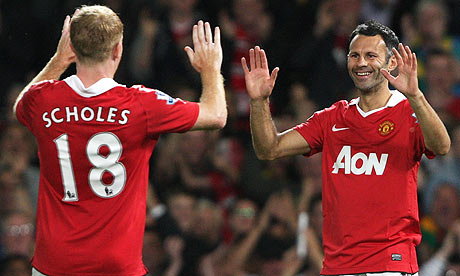
Paul Scholes and Ryan Giggs are crucial to Manchester United's
cause but they can not go on forever. Photograph: John Peters/Man
Utd via Getty Images
Try this for a quiz question. What do Graeme Souness, Terry
McDermott, Mark Lawrenson, John Aldridge and Ray and Alan Kennedy
all have in common? Apart from playing for Liverpool at the height
of their success and contributing to the record 18 titles that
Manchester
United are now on the verge of overhauling.
The answer is that all of them were moved on to other clubs at
the same age, roughly 31. Even Emlyn Hughes only stuck around at
Anfield until he was 32. Liverpool in the 70s and 80s were widely
admired for their businesslike knack of extracting the best years
from a player then shipping him out while he still had a little
shelf life remaining. When coupled with an equally slick facility
for finding quality replacements and having them ready to step up
exactly when needed, Liverpool at the time appeared to have found
the blueprint for continued, seamless success. The faces would
change but the style of play and the winning ethos remained the
same. That, as Dire Straits were singing at around the same time,
is the way you do it.
Or it used to be. Should Manchester United win a 19th title this
season they will have taken a markedly different route to achieving
the same consistency. At the age of 37 Ryan Giggs has
just signed a contract extension to cover next season, and
Paul Scholes,
one year younger, is thought to be about to do the same. Sir Alex
Ferguson certainly wants him to, and with United reportedly willing
to pay him £60,000 per week it appears Oldham Athletic's hopes may
be dashed once again.
These are not just players who were involved in the historic
treble campaign of 12 years ago, they are players who began their
United careers in the early 90s. Giggs made his league debut 20
years ago on Wednesday and has been a virtual ever-present since
the 1991‑92 season, when Howard Wilkinson's Leeds kept Ferguson
waiting for his first title, while Scholes came to the fore in
1994-95, when there were still 22 teams in the Premier League and
the top three at the end of the season were Blackburn, United and
Nottingham Forest.
Watching the United midfield's laboured attempts to break down
Marseille in midweek it could be readily understood why Ferguson
still feels he needs the creative input of Scholes and Giggs – even
at their present ages they appear to have more to offer than Darron
Gibson and Michael Carrick – yet it still came as
something of a shock to work out that when Wayne Rooney offered the
excuse that "a few big players were missing", he must have been
referring to a duo whose careers seemed to be drawing to a close
several years ago.
Giggs, in particular, is playing better now than he was in his
early 30s. He has not quite travelled full circle to rediscover the
exhilarating freedom of his youth, but he has refined his game to
focus on what he can still do to good effect and become a more
economical and effective player in the process. A section of the
Old Trafford crowd used to be on Giggs's back a few years ago,
moaning that he took too many wrong options, failed to see the
killer pass and frequently misdirected his final ball. Now Giggs
has corrected most of those faults United fans want to see as much
of him as they can, knowing that this legend is now as large and as
valid as anything from the club's illustrious past.
Scholes is regarded in much the same way, though it is hard to
argue the midfielder is playing some of the best football of his
career at the moment. By his own admission, he isn't, and neither
is he scoring as many goals as he used to, largely because he is
playing deeper. If he is still seen as United's best midfielder it
is because the competition in that department has yet to match his
peerless standards. Scholes stands out more due to the relative
ordinariness of the players around him. United keep assuming he
will fade into the background then realising they still need
him.
And this is the team that could topple the Liverpool record. The
team that could finally count out Chelsea's wavering defence of the
title with victory at Stamford Bridge on Tuesday. Chelsea's loss to
Liverpool this month means the game can no longer be seen as the
title showdown Carlo Ancelotti had been hoping, but with Arsenal in
such close pursuit United can ill afford to drop points anywhere.
Their away record is a recognised weak point this season, the
leaders have to travel to Liverpool as well as Chelsea in the next
eight days, and as long as Arsenal can keep in touch at the top
they can look forward to a May Day meeting with United at the
Emirates that could go a long way to deciding where the title ends
up.
If events do work out that way, attention is more or less bound
to focus on the irresistible subplot involving Scholes and Jack
Wilshere, two players who are not only similar to each other in
style and temperament but have been singled out by their peers as
the best of their generation. Only time will establish whether
Wilshere really is the new Scholes, but time is certainly on his
side. Ferguson must wish he had Scholes aged 19 all over again.
True, the United man has all the experience, but football is
essentially a young man's game and Ferguson surely cannot keep
turning to the same players. That is precisely what he did two
years ago, when to general surprise he used Giggs and Scholes in
the 2009 Champions League final, only for United to lose quite
badly. A Scholes goal had been enough to dismiss Barcelona the
previous season, but the Catalans were all over United in Rome.
Not even the most remarkable careers can go on for ever. United,
like Chelsea, appear in danger of being caught out by diminishing
returns, and when you can spot the signs it is usually too late.
While Arsenal may not catch up this season, at least they know how
to replenish.