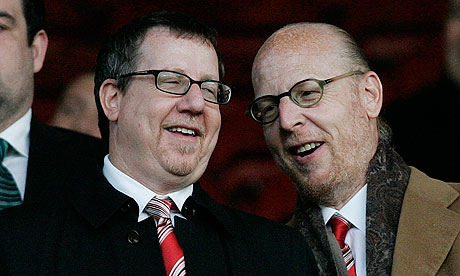
Manchester United's joint chairmen Bryan Glazer, left, and Avram
Glazer whose family bought the club for £831m. Photograph: Lee
Smith/Action Images
Only the al-Thani family in Qatar, the Glazers and their closest
advisers really know whether there is any truth to the persistent
rumours of the sale of Manchester United. What is clear is
that the ownership of the club will change when the Glazers believe
they can sell for the maximum profit.
In December last year, the United director Michael Edelson said
what everyone in the financial world knows, that "it is inevitable
that at some time they [the Glazers] will sell". Such is the nature
of leveraged buyouts; the buyer makes money by putting in place a
relatively small amount of equity (in the Glazers' case no more
than £272m of the £831m total price paid) in the hope that the
value of the asset will rise, leaving them a handsome profit. While
the Glazer takeover has cost Manchester United over £300m in
interest payments, losses on derivatives contracts and banking
fees, the family have taken only £23m in "consultancy fees" and
loans in the past five and half years. To make serious money from
United, the family from Florida needs to sell at a profit. But that
may be hard to achieve.
At £1bn, the low end of the range of putative sale prices quoted
in the media in recent weeks, the Glazers would make only a small
profit on their original purchase. From that £1bn must first be
deducted around £390m of net debt on the club's balance sheet. Then
there is the mysterious case of the "payment in kind" or PIK loans,
which the Glazers repaid in November at a cost of £249.1m. The
repayment came either from the family's own resources or, more
likely, from refinancing old loans with new.
Either way, that money needs to be taken into account too and
together with the net debt would reduce the value to the family
from a £1bn bid to circa £360m. Because the pound has fallen 13%
against the dollar since the takeover in 2005, that £360m is now
worth $583m today, compared to the $504m it cost them to put in
their original £272m of equity. A $79m (£49m) profit is not to be
dismissed, but is not compelling. So to make "real" money, the
Glazers need a price nearer the £1.5bn mentioned in recent
reports.
The problem with a figure of this magnitude is that it values
the club far above the level that most financial analysis would
suggest is rational. Football clubs are unique assets, making them
hard to value, but we do have some benchmarks.
Although the value of Arsenal shares has been puffed up by the
battle for control between Alisher Usmanov and Stan Kroenke, the
share price gives Arsenal a valuation of only around 11.5-times
last year's "Ebitda" (cash profits excluding player sales).
Using multiples of Ebitda is as good a way as any of comparing
clubs' valuations as they indicate trading profitability without
the x-factor of transfer income. By this measure John W Henry's
Fenway Sports Group's £300m deal to buy Liverpool last year valued
the club at 8.6-times Ebitda.
Last year Manchester United made Ebitda of £100m, and therefore
the Arsenal and Liverpool benchmarks would suggest a value for
United of between £900m and £1.2bn.
The Glazers would no doubt claim that United's unique
money-making ability means the club warrants a higher valuation but
not everything is rosy at Old Trafford. Player wages continue to
increase at a frightening place; Wayne Rooney's new contract alone
will reportedly cost an extra £4.5m per year, just under 5% of
profits.
The squad is reliant on ageing players who will need to be
replaced and despite prices being frozen this season, the club
failed to sell all its season tickets for the first time in
decades.
The growth in domestic TV money has slowed to a trickle (the
latest three-year domestic deal is worth only 4.5% more than the
previous one). And then there is the question of how to replace Sir
Alex Ferguson when he finally decides to retire. How the Glazer
family weigh up these challenges facing their most valuable asset
will determine the timing of their eventual sale. In the meantime,
a British media keen to talk up the club's value will hardly be
unwelcome in Florida.
Andy Green blogs on Manchester United and their finances
at http://andersred.blogspot.com/
