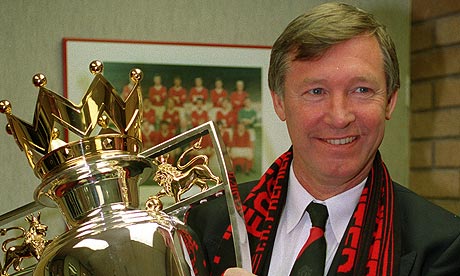
Sir Alex Ferguson had been in charge of Manchester United for
seven years before winning his first league title in 1993.
In the age of the disposable football manager, it will do the
game no harm to be reminded of the importance of the job to the
success, continuity, evolvement and general wellbeing of a club,
big or small. When Manchester United meet Chelsea at
Stamford Bridge on Sunday Sir Alex Ferguson will have been
manager at Old Trafford longer than Sir Matt Busby – 24
hair‑raising, hair-drying years, one month and 15 days.
Blackburn's new Indian bosses may have decided that a solid,
experienced manager like Sam Allardyce is as redundant as a punkah
wallah in a monsoon but Ferguson has proved, season after season,
that good hands-on management can never be replaced by coaches,
technical directors, friends of the owner or, heaven help
football, agents.
When Busby was in charge at United from 1945 to 1969 the
question never arose. Managers usually stayed in the background,
seldom noticed, rarely heard. They were sacked from time to time,
but not at today's frenetic pace of hiring and firing. Busby was
much admired but only became a personality after the Munich plane
crash early in 1958 had destroyed his young team, the Babes. Then
he was practically canonised by the media; after all, he had twice
received the last rites during his nine weeks in a German
hospital.
Apart from their being Scottish, sharing the same first name –
Busby was christened Alexander Matthew – and receiving knighthoods,
it would be difficult to imagine two more contrasting football
figures. Busby was as tough as the old shin-high boots he wore as a
player for Manchester City and Liverpool but he presented an
avuncular face to the world at large. Ferguson is more Macbeth on a
bad day.
Between them, however, they have created and recreated a
succession of winning Manchester United teams over a combined
period of nearly 50 years and if Ferguson leads the present,
relatively modest side to a record‑breaking 19th league
championship, one more than Liverpool, he will have done so in the
spirit of make-do-and-mend which characterised Busby's early
seasons in charge immediately after the second world war.
Busby literally inherited a ruin. Old Trafford had been badly
bombed and until 1949 United played their home fixtures at Maine
Road. Having turned down the manager's job at Anfield Busby
transformed United, who nearly went bust in the 1930s, into a major
force in English football with his emphasis on attractive,
attacking play. The 1948 FA Cup final, in which Busby's team beat
the Blackpool of Stanley Matthews and Stan Mortensen 4-2, is still
regarded as one of the great Wembley classics.
According to Eamon Dunphy, a reserve player under Busby, "His
greatest achievement was to create the illusion of beauty in a
craft wretchedly deformed from the beginning". Well, that was
something. Ferguson remembers Busby, long after he had retired,
attending the 1991 Cup Winners' Cup final in Rotterdam, where
United beat Johan Cruyff's Barcelona: "Suddenly Sir Matt arrived
and the wild cheering turned to respectful applause. It was quite
touching, just like the pope arriving."
Busby built three outstanding United sides, the first led by
Johnny Carey, then the Babes and lastly the team of Denis Law,
Bobby Charlton and George Best. He saw Best as the fulcrum of
another great side but George was drinking, the team withered on
the grape vine and although Busby, having retired once, took over
again briefly in 1970‑71, he could not halt a decline which
eventually led to Manchester United being relegated in 1974. They
won promotion the following season but had to wait until 1993 for
Ferguson to win the first of his 11 top-flight championships.
Both Busby and Ferguson have benefited from having boardrooms
blessed with rather more patience than some of their modern
equivalents. Before winning the league in 1952 Busby's United had
come second three times and Ferguson needed seven years to win
his initial title after taking over in 1986. Nowadays Roberto
Mancini may not survive if he fails to get Manchester City
into the Champions League in his first full season at
Eastlands, always assuming he lasts that long, while doing the
Double with Chelsea at the first attempt does not appear to be
helping Carlo Ancelotti much at Stamford Bridge.
Ferguson will be 69 on New Year's Eve, nine years older than
Busby was when he retired. Although Fergie has several times hinted
at retirement, his appetite for the game and his rage for success
seem stronger than ever. When he stops being angry football will be
the loser – and hair the wetter.