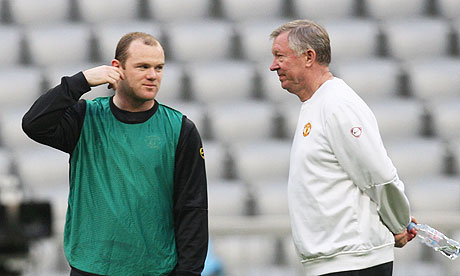
Sir Alex Ferguson, right, has persuaded Wayne Rooney to stay at
Manchester United, ending a week of uncertainty about the striker's
future. Photograph: John Peters/Man Utd via Getty Images
It has been a week of breathtaking cynicism and opportunism
seldom exceeded when it comes to exposing so much that is wrong and
morally bankrupt about modern-day footballers and a grubby industry
where the rich are so obsessed with getting richer it can feel like
money is how we must now keep the score.
Never again will anyone speak of Rooney, that old street
footballer, being a throwback to those days when we would like to
believe there was a bit more nobility about the men we wanted as
our heroes and the most important words in the lexicon of the sport
were not "pound", "thanks" and "cheerio".
Football has become a business where young men with fluffy chins
can barely spell their own name but sure as hell do a good job when
it comes to adding up – and there is a depressing inevitability
that we will soon be subjected to the sight of Rooney putting the
badge on his shirt to his lips, as if all the posturing and
strategic manoeuvring and the cha-ching of men who like to chew gum
as they swig their champagne has been a trick of our collective
imaginations.
A part of you admires his nerve. It takes a special form of
self-interest, after all, not only to wangle an extra
God-knows-how-many millions out of England's biggest club over the
space of his new five-year contract but to have done so at a
juncture in Rooney's life when public opinion of him had dropped to
a point where it was not just low but subterranean in some
places.
And yet it has also been a week in which there has been at least
one glowing reminder of the pleasures and the pride that should
accompany being employed by Manchester United and the impression
left is this: whatever you think of Sir Alex Ferguson, his hypocrisies,
the frequent mistruths and the even more frequent rages, how can
anyone not have at least begrudging admiration for that shrewd,
political mind, still as sharp as a tack as we approach the
beginning of his 70th year?
A preconception has built that Ferguson will send any player who
challenges his authority to the guillotine. It is one he likes to
cultivate himself. "If footballers think they are above the
manager's control," he once said, "there is only one word to say:
'Goodbye.'" And there is a decent XI – Jim Leighton, Jaap Stam,
Paul McGrath, Gabriel Heinze, Norman Whiteside, David Beckham, Paul
Ince, Neil Webb, Roy Keane, Ruud van Nistelrooy, Dwight Yorke – who
could testify to this ruthlessness.
But Ferguson is a pragmatist. He did not move on Peter
Schmeichel after losing a 3-0 lead at Liverpool in January 1994,
when a screaming match came close to turning into a punch-up. Paul
Scholes was not transfer-listed in 2001 when he turned up his nose
at playing with the kids in a Carling Cup tie against Arsenal and
refused to board the bus. Whiteside and McGrath were ushered out
for their apparent belief that beer and football were virtually
synonymous but Ferguson kept Bryan Robson even though the great
warrior had many of his own lost nights.
This was what compelled Ferguson to seek out Rooney at the
club's training ground at 10am yesterday: the knowledge that losing
him would cause too much damage to the team.
It was the morning after the night in which manager and player
had never seemed further apart. Paul Simon once sang there are 50
ways to leave your lover and Rooney's idea was the worst kind of
infidelity, namely to go off with their worst enemy, Manchester
City. To twist Ferguson's analogy, he had seen a cow in a different
field and, well, he wanted to milk its udders. But Ferguson,
however much he felt personally let down, never lost sight of the
fact that Rooney is the talisman of this team and, still only 24,,
at 24, the great hope.
The manager set to work, reminding him of the club's history,
the trophies he has already won, the size of the place, the
traditions, the romance and what it means to put on that red shirt.
He told Rooney he was making the most calamitous mistake of his
professional life contemplating a move to Eastlands. He asked him
whether it was worth becoming a pariah, to be remembered for all
the wrong reasons. He asked him to put a price on the prestige of
running out at Old Trafford – before answering the question himself
and saying there was none.
As we have seen over the past five days, there is nobody better
when it comes to long, impassioned homilies. Rooney listened, took
it in and rang his agent, Paul Stretford, on the drive home to
suggest they arranged another meeting, one final set of
make-or-break talks.
A conference call was set up with the club's chief executive,
David Gill, and two of Malcolm Glazer's sons, Joel and Bryan.
Ferguson had done his bit. He had seen in Rooney's eyes that his
words had got through but he knew there was still the issue of
money to be resolved. Then, finally, at some point last night he
took a call from Gill. The first two words were: "Good news."
Whether it is a cause for celebration is another matter but
Ferguson was entitled to blow out his cheeks and chuckle as he sat
down for an interview with MUTV today. Rooney, he said, had
apologised to him and the other players, and would do likewise to
the supporters. Rooney was then interviewed, but there was no
apology. Somehow it symbolised a grubby week.

