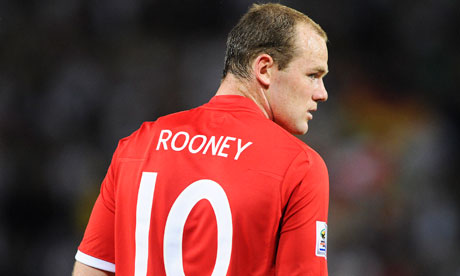
Journey: From his time at Everton through to United
and then on the international stage, Rooney has always been
special
A week on Saturday England will meet the USA in
Rustenburg and Rooney will be the focal point of a nation’s hopes.
There is a ‘Roo-stenburg’ headline waiting to be
written.
A steady time in South Africa and Rooney will have cemented his
reputation. But a prosperous time and he will be elevated
again.
As Rooney said 12 months ago: ‘Next season could be the one that
transforms me from someone who could be a great player into someone
who is a great player. That’s what I’m hoping.’ He is not
alone.
There were no jumpers on the ground down on Armill Road, though.
It was Monday lunchtime, suburban quiet, less than 24 hours after
that ovation at Old Trafford and three days before the ceremony in
London.
Here, on a narrow, short strip of Liverpudlian land, there was
nothing to suggest a connection to either event. Yet it was on this
patch that the boy-man dubbed ‘the last of the street footballers’
emerged.
No ball games! But that didn't stop him: Armill
Road, the street where Rooney used to live
Wayne Rooney, England’s No 10, Manchester United’s No
10, comes from Liverpool 11. It is on the No 14 bus route, the part
of Croxteth in which the car-less Rooneys lived.
Some of the extended family are still here — Rooney’s uncle
Ritchie runs the local boxing club and a football team called the
Oyster Martyrs, in which Rooney’s brother Graeme was a full back —
but the Rooneys left the house on Armill Road more than a decade
ago.
They moved around the corner, so the territory remains familiar
to Rooney and his wife, Coleen, who also grew up in the area. ‘I’ll
always be a Croxteth girl,’ is a Coleen statement.
Her father, Tony, was an amateur boxer, as was Rooney’s father
Wayne Snr, and the area has that old working-class reputation where
sport is valued. It is known chirpily as ‘Crocky’.
Off Armill Road, on Storrington Avenue, one house has the
Everton club insignia on its front: Nil Satis Nisi Optimum —
Nothing But The Best Is Good Enough. It is a reminder of that
famous photograph of Rooney’s front window with its Everton
pennants and car number plate.
Few families can be as Toffee-blue Everton as the Rooneys. Wayne
Snr wanted to call his first-born Adrian, after Adrian Heath, but
Wayne Jnr it is.
True blue: The iconic image of Rooney's bedroom
window at his family home in Croxteth
The Evertonian nature of brother Graeme’s Christian name
is confirmed by one of his middle names, Sharp. Graeme Sharp and
Adrian Heath were forwards in an Everton team that might have
dominated Europe but for the Heysel ban.
By the time Wayne Jnr started supporting, his hero was Duncan
Ferguson. It is a measure of Rooney’s devotion that he wrote two
letters to Ferguson while the combustible, pigeon-fancying Everton
centre forward was in Barlinnie Prison in 1995. Rooney was in
primary school. Ferguson had never heard of him.
At the top of Storrington Avenue is the Western Approaches pub,
where Rooney occasionally re-appears when visiting his mates from
his new base in footballer-belt Cheshire.
Here there is another message from a window. It reveals another
side to Croxteth, the one that made it infamous nationally,
particularly for a few weeks back in 2007.
It reads: ‘In Rhys’ Name, Get Guns Off Our Streets.’ Rhys Jones
was 11 when he was shot dead in the car park of the nearby Fir Tree
pub in Croxteth.
Also an Everton fanatic, Jones was on his way back from football
training. He was buried in a blue coffin with an Everton crest on
it. Sean Mercer was charged with the murder. Mercer went to the
local De La Salle secondary school. As did Wayne Rooney. It is
coincidence.
Loss: The murder of Rhys Jones shook Croxteth's
former inhabitant, who left flowers for the murdered
youngster
Another came in the Liverpool Echo last month. The guns
have not left Croxteth’s streets, far from it — there is a
turf/drug/gang war ongoing.
The manager of Western Approaches FC, Nicky Ayres, was murdered
on April 29. A man with the nickname Pancake — referred to as a
‘city gangster’ in The Echo — was bailed.
After another recent Croxteth shooting it was reported: ‘Bullet
casings were recovered from the pavement outside the bar . . . as
parents took their small children to church at Our Lady Queen of
Martyrs just 50 yards away.’
The coincidence this time comes in Coleen’s book, Welcome To My
World. In it she writes of Rooney, who had just borrowed a
videotape of the film Grease from her: ‘That’s when we first
kissed, around the back of the local church, the Queen of
Martyrs.’
This is a reflection of Croxteth, Liverpool and modern urban
England. Should he choose, Rooney could discuss street violence
with England team-mate Jermain Defoe, whose half-brother Gavin was
murdered in east London last year, or with Rio Ferdinand, who grew
up close to where Damilola Taylor was murdered.
Others such as John Terry will have their own street tales to
tell, while it was said of Bobby Moore that in 1960s East End
London ‘from time to time he had to shake hands with people you’d
want to avoid’.
Fifty years on, the car, disappearing playing fields, the
academy system and children’s changing lifestyles are cited as
reasons why it is believed Rooney is the last of the street
footballers. There may be other reasons.

Blues brothers: (From left) John, age 7, Graeme,
age 10, and Wayne, age 12, were all snapped up by the Everton
academy
Wayne Mark Rooney was born in Fazakerley Hospital in
October 1985, when Everton were the champions of England. Wayne Snr
was an often unemployed labourer, mother Jeanette worked as a
dinner lady in her son’s De La Salle school.
Son Wayne’s primary school, St Swithin’s, did not play organised
football, so his first ‘proper’ match came as a seven-year-old, for
the Western Approaches under 11 team. Rooney went on as a sub for
his debut, and scored. It was the beginning of a Rooney pattern:
younger and better than the rest.
Wayne Snr, being a season-ticket holder at Goodison Park, must
have held his breath when his first-born was soon offered a trial
by Liverpool before Everton. Fortunately for both Waynes, Everton
scout Bob Pendleton followed quickly.
Rooney was then playing for a team called Copplehouse. He was
shortly in Everton’s centre of excellence and Rooney’s name was
quickly going into the notebooks of men across the country who know
about these things.
Paul McGuinness, now Manchester United’s academy manager,
recalled his first sighting. ‘Our under nines played Everton’s boys
and they absolutely hammered us,’ he said. ‘Rooney scored a few
(six), but there was one that stood out. 'It was basically the
classic overhead kick, the perfect bicycle kick, which for a kid of
eight or nine years old was really something special.’
That was the 1995-96 season, when Rooney scored 114 goals in 29
games for Everton’s under 10s and 11s. (Another junior record of
Rooney’s was broken last week by an 11-year-old from his old school
called Gerard Garner).
A few months later, in November 1996, shortly after Rooney’s
11th birthday, he was Everton’s mascot for the derby game against
Liverpool at Anfield. In the warm-up Rooney chipped the ball over
an unimpressed Neville Southall.
Gary Speed has good reason to cherish that game. He scored the
Everton equaliser in front of the Kop. What Speed also remembered
was thinking: ‘Mmm, the mascot’s not bad.’
All at Goodison knew that an exceptional talent was on his way.
So did others — Everton had to fight off interest from Wolves,
Liverpool and Tottenham — but they knew that until Rooney was 17
they could not sign him as a professional.
There was relief then when two months after his 16th birthday,
in 2001, Rooney signed a pre-contract. The significance can be seen
in the venue for this event: Goodison Park, in front of 38,000, the
day Everton faced Derby in a Premier League match.
Presumably one of Everton’s substitutes will have taken wistful
notice: Paul Gascoigne. Everton won but there was to be only one
more league victory in the next four months. Manager Walter Smith
was replaced by Moyes.
Under Moyes the 16-year-old prodigy began to travel with the
first team. And on the opening August day of a momentous 2002-03
season, Rooney was named in the Everton first XI. He had been given
the squad number of a released player — No 18, Gascoigne. There was
no dream debut goal but Rooney was still delighted. He celebrated
with a kickabout in Croxteth that night.
Finding himself replacing or being replaced by Niclas
Alexandersson, there was no Rooney goal until the League Cup in
October. That night Everton went to Wrexham, who had Sir Alex
Ferguson’s son, Darren, in their team. Rooney came on for Tomasz
Radzinski and scored twice.
It was the start of Rooney’s month of arrival. Five days before
his 17th birthday, on October 19, with Arsenal the visitors, the
score 1-1 and the Gunners about to extend their unbeaten league run
to 31 games, Rooney replaced Radzinski.
Remember the name: Rooney announced himself to the
country with a stunning goal against then Champions
Arsenal
There were 10 minutes left. Arsenal were the champions,
accustomed to seeing games out. In the 90th minute Thomas Gravesen
clumped the ball forward. As it fell, it did so on to the soft toes
of a 16-year-old most of the nation had not heard of. In the next
two seconds that changed.
Rooney brought the ball down 30 yards from goal, swivelled,
looked up and drilled an arcing shot past the gaze of Arsenal’s
centre halves, Sol Campbell and Pascal Cygan. Behind them, the ball
soared over England goalkeeper David Seaman.
Cygan, 36, and now with Cartagena in Spain, remembers: ‘Before
the game, Arsene Wenger told us about how dangerous Rooney
was.’
Wenger, as they say, knew. Afterwards he said: ‘Losing our
record is a big disappointment, but at least we lost to a special
goal from a special talent. He is the biggest English talent I’ve
seen since I took over at Highbury.’
There was no BBC Match of the Day then — ITV had won the rights.
So it was on their watch when commentator Clive Tyldesley uttered:
‘Remember the name — Wayne Rooney!’
The 16-year-old had invaded the nation’s living rooms. He has
been part of the furniture ever since.