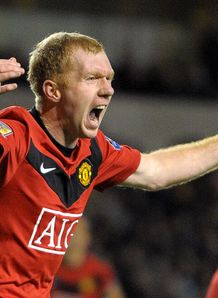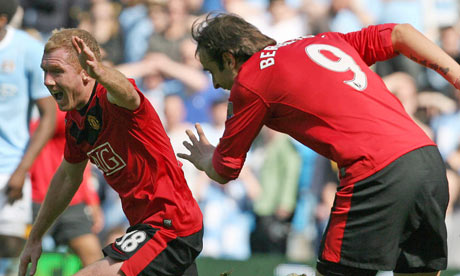
Manchester United's Paul Scholes celebrates his
injury-time winner against Manchester City. Photograph: Lindsey
Parnaby/EPA
Their body language said it all. They thumped the ground. They
looked to the skies. There is nothing in football as brutal as the
stoppage-time winner and at the final whistle the pitch was
littered with players on their hands and knees: exasperated,
broken, disbelieving. All of them wore blue shirts.
The game had waited a long time for some drama and when it
finally arrived it was in the 93rd minute, with the referee Martin
Atkinson already checking his watch. For one so small, Paul Scholes has always been
magnificent at the art of heading a football. This was classic
Scholes: the perfectly timed run, the arched jump, the twisting of
the neck muscles and then, finally, that familiar sunrise of a
smile.
Was this the moment the title race took another late twist? At
the final whistle no one here could truly know the answer to that
question, but Gary Neville was running half the pitch towards the
away end, pulling deliriously at the badge on his shirt. Wayne
Rooney was roaring. These were scenes of wild jubilation. They ran
together, cavorting, embracing, with Sir Alex Ferguson doing that
curious little war-dance on the touchline. It was reminiscent of
that centre-circle dash in Moscow two years ago.
It had been a poor game, pockmarked with mistakes, as these
matches often are, but United were marginally the better team. City
looked tentative at times and they might have to be more
adventurous in their last four games if they are to finish in
fourth position and reach the Champions League qualifiers. Kirk
Bradley, the 26-year-old fan, who has a tattoo commemorating City
as the "2010-11 Champions League winners" might regret that
decision one day.
Perhaps they might have penetrated the United defence more had
they exploited Craig Bellamy's pace against Gary Neville. Or maybe
the credit should go to the visiting defenders. Carlos Tevez buzzed
around and Emmanuel Adebayor toiled away. But the three did not
combine as they have recently against lesser opposition. Bellamy,
in particular, had a disappointing game, although, in mitigation,
it was a common theme for the front players from both sides. This
was one of those games when, for long spells, the more effective
players were tacklers such as Nigel de Jong and Darren Fletcher or
defensive stoppers such as Vincent Kompany and Nemanja Vidic.
The Premier League is so fast these days
it can be like watching ice hockey on grass at times. Scholes
seemed to be the only player who realised that sometimes it can be
of benefit to put your foot on the ball and slow everything down –
pick out the pass, spread the play. Ryan Giggs, with a proud record
of having featured in every Manchester derby since making his
debut, also brought a measure of poise and Dimitar Berbatov did
well when he came on but there was no doubting the identity of the
best player: cometh the 93rd minute, cometh the little ginger
man.
As a spectacle, however, there were too many attacking players,
Rooney and Tevez included, who struggled to impose themselves.
Perhaps Tevez was trying too hard. As for Rooney, he looked
laboured throughout his 74 minutes on the pitch, not as sharp
across the first few metres, perhaps only 80% fit. You can always
tell when things aren't going well for Rooney when he starts
sniping at the referee and he was yapping away at Atkinson for most
of the first half.
Atkinson was a strange choice given that he was the referee at
the centre of the "Fergie Time" controversy when the teams met at
Old Trafford in September. The original choice, Steve Bennett, was
abroad, unable to fly back because of the Icelandic volcano
eruption, and City had been sufficiently concerned about Atkinson's
switch from Stoke against Bolton that they tried to contact the
Premier League referees' chief, Mike Riley, to voice their
misgivings on Friday afternoon. In other words, Ferguson is not the
only practitioner in the art of trying to influence match
officials. The biter had been bit – and you can only imagine the
eruption from United's manager if Atkinson had made a telling
mistake in City's favour.
As it was, Atkinson made a few errors here and there but
generally got by without any major controversy and, ironically, his
most obvious oversight was not booking Rooney after he had flicked
out his leg to trip De Jong. The truth is it has been a bad season
for the Premier League's referees but, on this occasion, there was
no sense of grievance about the dramatic, late and decisive
goal.