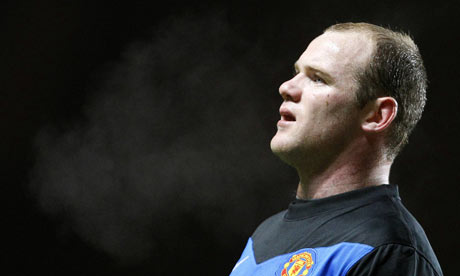
Rooney's injury pain adds to litany of late-season
calamities
Lothar Matthäus once joked that football is a simple game: 22
men run around for 90 minutes, he said, and then the Germans win.
Manchester United turned this gag on
its head in the 1999 Champions League final in Barcelona
and last night Bayern
Munich turned it the right way up again at English football's
expense.
A winning German goal in added-time – and an Englishman
jack-knifed on the floor. Not any old John Smith, but
Wayne Rooney, United's greatest weapon and England's best hope of
ending a 44-year wait to reach a second World Cup final. Eleven
years ago it was Teddy Sheringham and Ole Gunnar Solskjaer with the
late fireworks and Bayern Munich players on the deck
slapping the grass. For Germany's most illustrious club this 2-1
quarter-final first-leg victory produced the perfect transposition
of that melodramatic night at Camp Nou.
A measure of Rooney's importance to club and country is that
this potentially terminal defeat for England's champions was far
less haunting than the spectacle of the shoo-in footballer of the
year jumping like an electrocuted cat as his feet became entangled
with those of Mario Gómez in the move that led to Ivica Olic's
winner when the clock had passed 90 minutes.
Students of metatarsal breaks and will-he-won't-he-sagas were
quick to add Rooney's pained reaction to the file of late-season
calamities endured by senior England players. It took some of us
back to an April day at Stamford Bridge in 2006 when the little
terror pulled up lame in a United shirt and left the ground in
tears. This time, he hobbled for a few paces before crumpling to
the turf. After Olic had delivered his coup de grâce, Rooney was
shoulder-carried from the field and tried unsuccessfully to plant
his right foot before being lifted down the tunnel.
The nation was gripped by foreboding. Surely not another vigil
outside a physio's room? The lord spare us from another rushed
recovery and an umpteenth listless talisman not being quite himself
in a big World Cup tie. But there are domestic implications first.
Unless Rooney was in some kind of physical shock that will have
passed by morning, the eye says he will miss Saturday's Premier
League smash-up with Chelsea at Old Trafford, a loss which could
influence the direction of the title.
"I don't think it's terribly serious but we'll wait and see,"
Sir Alex Ferguson, his manager said, while praising Edwin van der
Sar in the United goal for "keeping us in the game". Ferguson's
diagnosis was that United surrendered possession too often to
preserve their lead, secured after 1min 7secs through Rooney's
close-in finish from a Nani free-kick. Next: another molten night
back in Manchester, where United's love of adversity will be
stretched to its limit by the pursuit of a win to prove that their
profligacy with the ball in Bavaria was an aberration.
Ferguson's pre-match ruminations were right: on these nights you
face not only the 11 opponents but the club itself, the history,
the crowd's energy. There would be no point chopping away at the
hard rock of success for decades unless accumulated spirit and
knowledge made it hard for visitors to such an intimidating
stadium.
To assume this Bayern team were motivated by an urge to avenge
United's astonishing comeback in 1999 would be to buy into
convenient hype. Yet a feature of football's biggest names is that
great victories and painful defeats seep into the psyche and
resurface through whichever players happen to wear the shirt. It
might have been coincidence, of course, but revenge archivists were
entitled to place Olic's late flourish in the book of settled
scores.
Except that this is only the quarter-final stage. United's
riposte won them the Champions League. To do so for a third time in
the Ferguson era they need Rooney's brand of havoc. United have won
important games this season without their leading scorer and
spiritual leader but each game now will require that special
ingredient, that extra application, which Rooney brings. They need
ball retention and strong defending, too.
An overlooked truth about Ferguson's long reign at Old Trafford
is that his best United sides have been built around strong
centre-half partnerships. The eye drifts naturally to Eric Cantona,
Cristiano Ronaldo or Rooney and away from the blanket throwers at
the back. Starters, not stoppers, are the darlings of the Old
Trafford crowd.
But from Gary Pallister and Steve Bruce to Jaap Stam and Ronny
Johnsen and Rio Ferdinand and Nemanja Vidic, United's defensive
pairings have sacrificed themselves for art.
It was a wonder, then, that the team began an eight-day grapple
with Bayern and Chelsea in such a potent state given that this
encounter was only the 11th time this season that Vidic and
Ferdinand have started together. In the most searching trials they
still lack battle-hardness. The two defensive guardians are still
groping for consistent speed of limb and thought.
Matthäus, who was referring to England-Germany games, was right
about club football, too, 11 years late. Next week United must flip
the joke again: maybe without Rooney, their destroyer.