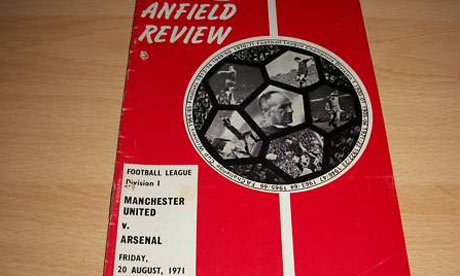
Even the matchday programme came replete with a picture
of Bill Shankly and Liverpool's legends of the day. Photograph:
Public Domain
On Friday 20 August 1971 a team wearing red walked out at
Anfield to rapturous applause from supporters bedecked in red and
white scarves and standing on the Spion Kop. Their opponents were
Arsenal, who had beaten Bill Shankly's
side 2-1 in the FA Cup final to secure the double in May of the
same year. But the home side were not Liverpool. They were Manchester United.
Hidden deep within the pages of football's dustiest history
books lurks a dark secret – or so it appears. The club that now
boasts 18 league titles, the same number as Liverpool, could once
call Anfield its home, just as Liverpool's great city rivals
Everton did in the 1880s. In 1971, with United banned from playing
their first two home matches in Manchester, after hooligans had
thrown knives into the away section at a match at the end of the
previous season, their opening "home" games would be played at
Anfield and Stoke's Victoria Ground.
But so forgotten is this forgotten story that even some
Manchester United players who took part in the 3-1 victory over
Arsenal cannot remember doing so.
A lethargic first-half performance by a United side still trying
to find its feet under a new manager, Frank O'Farrell, following
Matt Busby's departure in June 1971, found themselves trailing to a
fourth-minute Frank McLintock strike. United would enjoy a stirring
comeback in the second half thanks to George Best's growing
influence, which led to an equaliser deftly lifted over Arsenal's
goalkeeper, Bob Wilson, by Alan Gowling. A United goal at Anfield
celebrated by the home fans must be among the rarest things in
football. So such a memorable occasion would be dear to Gowling,
wouldn't it?
"I can't remember," he says. "Who did we play?" I remind him
that it was Arsenal. "United played a home match at Anfield? Give
over," he says, incredulous. So inconceivable does it seem that one
can almost understand Gowling's reaction, but a picture in the
Guardian of 21 August, 1971 clearly shows him leaping over Wilson
to celebrate his goal, scored at the Anfield Road End.
Would David Sadler, who commanded United's defence, recall the
occasion?
"Was I playing?" he says. "I just can't remember. Alex [Stepney,
the Manchester United goalkeeper] might recall it. He's better at
remembering matches than me."
Stepney tipped a shot from the diminutive Arsenal winger George
Armstrong against the bar at the Kop end in the second half to keep
United in the game at 1-1. Did he enjoy being the only Manchester
United goalkeeper in history to feel the full support of United's
fans emanating from the Kop?
"I vaguely remember that we had to play two games away from Old
Trafford, but I can't recall that match," says Stepney, who made
over 400 appearances for United. Perhaps there's some kind of
conspiracy to hide the truth.
"I thought I'd only ever won one match at Anfield, when we beat
Liverpool 4-1 [in December 1969] – so I can add a second win now,"
he says. "The only one I remember playing away from home was when
we played a home match at Plymouth [Uefa banned United from playing
their home leg of a Cup Winners' Cup match against St Etienne
within 200km of Manchester, following crowd trouble during a 1-1
draw in France in 1977]."
The Manchester United captain, Bobby Charlton, scored his team's
second goal at the Anfield Road End with a free-kick curled around
the wall and into the left-hand corner of the net. Brian Kidd, who
is now Manchester City's assistant manager, wrapped things up with
a goal in the dying minutes.
One man who can just about recall the match is the "Voice of
Anfield", George Sephton, Liverpool's stadium announcer who had
started the job a week before. "I can still see the half-empty
ground," he says. "It was spooky. I had just started, it was an
extra match, it was Friday night so a bit of piece and quiet, I
thought."
And what of Liverpool's famous anthem? Surely United's players
didn't run out as the home team at Anfield to "You'll Never Walk
Alone"?
"It was only the third game in my career," says Sephton. "I
couldn't swear on the bible but I'm almost certain I didn't play
'You'll Never Walk Alone' at the game. It's been 'our' song since
1963! It was weird because Anfield felt like a neutral ground but
from my perspective I was just happy that I had an extra couple of
quid in my pocket because I was young, just married and was saving
up for a house.
"I don't remember any trouble on the night. The enmity with
United wasn't as bad in those days as it is now so it was nice to
turn up and watch a game which you weren't bothered about in terms
of the result. If it happened nowadays of course, I'd be cheering
Arsenal on. But now they would just play the match behind closed
doors."
The FA's decision to send United to play at Anfield in the wake
of a hooliganism incident seems hare-brained now, but at the time
hooliganism happened at most games and in any case, as the former
Liverpool club secretary Peter Robinson, who helped organise the
fixture, explained last year, the animosity didn't exist as it does
today.
"When I started at Liverpool in the 1960s the great rivals were
always Everton," said Robinson. "The rivalry has changed. It turned
into Manchester United when they had this terrific emergence but
before that I can remember them being relegated [in 1974] and
having some really difficult times. I can also remember United
supporters standing in the Kop. It wouldn't happen today, would
it?"
The rivalry between groups of hooligans was still fierce
however, even if the antipathy felt between real football
supporters of both sides was not, and the front page of the
Guardian the morning after the match carried the usual depressing
news of trouble. "About 100 fans" were ejected from Anfield,
according to the report, the windows of some houses in Anfield were
smashed and "600 skinheads" were said to have been "kept in check"
by police after throwing bricks at the United supporters as they
were frogmarched back to Lime Street station and on to trains back
to Manchester.
The Guardian correspondent Eric Todd's match report brimmed with
frustration at the behaviour of the fans in the Kop and of the
wider trouble that was prevalent in football in the 1970s.
"Once again, certain sections of the crowd, whatever their
places of origin were the villains of the piece," he wrote. "And
those psychiatrists, amateur or professional who spend many hours
trying to explore the minds – the word is used quite loosely of
course – of certain members of the footballing public would have
enjoyed last night.
"As soon as the teams arrived on the field the Kop vomited
scores of young 'supporters' of both sexes who ran down the field
to the end where United were warming up. The police, although
hopelessly outnumbered, did their best and removed as many as they
could capture. When the invaders discovered that United would
attack the Kop end they retraced their steps and suffered further
losses."
United would suffer further losses too. Liverpool were given 15%
of the gate receipts from the 27,649 fans who attended the game and
United were instructed by the FA to pay Arsenal compensation, as
the gate was below the 48,000 that attended the fixture at Old
Trafford the previous year. (Until the 1980s, gate receipts for
league games were shared). Even Everton stood to benefit if the
crowd at Goodison Park was below 46,000 the next day, for their
match against Sheffield United.
You can stop whispering now. The secret is out.