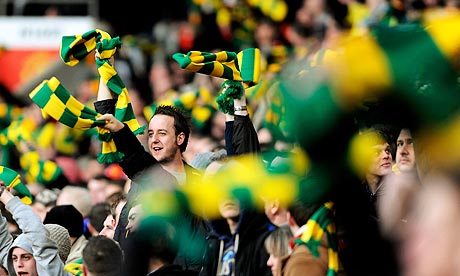
Manchester United fans will be decked out in green and
gold again at Wembley. Photograph: Michael Regan/Getty Images
When a Manchester United supporter still
known only as "chatmaster" floated the idea on an internet
messageboard that fans might defy the debt-laden Glazer family's
ownership by wearing green and gold, he can surely not have dreamed
the scale the demonstration would reach. At tomorrow's Carling Cup
final against Aston Villa, United fans in their thousands will
arrive at Wembley sporting scarves or shirts in those original
colours of Newton Heath, the club formed in 1878 by workers on the
Lancashire and Yorkshire Railway, which later became Manchester
United.
It will, surely, be the first time in football history that fans
choose a showpiece final to protest en masse against their club's
owners, and that signifies the remarkably educated nature of this
United fans' campaign. The half-hearted argument that they have
nothing to demonstrate about given three Premier League
championships, a Champions League trophy and now yet another
Wembley final since the Glazers bought the club in 2005, is having
no impact.
Last month the Glazers published their bond-raising prospectus
setting out the details of their ownership. The fans know that Sir
Alex Ferguson and his team's success has been achieved despite the
£716m of debt the Glazers loaded on to the club, the £464m fees and
interest for which United have since become liable, and the £22.9m
the family have taken out in fees and personal loans. No
justification of that, or attempt to say it has not affected the
club, from Ferguson, the chief executive, David Gill, or the Glazer
family's representative, has swayed general outrage among fans
whose ticket prices have steadily risen to pay for it all.
"It had a very powerful impact for fans to see from the Glazers,
in their own document, that so much money is going out of the
club," says Duncan Drasdo, chief executive of the Manchester United
Supporters' Trust. "Green and gold has become so effective because
it is a clear way to protest against the Glazers while supporting
the team and proposing a better vision for United. It feels now
like a widespread movement for change."
The yearning fuelled by this reaction is for United to be owned
not by investors like the Glazers, but by the supporters, for the
club to be truly a club. Given the scale of finance required to buy
the Glazers out, presumably with a profit, and the £716m debts to
take on or pay off, this is beyond a movement of ordinary fans. The
trust, though, is in contact with the "red knights", a group of
wealthy United supporters developing a bid to put to the Glazers.
That, Drasdo says, is likely to involve 40 or so people taking a
small stake each, and giving opportunities to the trust and fans
generally to build up a shareholding.
Andy Green, an investment professional and United supporter who
wrote a challenging open letter to Gill last week under his
blogging name Andersred, says: "There is a very serious process
going on in the City, with investors looking at a structure in
which fans can develop as significant a stake as possible. Key will
be persuading the Glazers to sell."
Keith Harris, the merchant banker and United supporter working
with the red knights group, called this week for supporters to hit
the Glazers where the prospectus showed they would be truly
damaged, by withholding the money that services all that interest
and fees. Drasdo says the prospect of replacing the Glazers with
ownership more suited to United's character is hugely important to
fans.
"Supporters do have very significant power because the Glazers'
financial plans rely on fans continuing to pay their money in a
variety of ways," he says. "I think when a very credible bid comes
forward, fans will then feel most motivated to wield that power. We
already know there is a huge drop in demand for executive
facilities, and we believe many people will not renew those
subscriptions next season."
The Glazers' representative has declined to comment on any
alternative bid, and continued to say the family are long-term
investors at United. Yet anger at the debts their takeover has
imposed on the club, the other north American "leveraged buyout" at
Liverpool, and Portsmouth's financial collapse has popularised the
idea of supporter-owned football clubs beyond the passions of a
small group of active fans. Supporters from the City of London to
the Stretford End are asking why great sporting institutions like
Manchester United should be owned by speculators from Florida with
no previous connection to it, rather than the crowds of adherents
who have supported it for life.
Some fans did turn away from Old Trafford immediately after the
Glazer takeover in 2005, and today FC United of Manchester, the
supporter-owned club that has since enjoyed three promotions to the
UniBond League Premier Division, are holding a rally "Beyond the
Debt" at their Gigg Lane ground, to promote supporter
ownership.
"Those of us who formed FC United did so because we recognised
there was a need to provide a positive, supporter and
community-focused alternative," says Andy Walsh, the anti-Glazer
campaigner turned general manager of the club. Today's rally will
be attended by the Liverpool supporters group Spirit of Shankly,
Portsmouth fans and Dave Boyle, the chief executive of Supporters
Direct, the organisation that promotes democratic fan involvement
in clubs.
Boyle and Walsh were in Brussels this week lobbying the European
Parliament for an idea whose time, they believe, has come –
together with Uefa, which enshrines in its document "Vision Europe"
the idea that clubs should be clubs, owned by the fans. "In an
ideal world," it says, "all clubs would be controlled and run by
their members – eg supporters – according to democratic
principles."
At Gigg Lane today and in green and gold at Wembley tomorrow,
supporters will be united in campaigning for football to reassess
its tortured relationship with money and rediscover its true
colours.

