Sir Alex Ferguson and Wayne Rooney play a game at the
Manchester United training ground.
Ferguson says: "He's the best at coming up to me and asking:
'What's the team?' I say: 'You're not playing.' He says: 'Come on,
give me your team.' I say: 'No, I won't, I'm still thinking about
it.'
"Then he says: 'I'll give you my team.' And he gives me his
team. He's brilliant at it. He's never far wrong. He thinks about
it, you see. He knows the game."
This is Ferguson in his element, larking about with a
world-class footballer whose development he has overseen from the
star's late teenage years. Rooney is the great individual delight
in a season of immense challenges for the manager, who is hunting
down a record fourth consecutive English league title, and a 19th
in all for the club, in a season beset by mounting disquiet among
supporters over the £700m-plus of debt loaded on to United by the
Glazer family's borrowings.
Ferguson, who remains bullish despite yesterday's 3-1 defeat at
Everton, has built a succession of illustrious United sides since
his arrival in Manchester in November 1986, and now Rooney has
become the Eric Cantona or Cristiano Ronaldo of the next era. There
is a touch of Roy Keane in there, too, judging by Rooney's eruption
at half-time in the thrilling 3-2 win over Milan in Italy on
Wednesday night. "I was very frustrated in the first half with a
lot of things," Rooney said. "Some people were not doing their jobs
and I let my feelings be known."
"He keeps telling me he's centre-back. Then a right-back. Then
he says: 'Oh, and I can play midfield,'" Ferguson says, in an
exclusive interview granted to coincide with today's
Observer relaunch. "He's a one-off in terms of the modern
type of fragile player we're getting today, cocooned by their
agents, mothers and fathers, psychologists, welfare officers.
Rooney's a cut to the old days. His attitude is: 'Give me the ball,
I'll tell you how good I am.' He's a throwback. I don't think he
has any inhibitions about that. He knows what he is.
"What we're seeing now is a terror of a player. What he's got
that he can't lose is an in-built hunger, in-built energy, in‑built
desire. Some people are born with these things. We've seen many
players like that, by the way, and they've all been great players.
Some really ordinary players have made great careers because
they've got this drive inside them."
Unceasing vigour explains not only Rooney's endless foraging on
the field but the tightness of his manager's grip on power since
the early 1990s, when the Premier League winning class of
1992-93 set him on a path to the 11 English titles that have
brought the club level with Liverpool on 18 overall. Ferguson's
retirement, always a hot topic, has gone back off the agenda at Old
Trafford.
"Winning this 19th league title is very much in my soul," he
says, as the scale of United's mission between now and May floods
our conversation. The targets: an unprecedented fourth consecutive
Premier League crown, a third Champions League final in a row –
never before achieved by a British club – and the top-place finish
that would deprive Liverpool of their great domestic bragging
rights.
All this, while Ronaldo is lighting up a distant sky at Real
Madrid, supporters are protesting against the Glazers in the old
Newton Heath colours of green and gold, and those "noisy
neighbours" at Manchester City are spending like a lottery winner
on Coronation Street. Ferguson insists he welcomes
provocations: "Don't ever think you're above a challenge. It's not
right. Arrogance is not a quality, it's a hindrance to
success."
The secret of his durability in the face of Liverpool, Arsène
Wenger's Arsenal, Roman Abramovich's Chelsea and now oil-rich City
is strategic wisdom, a talent for controlling change. There has
been no greater setback since Cantona abruptly retired than
Ronaldo's move for £80m to Real Madrid, which has at least allowed
Rooney to shine in that void. Ferguson maintains that United fans
should not confuse Ronaldo's sale with the £67m paid by the club in
interest last year or the Glazers' frantic search for £500m in new
bond loans to soften crushing interest fees, though the supporters
themselves say the big issue is where most of the £80m went
subsequently: to a transfer fund or to the banks.
"Ronaldo was sold simply because the boy wanted to leave. I did
well to keep him another year. When we sat down, you could see it
in his eyes. He said: 'Boss, I just want to play for Real Madrid,
it's nothing against Manchester United. I'm going to go because it
will be an experience for me.' The only reason he was sold was
because the boy fervently wanted to leave. He played that extra
season, did fantastically for us, and after the Cup final [the
Champions League loss to Barcelona] came to me and said: 'Boss, I
want to leave.' I said: 'Right, you've done another year, let me
consider it.' The next day an offer came in for £80m."
Relations between the world's No1 footballer and the manager who
enticed him from Sporting Lisbon at 18 years of age remain
unusually cordial. Ferguson says: "I got a text from him last week
saying: 'I miss you so much.' I'd texted him to say happy birthday.
He was 24. And he said he missed me, and 'thanks for all the kind
things you're saying about me'. You appreciate things like
that.
"He had six years with me. We have to be grateful because he was
a fantastic lad. Great lad. Popular in the dressing room, popular
with the staff, and he made a great contribution to Manchester
United. If he was going to leave, we made sure we got the best deal
we could. We thought the structure of the club was good, with young
players about the place, and players likely to improve. It's like
everything else: when a great player comes along, and then a great
player leaves, there has to be a loss to a degree that you don't
realise until that loss is on your toes. And it was a loss, a major
loss, but we have compensated in some ways. We've actually scored
more goals this season than we did last year."
Behind the fierce exterior, the game face, the professional
warrior mask, Ferguson is always looking for the funny line, the
comedic anecdote. Away from the front line he assumes a wry
detachment that is not apparent when he is, say, laying into Jonny
Evans during a match (as he did in Milan) or excoriating
referees.
He smiles, for example, all the way through this observation
about Manchester City: "We've got a noisy neighbour. Although you
don't like it, they never stop. You know when you've got a noisy
neighbour and they keep the radio on all the time? What can you do?
You can complain to the council, you can bang on their wall, you
can go to their door, but they still keep their music on. So what
do you do? You get used to it."
But to be manager of Manchester United requires the political
acumen of a statesman who can balance the corporate agenda of the
club against the needs of the team and the demands of a worldwide
congregation. It is here, in the growing supporter anger about the
debt problem, that Ferguson faces a new and daunting test of his
capacity to hold the institution together. He narrows that job
down, finally, to the need to keep his side winning and on target
to make more history. He says: "I cannot let it interfere with my
direct route to winning the title or the European Cup. That's the
only thing that concerns me."
This is his critique of the anti-Glazer demonstrations: "I'm
never against protest. I've been brought up in protest all my life.
I was involved in the [Govan shipyards] apprentices' strike of
1961. I don't think there's anything wrong with people protesting
if they think their position in life has been changed, if they're
not getting the proper respect or valuation of their worth.
"It's everyone's right, there's no doubt about that. But my
problem with it, being manager of Manchester United, is that I've
got owners who have never caused me any bother. Any time I've asked
for money they've given it to us.
"I can only speak as the manager, because so far it hasn't in
any way affected me financially at all. It's wise always to
concentrate on doing your job. I said this to the fans in my
programme piece. I've been in the boardroom many times over the
years and tried to support the fans' views about certain things in
the club, and I've argued for them, without being too contentious.
I've made my point. Time and time again I've done that with David
Gill and Martin Edwards through the years.
"But when I walk through that door I'm back as manager of
Manchester United. And my job is to make Manchester United the
best. That doesn't change. So the stance at the moment with the
fans is: I completely understand it. When they were waving these
green and gold flags, and scarves, it caught your attention. But it
still doesn't change the fact that I have to be manager of my club,
and manager of my team, and I've got too many priorities."
We speak in London as Ferguson is en route to a dinner at
Wembley staged by his beloved League Managers Association. He
recalls Nani's sending-off in the first half of the recent 1-1 draw
at Aston Villa and uses the incident to convey his determination
not to submit to distractions. "At half-time at Villa Park I only
spoke of winning the match. I didn't care whether we had 10 players
or eight or nine. I only spoke of how we could win the game. So
when the dust has settled, along with the carry-on about the Glazer
family and the financial situation, I cannot get myself involved
with it.
"They're difficult circumstances when I keep reading all these
things about the debt. And the debt has concerned a lot of people.
David Gill has had a lot of chats with the staff to settle them
down, to assure them everything's fine. As far as I'm concerned, I
bought [Chris] Smalling for big money [£10m for the Fulham
centre-back]. So for me, life goes on. And as I say, the Glazers
have been fine with me, I've never had any problem."
The field, not the financial sector, is where Ferguson defines
himself, and as the conversation returns to Rooney it points to the
old truism that teams reflect the character of their manager.
Centre-forward, working-class hero, short fuse, strong sense of
self, indefatigable, despises losing, never satisfied for long with
any triumph.
This season, through talks and training‑ground adjustments,
Ferguson says he has returned Rooney to the barnstorming central
role of his youth. "I related it to height. When I was a kid I used
to go hunting for pigeons, under bridges, in church steeples and so
on. And heights never bothered me. As you get older, maybe on the
25th storey of a big hotel, you look out and you get dizzy. Age
changes you.
"When Rooney first came to us he was the best I've ever seen at
turning round a defender and running at him. There was a period –
whether it was transition, or whether he was trying to mentally
change what type of player he was – when he stopped doing that. So
we spoke to him, took him in a couple of sessions after training,
and said: get back to turning on the defender. It's as if he's
walked in another door.
"His temperament's improved. He's not rushing about doing the
silly things. He's maturing well in that way. It's great to see
that. He's a fantastic boy. He'd give you anything. He'd give you
his last penny. He's that type. He's generous in everything. I say
to him – there's someone here who wants to meet you, and he says
'Aye, no problem.' He's so free with his time. So he has these
wonderful qualities that you don't get a lot in people today. I
have to say he's blessed with these things. And I don't think he
will change. His wife [Coleen] seems exactly the same. She's clued
in, wise, clever, she listens."
Reaching for a parallel for Rooney's restoration as a central
striker, Ferguson remembers selling Steve Archibald when he was in
charge of Aberdeen: "I sold Archibald to Tottenham and he was on
the phone to me a lot, saying 'You ought to come down and see me.'
I went down to see him play Everton, who were a right good team at
the time, and Steve was playing in midfield. I said: 'What are you
doing playing in midfield?' He said: 'Garth Crooks [his fellow
Tottenham striker] and I have an understanding.' I said: 'Have you,
aye, it's a good one. He's scoring the goals and you're messing
around in the middle of the park.' I said: 'Steve, you're not being
clever.' He said: 'Sometimes Garth drops.' I said: 'Steve, you're a
centre-forward, you've two great feet, you're brilliant in the air,
you have elasticity, you're brave. What do you want to play
midfield for?' He went to Barcelona and he didn't play midfield for
Barcelona."
The praise for Rooney drops short of unconditional, as it
usually does when Ferguson is protecting a young player from the
inflations of spectators and the media. "Where I hope he improves
more is with his predatory instinct in the penalty box. He's done
great this year. But he's still got to get to the levels of [Ole
Gunnar] Solskjaer and Andy Cole and [Ruud] Van Nistelrooy. If he
got to that level he'd be the best in the world.
"I think a lot about energy and how that should be channelled in
the right way, and Wayne should be through the middle. Yes,
sometimes he drops in there, it's a natural thing at times, I don't
have a problem with that, but his great energies – desire, purpose,
courage – all the great strikers, Denis Law, John Charles, had that
courage to be in there, get the battering, take the hits, score the
goals, be in the right place at the right time. I know there's more
there, more to be developed, and I know he can do that."
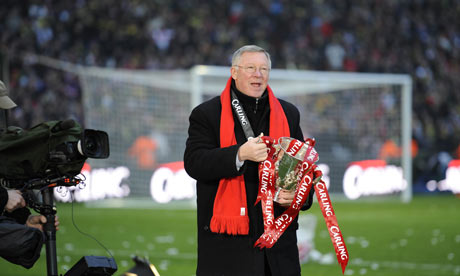
With next Sunday's Carling Cup final against Aston Villa
presenting the first trophy-winning opportunity of a potentially
historic campaign, Ferguson says: "We feel the team's coming to the
boil at the right time, they're starting to produce their best
football." The victims, in the League Cup semi-final, of course,
were City, who Ferguson now challenges to match the United spirit,
the Old Trafford way.
"It has increased that competitive element between the fans and
the media, no doubt about it. The decibel level went up in the last
two games. We have to get used to it, have to do something about
it, and accept the challenge. There's nothing wrong with having a
challenge. We have to do what we're good at and hope it's good
enough.
"This is a club with so much wealth they could buy every player
in the world, but can they buy a team, can they buy a Manchester
United spirit? I don't expect City to be bigger than us, I really
don't, even with all that money. The problem with having all that
money is that you buy indiscriminately. Sunderland, in the 1950s,
the Bank of England team: relegated. I wouldn't wish relegation on
City."
And he meant it. Or I think he did.