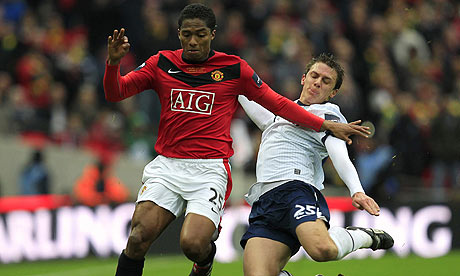
Antonio Valencia's partnership with Wayne Rooney is
bringing rewards and the winger crossed for the striker's winning
header against Aston Villa. Photograph: Eddie Keogh/Reuters
A right-winger starring in a Wembley showdown will always carry
a special resonance, and in the week when Stanley Matthews's boots
from the 1953 FA Cup final were auctioned for £38,400, more than
five times their estimate, it was particularly fitting that Luis
Antonio Valencia Mosquera should shape the outcome of yesterday's
match.
Aston Villa had been giving their
supporters no shortage of encouragement as the 50th League Cup
final went into its last quarter. But with a strong run and a
precise cross, Valencia gave Wayne Rooney the opportunity to put
the finishing touch to the goalscoring combination that has given
Manchester United a new impetus as the
season enters its decisive phase.
Bought by Sir Alex Ferguson from Wigan Athletic for £16m last
summer, Valencia had a relatively quiet start to his United career.
In the past fortnight, however, the 24-year-old Ecuadorian has
produced performances evoking the club's list of specialist wingmen
over the past half-century, from John Aston to David Beckham.
In the first leg of United's European Cup tie against Milan at
San Siro two weeks ago Valencia came on to replace the erratic Nani
midway through the second half, with the match tied at a goal
apiece. Within a minute he had provided the cross from which Rooney
headed the ball back across Dida to give the English club the lead.
And at Old Trafford against West Ham last Tuesday there were two
more Valencia crosses and two more Rooney headers to provide the
first two goals in a 3-0 win.
Wingers are nowadays generally expected to do more than lurk on
their favoured flank, waiting for the ball that will give them the
opportunity to run at the full-back. Such behaviour is usually
dismissed as self-indulgent and wasteful; players who would once
have hugged the touchline are encouraged to follow the example of
Cristiano Ronaldo, Valencia's predecessor at Old Trafford, roaming
across the width of the field and resisting classification as well
as marking.
Who started the fashion of switching wide players to the
opposite flank? Perhaps it was Arsène Wenger, first with Robert
Pires and then, even more successfully, with Thierry Henry, who
brought the art of using right-footed skills on the left flank –
think of all those sidefooted shots curling around the goalkeeper
and inside the far post – to a high level. At Barcelona, Frank
Rijkaard used the left-footed Lionel Messi on the right side and
Ronaldinho, who favours his right, on the left, the idea being that
when the forward cuts inside, the opposing full-back is always
being challenged on his weaker side.
As we saw yesterday, Martin O'Neill has been mixing and matching
both approaches with his Aston Villa wingers. Stewart Downing and
Ashley Young, who favour their left and right feet respectively,
started the match in the conventional stations but had switched
flanks within a couple of minutes, and kept switching in an effort
to keep United's full-backs permanently off balance. Both forwards
are exciting players and at times the tactic looked like working,
particularly with the neat James Milner and the sage Emile Heskey
calmly organising the distribution.
Sometimes, however, there is no substitute for letting a
specialist do what he does, without trying to complicate things.
Valencia is not being asked to do much more than destroy defences
on his natural side of the pitch, and when he sent over the cross
that hung in the air to await the application of Rooney's forehead,
it could have been Matthews supplying Stan Mortensen in that
classic encounter between Blackpool and Bolton.
A gifted winger who goes about his business with a sense of
focus and economy can be a priceless asset. Alert English fans have
known about Valencia since 2006, when he played against Sven-Goran
Eriksson's team in the first knockout stage of the World Cup, a
match in which England laboured to a 1-0 victory. His three seasons
with Wigan, two of them on loan from Villarreal, created a good
impression, not least on Ferguson. And if he was bought to replace
Ronaldo, it was not to keep up the quota of stepovers and
pouts.
The Ecuadorian may not possess the technical originality of his
Portuguese predecessor, and his goalscoring contribution – he has
six this season – is unlikely to match that of Ronaldo. But he has
genuine pace and a cool head, and if he can keep getting behind his
marker and directing his crosses to make the most of Rooney's
timing, positioning and aerial power, then he will have given his
side a weapon that is both reliable, thanks to its essential
simplicity, and, as we saw when Rooney hit the Villa woodwork from
a second Valencia cross four minutes after the goal, extremely
difficult to counter.