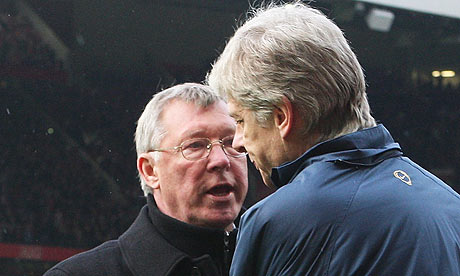
Sir Alex Ferguson and Arsène Wenger have enjoyed a more
harmonious relationship in recent years. Photograph: John
Peters/Getty Images.
From the shipyards of Govan and a bar-restaurant in Alsace came
the two romantics who have done most in modern times to imbue
English football with artistry.
If the world's favourite game is pretty much one long episode of
Wacky Races, Sir Alex Ferguson and Arsène Wenger have been wheel to wheel
since the last century, or September 1996, when Professor Pat
Pending, as he would most likely be, entered Highbury's marble
halls to declare war on the prosaic 1-0 win. For 14 years, hard
Scot and visionary Frenchman have raced one another demonically,
dropping out of the frame only briefly to allow Dick Dastardly
(José Mourinho) to seize a pair of Premier League medals.
Ferguson served up Eric Cantona, Ryan Giggs, Cristiano Ronaldo
and Wayne Rooney, and Wenger has offered us Thierry Henry, Cesc
Fábregas and Robert Pires. Each manager has bestowed gifts on the
English game that far transcend the tribal loathing that will
splash across this afternoon's confrontation in north London.
Neither chieftain will kick a ball as the teams grapple for vital
psychological points but the match will be an expression of the
characters of the two managers just as it always was.
This eternal conflict is in a class apart. Almost without
respite the pair have fought over the high ground of expressive
winning football. Ferguson went off to deal with Chelski for a
while and Wenger busied himself rebuilding the London Colney
kindergarten after the Invincibles had been reacquainted with
defeat (and the pizza had flown) at Old Trafford in October
2004.
Today's convergence comes as Wenger's House of Promise might
finally churn out the goods and United ride high in the title race
despite five league defeats in 23 outings and a dip on their
flamboyance chart. In Wednesday's Carling Cup semi-final
second-leg, there was an early sense that the victors would be the
side with the greater appetite and conviction. Manchester City may
have that one day but it takes years to acquire. Fighting spirit
has always competed with creativity to determine who goes home with
the points when Arsenal and United clash.
Only when you really study the Ferguson-Wenger years do you
realise how big a part they have played in our sporting lives.
There may be nothing to match it in any major team sport across the
world. When one looks for equivalents in post-war English football,
Bill Shankly versus Matt Busby and Brian Clough against Don Revie
drift back on the wind. But they fall far short.
The Busby-Shankly overlap spanned 12 years if you include the
season Wilf McGuinness took charge before Busby returned, briefly,
from upstairs. From 1959-71 Shankly won two league championships
while Busby grabbed a couple to go with his 1968
European Cup.
The Clough-Revie duet was short and toxic. Revie was in charge
at Leeds from 1961-74 but collided with Clough properly only when
his successor at Elland Road was at Derby County from 1967-73. They
won a title each in that period. It was Clough's hatred of Leeds
and the 44 days he burned trying to eradicate their culture that
turned his rivalry with Revie into such a rich seam of writerly
material. Clough won his two European Cups with Nottingham Forest
when "uncle" Bob Paisley was in charge at Liverpool and that, too,
deserves a mention. Revie had his own skirmishes with Busby and
Shankly in the 1960s.
But now consider the Ferguson‑Wenger narrative. In their 14
years Wenger has scored three Premier League titles and four FA
Cups. Ferguson has amassed eight domestic championships, two FA
Cups and two Champions League garlands. Their ambitions have played
out continuously on the grandest stage conducted for club football:
the Champions League, which has added a dimension denied to earlier
generations, however piquant the old European Cup.
Today's Arsenal-United games lack the incendiary macho drama of
the Roy Keane-Patrick Vieira era. From mutual disdain Ferguson and
Wenger have evolved to respectful tolerance. The realisation that
there was more to unite than divide them set in when Roman
Abramovich came down in his helicopter to buy Chelsea.
The two have also seen from north and south the slow death of
the autocratic manager. They have watched power shift to
speculators and know-nothing owners who consider it business
suicide to abdicate full control over a corporation to a guy in a
tracksuit, however good.
Ferguson and Wenger are the last two untouchables in top
football management. Through their wisdom and success they have
saved their trade from being fully downgraded to the status of
departmental head (man in charge of stuff that happens on the
pitch).
They know they need each other to uphold the autonomy of the
choreographer. When they're finally pulled apart, a huge light will
go out.