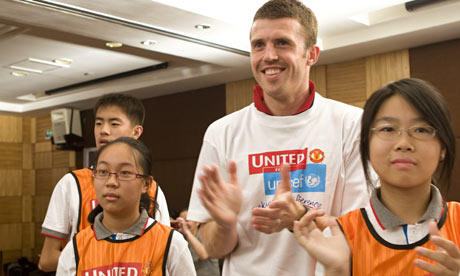
Michael Carrick joins Chinese children in an activity
aimed at developing the skills needed to prevent transmission of
HIV, reduce stigma and end discrimination against people affected
by HIV and Aids. Photograph: Sharron Lovell/Unicef
It's easy to be cynical about footballers and charity but
fame is helping to combat the spread
of HIV in China
This is a story about fame. Last year, three men fronted a video
and poster campaign to try to reduce the spread of HIV in Sierra
Leone. They told young men to wear a condom, to stop blaming others
for not getting themselves tested, and to fight the stigma of the
virus. The campaign achieved dramatic increases in the number of
young men who knew how to practise safe sex and who were prepared
to be tested. However, the people giving the advice were not
doctors, politicians or even film stars, but footballers: Ryan
Giggs, Rio Ferdinand and Patrice Evra.
"It is weird," said Michael Carrick, who is talking to teenagers
in Hangzhou about the stigma of Aids as part of a Unicef project.
"You see kids who maybe haven't got long to live, they meet you and
they are happy for a while. It is hard for me to get my head round
that. Why should they listen to me? I find that so strange."
It is a good question. Hangzhou is a modern, prosperous city to
the west of Shanghai, and Manchester United are big news. Their
hotel, on the shores of a mountain-ringed lake that gives it the
feel of an oriental Switzerland, was constantly under siege; the
moment someone in club uniform appeared on the stairs, hundreds of
voices in the lobby exploded. Some fans have slept on the pavement
outside.
However, Aids in China is largely a rural phenomenon,
with the virus most rampant in Yunnan province, near the border
with Burma, and it is spread by the drugs of the Golden Triangle
not sex. And surely nobody in Yunnan knows who Michael Carrick or
Dimitar Berbatov are?
Yet the Unicef officials in the Hyatt Regency tell a story of
one of their colleagues who travelled to a desperately remote
village in Trinidad that she thought had been abandoned.
Eventually, she found everyone in a single house, crammed around a
television watching the European Cup final. Manchester United have
never played in Sierra Leone and, given the poverty of the country,
are unlikely ever to do so. Most people in Yunnan have television,
and the name Manchester United will mean something to someone.
"Listen," said Berbatov, who, like Giggs, is a Unicef ambassador
and supports five care homes in his native Bulgaria. "If David
Beckham says something about HIV, then people will remember it.
People do listen to the famous and maybe that is a little bit
strange. When I was a boy I listened to my parents because what
better example can you get than your parents? But many of these
kids don't have parents; they need someone else.
"But really, I don't think you should need to talk to a famous
person before you can address the problems you face. You need to
understand the problems before they hit you. We come here for a
reason, that is to train and play football, but there is also this,
and I would say it is equally important and when I look back on my
life it might be more important."
Nearly six out of every 10 Chinese teenagers have no idea how to
protect themselves from Aids. Sixty-nine per cent believe it can be
passed on through chopsticks. Unlike in South Africa, where
Manchester United toured last summer, the Chinese government has
been quick to recognise the spread of the virus. It is illegal to
discriminate against HIV carriers, but to emphasise the point
Berbatov and Carrick take part in a game where each teenager has a
sticker placed on their forehead. They don't know what colour it
is. If it's blue, everyone can shake hands with them. If it is
yellow, you can go up to them but you can't shake their hands,
although they can touch yours. If you have a red sticker, nobody
goes near you. These 12- to 15-year-olds with red stickers quickly
discover what it is like to be shunned.
Games like these, along with books, educational materials and
sports equipment, are packed in boxes and sent to 295 schools in
the worst-affected areas. It is a two-year project and the £230,000
cost is borne by Manchester United. The box itself opens up into a
sort of blackboard. It trades under the name of "Skills for Life in
a Box".
It is easy to be cynical about footballers and these kinds of
events. You think of Cristiano Ronaldo constantly looking at his
watch during the club's media day to mark the 50th anniversary of
the Munich disaster; of Liverpool's reserve keeper Charles Itandje
giggling through the service to mark the 20th anniversary of
Hillsborough. It is a box to be ticked, like listening to Harry
Enfield's creations, Smashie and Nicey, talking about
"charideee".
But it matters to others. CLR James, the great writer on the
Caribbean, asked: "What do they know of cricket who only cricket
know?" It goes for football, too. "But if it wasn't for football, I
wouldn't have seen the things I have," Carrick reflected. "I am
being educated. I have been to hospices and orphanages and if not
for football, then I would never have done.
"It makes a massive difference now that I have a child of my
own. I went to South Africa last year. It was my first tour and
when I got home I thought that having a child changes a lot. I come
here, I see these children and what they are going through and look
at it in a completely different light.
"It puts into perspective how lucky I am, how lucky my little
girl is. She has things, she has her health. But it feels surreal
being here, trying to help but you just keep thinking ..." And he
can't put it into words.
www.unicef.org.uk