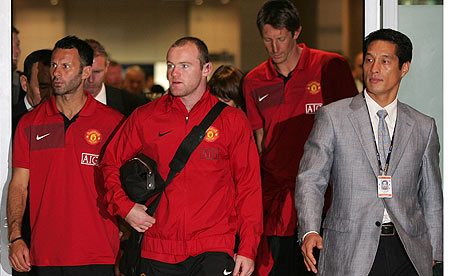
United are winning on and off the pitch on tour as they continue
to target the huge Asian market.
The sight of a small room creaking with journalists and
television cameras does not usually enthuse Sir Alex Ferguson. But
after 90 minutes of a match against Malaysia that was exhausting
simply to watch, the Manchester
United manager was grateful simply for the air
conditioning boasted by the press room in the Bukit Jalil
stadium.
There is no sound footballing reason why United were there. The
one-time England wicket-keeper, Jack Russell, prepared for an
England tour of the West Indies by going into a sauna fully kitted
out in cricket gear but United's attempt to become the first club
to win four successive league titles will be decided by how they
endure an English winter. And nowhere, not even at Portsmouth in
August, will they find a combination of 80% humidity and 35 degree
temperatures.
Logically, Manchester United should be with Arsenal in the Alps.
The Malaysian side they overcame in two sweat-streaked matches in
Kuala Lumpur might have been better than the bunch of Viennese
amateurs, SC Columbia, that Arsenal thrashed 7-1 but not by much.
And certainly not by enough to justify the 36 hours of flying the
team will endure on this tour.
Nevertheless, their arrival into South Korea on Wednesday was
second only to the solar eclipse that darkened much of the country
as a news event. Despite the adverts for Chelsea's shirt sponsor,
Samsung, that are on every other building, South Korea is prime
marketing territory for Manchester United. If, as Rio Ferdinand
recently remarked, being a United player is akin to being in the
Beatles, the ground where they will perform in front of 64,000 on
Friday is their equivalent to Shea Stadium.
This is a nation where to belong is everything – the friends the
South Koreans make at school tend to stay with them for life. It is
a nation where wearing a non-official club shirt would be
considered degrading and in the shape of Park Ji-Sung, United
possess the supreme vehicle to sell them. It is a nation where,
incidentally, 1.2m people have Manchester United credit cards.
Park has joined the tour in Seoul, his home city, where he is
still revered for the fight and unwillingness to give up that took
South Korea to the semi-finals of the 2002 World Cup. In Malaysia,
the crowds that flooded into the team hotel had Wayne Rooney as
their prime target. Here, there is another hero.
Tomorrow, Park will captain a team of youngsters against one led
by Rain, Korea's equivalent to Robbie Williams without the UFO
obsessions. Players will also be provided for a training session
with teenage footballers. None are likely to be able to leave their
hotel without being mobbed.
If United are winning over their target markets in Asia,
however, they appear to have given up on the American market,
unlike Real Madrid, who are touring the States at the same time as
Barcelona. Despite United's links with Nike, based in Seattle, they
have found it a difficult market to break and have no immediate
plans to return.
India, which the magazine Sports Business has called "the last
huge market left for football", is more interesting. The
subcontinent's turnover from television rights and sports
sponsorship is collectively worth $600m and Manchester United, with
their deep links to Asia laid down as long ago as 1975 when as
Second Division champions they attracted crowds of 70,000 in
Indonesia, are well placed to grab a slice. Madrid, meanwhile, have
brought forward some of their kick-off times so they can be
screened at prime time in South East Asia.
Ferguson has remarked that Manchester United are considerably
less glamorous when seen from the inside, saying they are like a
small family business. Here, you see his point. Ken Ramsden, the
club secretary, has been with them since he was a boy – his mother
polished the coffins when the dead from the Munich air crash were
laid out in the Old Trafford gymnasium. Old heroes such as Paddy
Crerand and Bryan Robson are taken along. Their media officer,
Diana Law, is the daughter of Manchester United's greatest striker
Denis. David Gill, their chief executive, in contrast to his
counterparts at City and Chelsea, has the air of a family
solicitor.
But they are very effective at hoovering up money without
causing offence. They have never, as Real Madrid did in Japan,
asked for a shopping centre to be closed so their players can spend
quality time with their American Express cards. Even when he is
asked for the 43rd time about Cristiano Ronaldo in an accent he can
barely fathom, Ferguson will respond. He will even allow
journalists to pose for pictures with him, a practice he does not
encourage at Old Trafford.
In January 2008 they flew to Saudi Arabia for a game that even
by modern standards appeared pointless. It was a testimonial for
Sami al-Jaber, a player, who it is fair to say, few at Old Trafford
had heard of. It was not an enjoyable trip. Riyadh was surprisingly
cold, there was nowhere save the British Embassy where you could
get a drink and time hung heavy. Seven months later, the Saudi
Telecom Company announced a five-year contract to market Manchester
United in the country, worth a reported £9.3m to the club. The real
result of the match.