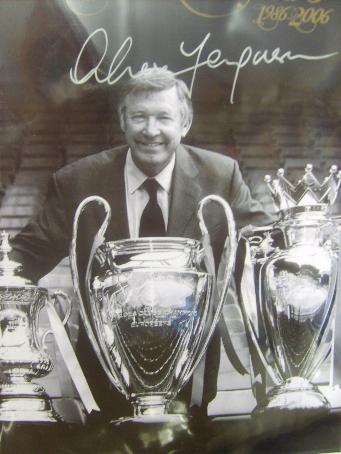
Another milestone for Sir Alex Ferguson, his 21st anniversary today
at Manchester United as the most consistently successful manager in
the history of English football and another need to ask the
questions that will probably never go away as long as he draws a
competitive breath. They follow him in a pack.
How it is that he acquires years but not age? Why is it that his
partiality still burns like some tinder-box canyon in southern
California? Can it be true that he still takes offence quicker than
a hell-fire preacher in a bawdy house?
Will he ever mellow? Will he ever take off the clothes of a
curmudgeon when things do not go quite as well as he likes?
No, he will not not as long as he does what he does so
masterfully. Not if he fights harder than some kid trying to make
his way. No, it is not always attractive. Indeed, sometimes it is
more than a little outrageous. The weekend saw a classic
effusion.
The huge consensus was that it was a match of beautiful ambition
and quite a lot of beautiful content at the Emirates. Arsenal and
United shared the points and the praise, but there was Fergie
raging on about a few head-banging Gooners who behaved pretty much
as their United counterparts do the moment Arsène Wenger takes his
place at Old Trafford.
Howard Webb, a referee on whom Ferguson has been known to heap
praise, was the author of United's failure to win the game. He
favoured Arsenal. Of course. It couldn't have been the resilience
of Arsenal's new captain, William Gallas, and the unstaunchable
enterprise of Cesc Fabregas.
To allow that would have broken one of Ferguson's cardinal beliefs.
It is that, for his United, victory is not a goal but a right.
Ferguson doesn't believe in defeat or even parity; it is not
something that just happens, it is a sinister development which has
to be explained and, having done that to his satisfaction, he can
return to the essential business of not letting it happen
again.
Twenty-one years at one football place, 21 years when ambition is
rekindled as formally as we turn back and forward the clocks, is a
phenomenal circumstance, and permits no routine explanation. It is
true that his great predecessor Sir Matt Busby went 23 unbroken
years at Old Trafford, built three great teams and survived,
bruised and agonised in the spirit, the tragedy of Munich. But then
if Sir Matt climbed great pinnacles, he also had years of pause,
gaps in success that would have tormented Ferguson to the point of
distraction.
Because of his nature, Busby was easier on himself and the rest
of the world. Ferguson has never stopped running, in ecstasy at
moments of supreme triumph, and in anger when things haven't worked
so well. He is fuelled by joy and rage and adrenalin. In another
man it might be a toxic mix. For Fergie is it is
life-sustaining.
Consider the ground he has covered, how much more of it there is
now than that of the great Scottish triumvirate around whose
examples he shaped his youthful ambition, Busby, Jock Stein and
Bill Shankly. Busby, weary of all the accumulated pressure, said
that enough was enough when he faced a fourth rebuilding challenge
in the wake of the 1968 European Cup triumph. With Best, Charlton
and Law heading towards the horizon, Busby just couldn't go again.
He was 62 the same age as Stein when he died on the Ninian Park
touchline while managing Scotland. Shankly was 60 when he walked
away from Anfield. Ferguson will be 66 on the last day of December.
Time to act like a guy who owns a bus pass? Not with Wayne Rooney
and Cristiano Ronaldo and the likely lad from Brazil, Anderson,
still in the foothills of their careers.
For some the celebration of Ferguson's 21 years at Old Trafford
needs to be muted. Yes, he has proved himself a natural-born
winner, but what about his bullying style, his refusal to see any
point of view but his own? Someone said he could have caused a row
among the flower people of Woodstock, possibly even at the Last
Supper. No doubt they are right, but then Ferguson is what he is
and the results have been tumultuous. If we salute Wenger for the
artistry of his football and recognition is, understandably
enough, running at a flood time now is he any better able to step
away from the trenches than his fiercest rival? Does it not hurt
him just as badly to lose, and are the results often not equally
unedifying? Of course, the answers are yes.
Today we have to judge Ferguson on his work and who can say that,
when you bring it all together, it does not represent a hugely rich
contribution to the English game? He has given us great players,
underpinned by ceaseless ambition, and if there has been
ruthlessness, if such separate characters as Roy Keane and David
Beckham have been let go without, in the end, a sliver of
sentimentality, it has been the mark of his understanding of how to
develop a team. Like Busby, he has made three championship teams.
Unlike Busby, he has been careless in the matter of creating waves
of controversy and shaping his image. His signings have not been
unerringly brilliant and sometimes his tactics have been open to
question.
But now we are in the margins of astonishing achievement. Above
all, he has demanded competitive honesty from his players, and
never was the result more spectacular than at the Nou Camp in 1999,
when a team who looked beaten found something that carried them
beyond the normal boundaries of commitment. He could have gone
then, with the historic hat-trick of league title, FA Cup and
European Cup gathered in at the age of 57, and of course some urged
him to do so. The advice has punctuated recent years, but, except
for one period of indecision, it has been brusquely rejected.
In this we find the great and continuing redemption of Alex
Ferguson. He cares less for his reputation as a gentleman of sport
than the sting of battle. He ignites the game to which he has
devoted his life and because he cares so much, and whatever we
think of his style, so do we. It means that today the toast is not
so much to a unique football manager as the sheer force of
life.
http://sport.independent.co.uk/football/comment/article3132449.ece


