Sir Alex Ferguson
Managing: Manchester United
Nationality: Scottish
Date of Birth: 31/12/1941
Biography:
Alex Ferguson succeeded Ron Atkinson as Manchester United manager
on 6th November 1986 and in his first full season guided United to
a League runners-up position. This was nothing compared to the
success he was to later enjoy at Old Trafford as he built a team
capable of matching the best in Europe.
Born in Govan, Glasgow Ferguson made his league debut for Scottish
Second Division side Stranraer in 1957 having joined from amateur
club Queen's Park and having represented his country at Youth and
Amateur levels. He joined St Johnstone on a part-time basis in 1960
whilst completing his apprenticeship as a toolmaker for a
typewriter manufacturer. He went on to score 19 goals in 37 league
appearances for St. Johnstone before an exchange deal took him to
Dunfermline Athletic as a full-time professional in 1964.
He gained his first taste of European football with the Fife club
and moved to Rangers, the team he supported as a boy, in 1967,
spending two-and-a-half years at Ibrox before joining Falkirk where
he began to take on coaching duties. His final playing days were
spent at Ayr United as a part-timer as he pursued business
interests before being appointed to his first managerial position
at East Stirlingshire in July 1974. He moved to moved to St Mirren
in October that year and promptly guided the Paisley club to the
First Division Championship in 1976-77. This led to a number of
offers from the bigger clubs in Scotland and Ferguson accepted the
manager's job at Aberdeen in 1978. It was with the Granite City
club that he really began to make a name for himself as The Dons
eclipsed their Old Firm rivals taking three league titles, four
Scottish Cups and a League Cup in eight seasons. Probably
Ferguson's greatest achievement at Pittodrie came in 1983 when he
led Aberdeen to victory over Real Madrid in the European Cup
Winners Cup.
The untimely death of Scotland manager Jock Stein in 1986 led to
Ferguson taking over the national team temporarily for the World
Cup finals in Mexico. He turned down the opportunity to remain in
charge of Scotland on a permanent basis however, as well as several
other lucrative offers, to move South of the border and manage
Manchester United. He was charged with returning the glory days to
Old Trafford and United fans were expectant having waited over
twenty years since their last league title. His first three years
at United did not bring the success that he had enjoyed in Scotland
however and it seemed at one stage that his tenure in Manchester
may be short-lived.
Victory in the 1990 FA Cup final replay over Crystal Palace however
began an incredible run that saw United win countless trophies as
they dominated the English game. A European Cup Winners Cup
followed in 1991 and a League Cup in 1992, as United were edged
into second place in the League by Howard Wilkinson's Leeds United.
The following year saw the inauguration of the Premier League and
Ferguson drafted in the mercurial French striker Eric Cantona, a
League Championship winner with Leeds and a precocious talent. He
was instrumental in helping United end their twenty-six year wait
to capture the elusive League title, with Ferguson becoming the
first man to manage teams to Premier League titles on both sides of
the border.
1993-94 saw United and Ferguson repeat their success of the
previous year, this time going one better, winning the League and
Cup double. Blackburn Rovers pipped the Reds to the trophy in
1994-95 and Ferguson tasted defeat in the FA Cup final but United
were triumphant once again, on both fronts, as they won another
Double in 1995-96, missing out on an unprecedented treble as they
lost to Aston Villa in the League Cup final.
Another League title followed in 1996-97 before Arsenal stole the
limelight, winning the Double themselves in 1997-98, coming from
behind to snatch the Premiership trophy from the holders. This
served only to stir Ferguson and his team into action as the
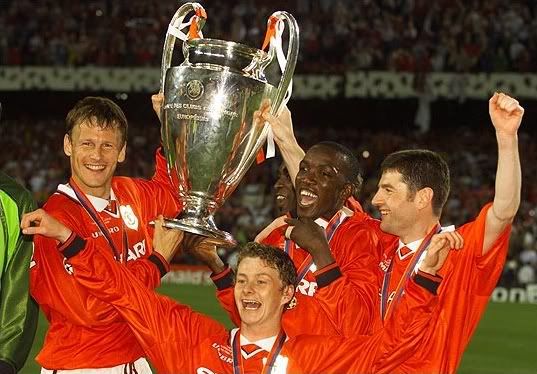
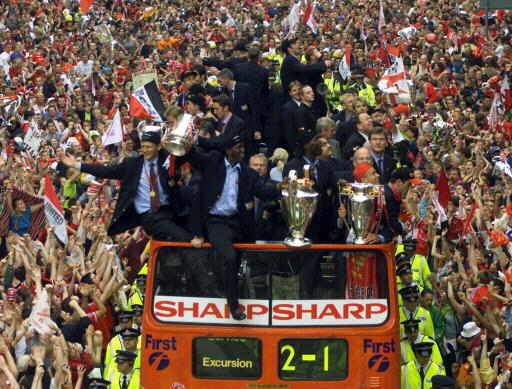
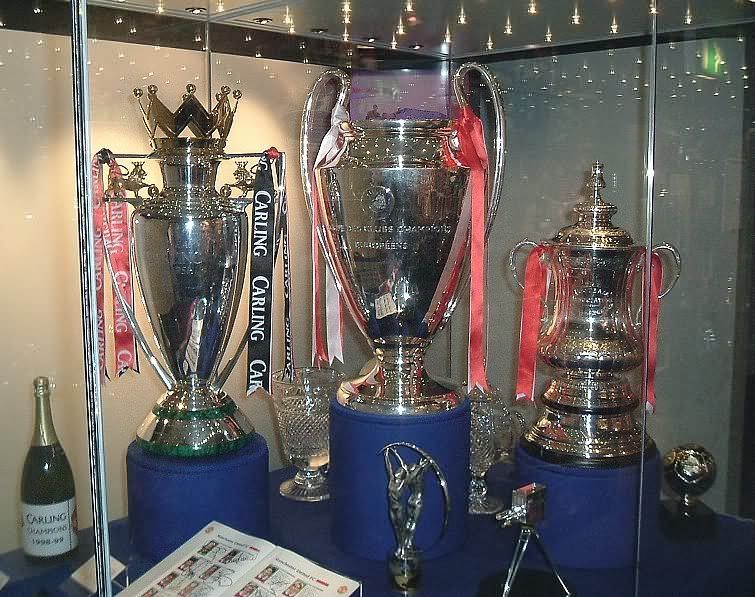
1999-2000 season brought United an incredible treble. Despite
losing his long-time assistant Brian Kidd halfway through the
season, Ferguson - with the help of Kidd's replacement, Steve
McClaren - led the Red Devils to victory in the League, the FA Cup
and the European Champions League in an incredible two-week period,
the like of which may never be repeated.
Controversially, United did not defend the FA Cup the following
year and they were knocked out of the Champions League at the
quarter-final stage by eventual winners Real Madrid. They made a
successful defence of their Premiership title however, beating
Arsenal by an incredible 18 points. The following season brought
United's seventh league title in nine years as they clinched the
Premiership crown yet again, this time with a record five games to
spare, making Ferguson the most successful manager in the history
of English football.
Alex Ferguson became Sir Alex in 1999 (having already received the
OBE and CBE honours in 1983 and 1995 respectively) as his
achievements in football were recognised. It is largely thanks to
his success in the transfer market that he has achieved so much in
English football. Signings such as Peter Schmeichel, Dennis Irwin,
Eric Cantona, Paul Ince, Andy Cole, Jaap Stam, Roy Keane, Teddy
Sheringham and Ole Gunnar Solskjaer have all made significant
contributions to United's success during Ferguson's time in charge.
Alongside young players like David Beckham, Ryan Giggs, Gary and
Phil Neville, Paul Scholes, Nicky Butt and Wes Brown, whose talents
have been nurtured at Old Trafford, these players helped United
produce an almost unchallenged level of performance that has
enabled them to dominate the domestic game in a similar fashion to
the Liverpool side of the 1980's.
In the summer of 2001 - Sir Alex took to the training field. Having
served his apprenticeship as a coach at Derby and Old Trafford,
Steve McClaren accepted an offer to become the manager of
Middlesbrough. Having planned to retire as manager of United after
the 2001/2002, Ferguson felt it would be unfair to recruit an new
assistant for a single season and appointed Jim Ryan as his number
two, taking on more of the coaching responsibilities himself.
Midway through the campaign, as speculation continued unabated as
to who would replace Sir Alex, the United boss had a change of mind
and signed a new three-year deal to stay on at Old Trafford.
Hoping to lead his team to Champions League glory once again, as
well as a record fourth straight Premiership title, Ferguson was
disappointed to end the year empty handed. Despite drawing both
legs of their semi-final with Bayer Leverkusen, United went out of
Europe's most prestigious competition on away goals. To make
matters worse, the league title was won by Arsenal - who completed
another domestic double - and Liverpool snatched second place and
automatic qualification for the following season's Champions League
proper. Nevertheless, Sir Alex's desire for success remains as
strong as ever, as do his efforts to promote the work of the LMA
and improve the lot of his fellow managers and the English game
itself.
Prior to the beginning of the 2002-03 season, he appointed a new
assistant, Carlos Queiroz, the Mozambique-born former Portugal and
South Africa coach, and smashed the British transfer record to sign
Rio Ferdinand from Leeds United for £33million; signally his
intentions for the new campaign.
Previous Clubs
Aberdeen (SC), St.Mirren (SC), East Stirling (SC)