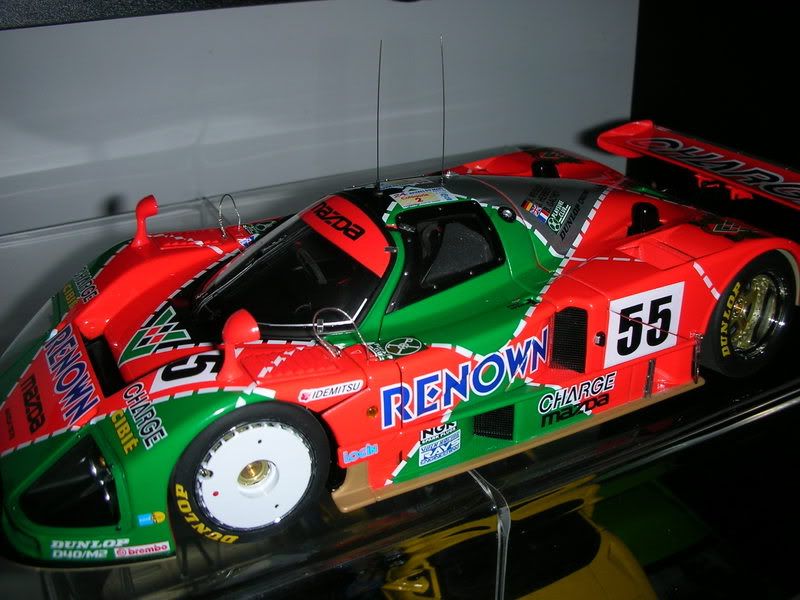
Let
me help you on the history of this car!
In 1991 Mazda became the first (and up to March 2007 the only)
Japanese manufacturer to win the Le Mans 24hr race with this car,
the 787B. Mazda began it's campaign to win the 24hrs of Le Mans in
1983 with the 717C, which was built for the then new Group C
regulations for sportscar racing. The most unusual feature of
Mazda's Group C sportscars was their rotary or Wankel engines (so
named after the inventor of rotary engines, Felix Wankel). Mazda
were one of the pioneers of rotary engine technology along with the
German company NSU, General Motors and Citroen.
Wankel engines have several major advantages over reciprocating
piston designs, in addition to having higher output for similar
displacement and physical size. Wankel engines are considerably
simpler and contain far fewer moving parts. For instance, because
valving is accomplished by simple ports cut into the walls of the
rotor housing, they have no valves or complex valve trains; in
addition, since the rotor is geared directly to the output shaft,
there is no need for connecting rods, a conventional crankshaft,
crankshaft balance weights, etc. The elimination of these parts not
only makes a Wankel engine much lighter (typically half that of a
conventional engine of equivalent power), but it also completely
eliminates the reciprocating mass of a piston engine with its
internal strain and inherent vibration due to repeated acceleration
and deceleration, producing not only a smoother flow of power but
also the ability to produce more power by running at higher rpm. In
addition to the enhanced reliability by virtue of the elimination
of this reciprocating strain on internal parts, the engine is
constructed with an iron rotor within a housing made of aluminum,
which has greater thermal expansion. This ensures that even a
severely overheated Wankel engine cannot seize, as would likely
occur in an overheated piston engine.
Unfortunately, rotary engines initially displayed a tendency to
wear out prematurely, due to the tips of the rotor wearing out
rapidly. The resulting warranty claims on the Wankel engined Ro80
nearly ruined NSU resulting in their takeover by VW in 1969. The
premature wear problem was solved by use of more durable materials
on the rotor tips and by injecting a small amount of engine oil
into the rotor chamber (which is another problem with rotary
engines, their tendency to be "oil burners" by design), but what
really killed off the Wankel engine was the first fuel crisis in
1973 following the Yom-Kippur Arab-Israeli war. Rotary engines are
considerably less fuel efficient than reciprocating type engines
due to their relatively large combustion chambers, with results in
a lower compression ratio. This means more fuel is burnt per cycle
of the engine.
Due to the engines lack of efficiency and due to concerns about the
difficulty in adapting the Wankel engine to future emissions
regulations, Citroen abandoned it's plans to build Wankel engined
cars after only a short run of GS Birotor were made in 1973 and
went so far as to try and buy back as many of them as it could to
avoid the responsibility of having to supply spare parts for them.
GM and Mercedes-Benz (who also planned to build rotary engined
cars) cancelled their rotary engine design projects leaving Mazda
as the sole builder of these engines for use in passenger cars. A
casualty of the decision by GM not to go ahead with it's rotary
engine was AMC who had designed their new Pacer to use the engine
under license from GM. The Pacer instead was fitted with AMCs old
and heavy straight six engine which made a dreadful car even more
awful than it would otherwise have been!
So if it were not for Mazda then the rotary engine's history as an
engine for passenger cars would have ended prematurely. Mazda
decided to develop the engine for use in sportscar racing due to
it's advantages in terms of size and weight especially. Having a
relatively small and light engine that still produces enough power
to be competitive was a real advantage for any race car.
The 1980s at Le Mans were dominated by the Porsche 956/962 until
1988 when the Jaguar XJR-9LM won. 1989 saw victory go to the
Sauber-Mercedes C9 and Jaguar won again in 1990. 1991 was the last
year for Group C cars at Le Mans and hence was also the last year
Mazda's rotary engined Group C cars could compete. From 1992, only
cars with 3.5 litre reciprocating engines were to be permitted.
1990 saw the introduction of the 787, but neither of the two 787s
entered lasted the distance.
For the 1991 race, Mazda entered three 787s, two of them being
787B's which had numerous improvements compared to the 1990 car.
All three finished the race, with the number 55 car (one of the
787Bs) driven by Johnny Herbert, Bertrand Gachot and Volker Weidler
crossing the line in first place. This marked the first and only
win to date (2007) by a Japanese manufacturer, and the only win by
a non-piston engined car. The winning Mazda completed 362 laps in
the 24hrs, 2 laps ahead of the 2nd placed Jaguar XJR-12. The
winning Mazda spent much of the race in 3rd place behind two
Sauber-Mercedes C11s, moving up to 2nd place when one of the German
cars spun off during the night. Up until the 22nd hour the Mazda
held onto 2nd place when the leading C11 hit trouble and the Mazda
went into the lead, which it held on to until the end. Johnny
Herbert drove an extra shift behind the wheel to finish the race
and was so exhausted he had to be helped out of the car and was
unable to make it to the podium. Belgian Gachot and German Weidler
stood on the podium without Herbert. Gachot at the time was also
driving for Jordan in Formula 1 and found himself in prison in the
UK after being convicted of assault a few weeks after his Le Mans
triumph. He sprayed a London cab driver with CS gas in a road rage
type incident and was given a 2 month sentence. The first race he
missed as a result was the Belgian GP which resulted in Michael
Schumacher being given the opportunity to drive Gachot's Jordan in
his place.
The winning 787B was retired from racing by Mazda and now is one of
the star displays at the Le Mans museum. It also makes appearances
at events such as the Goodwood Festival of Speed and the Monterey
historic races at Laguna Seca in California.
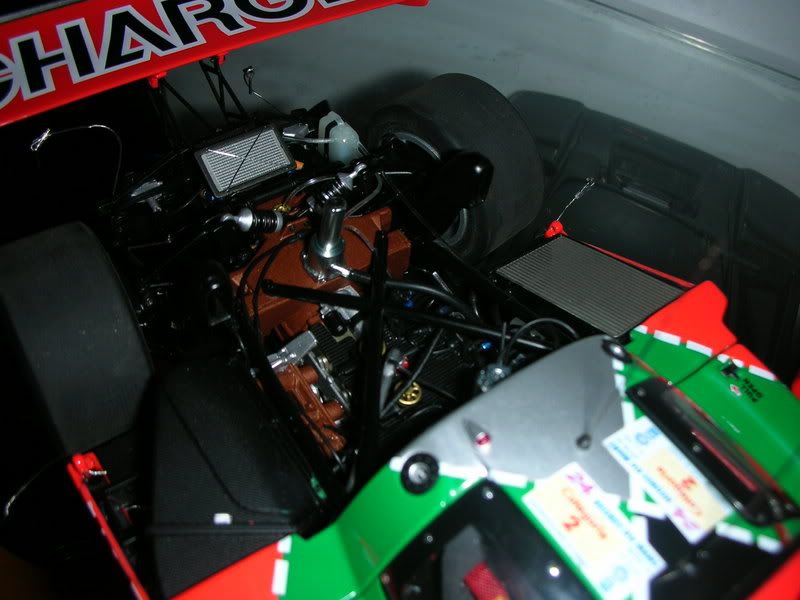
The car itself had a 4 rotor Wankel engine which produced around
700bhp in race trim. Drive was through the rear wheels via a 5
speed gearbox and the chassis and bodywork was made from carbon
fibre. One of the major improvements the 787B had over the 787 was
carbon brake discs compared to steel discs on the earlier
car.
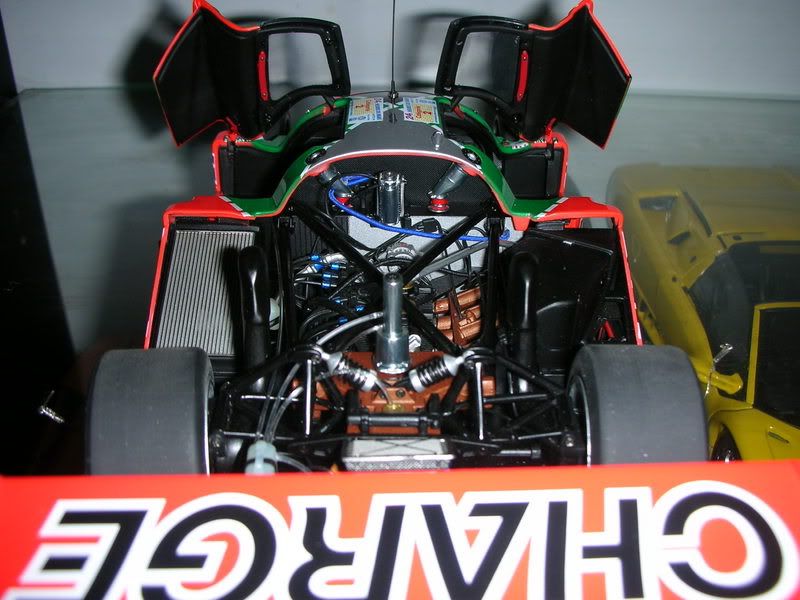
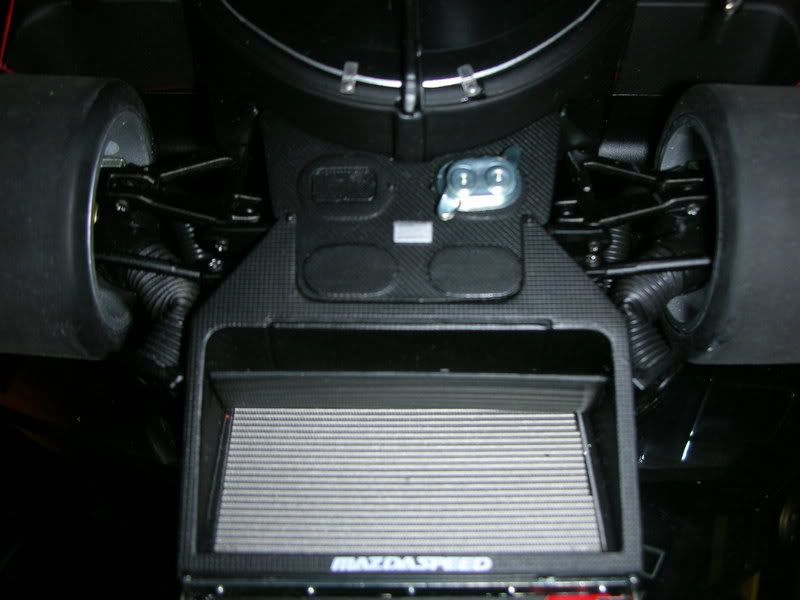
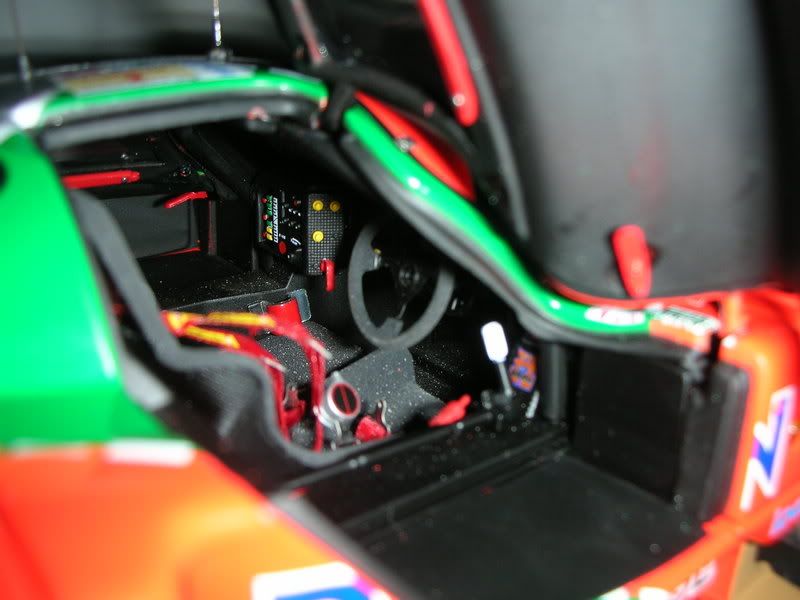
This 1:18th model of the winning 787B was the first release in
AUTOart's new "Signature" line, becoming available in the first
half of 2006. The new Signature series of models are meant to have
a higher level of detail than previously seen on older AUTOart
releases and unfortunately a higher price too! In fairness to
AUTOart this Mazda is comparable to similar models from more
expensive model makers such as Exoto and is still considerably
cheaper.