A sensor implanted in a paralysed man's brain has enabled him to
control objects by using his thoughts alone. The experimental
set-up allowed the man, who has no limb movement at all, to open
e-mail, play a computer game, and pinch a prosthetic hand's
fingers. The US team behind the sensor hopes its technology can one
day be incorporated into the body to restore the movement of
paralysed limbs themselves. The Massachusetts-based team's study is
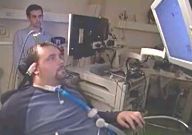
published in the journal Nature. Matthew Nagle, 25 at the time of
the trial, was left paralysed from the neck down and confined to a
wheelchair after a knife attack in 2001. He was the first patient
to try out the brain sensor. A team of scientists inserted the
device, called a neuromotor prosthesis (NMP), into an area of the
brain known as the motor cortex, which is responsible for voluntary
movement. The NMP comprises an internal sensor that detects brain
cell activity, and external processors that convert the activity
into signals that can be recognised by a computer.
Although the patient's spinal cord had been severed for three years
by the time of the trial, the scientists found that brain cell
activity - or neural firing patterns - persisted in the patient's
motor cortex. The electrodes in the NMP were able to record this
activity and send it to a computer. The computer then translated
the firing patterns into movement commands which could drive
computer controls or artificial limbs.