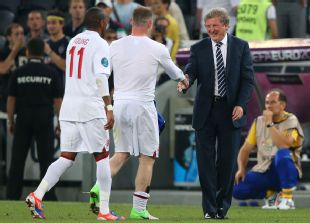
Arrivederci England. It was in Italy, in 1990, that penalties
first became a byword for national disappointment and it was to
Italy, in 2012, that England made their customary exit. This was a
familiar theme for England, going out to the first fine team they
have faced in the knockout phase of a major competition, and a
variation of a well-known pattern: first half good, second half not
so good, extra-time excruciating and penalties positively
painful.
The wait will be extended from 46 to 48 years of hurt but, as in
the last two World Cups, their removal was a merciful release. In
2006 and 2010, underachieving egos got their just desserts; in
2012, an out-passed, outclassed team were spared a potentially
embarrassing reunion with Germany. The woeful Ashley Young and the
rather better Ashley Cole were the culprits from the spot but, if
England were unable to find the Italian net from 12 yards, it was
symbolic: they were unable to locate team-mates from a variety of
distances.
As Roy Hodgson pointed out, England departed undefeated. They
have been hard to beat and, at times, hard to watch. A hotchpotch
of a team, thrown together at the last minute by a manager
parachuted into the impossible job have shown spirit, exhibited an
uncharacteristic unity, made some friends with their modesty and
were defiant in defence. In short, England have excelled at
everything except the most important aspects of the football –
principally getting and keeping the ball.
Yet this is the most fundamental failing of all, a reason why
the quarter-finals tend to represent England’s glass ceiling.
Technically and tactically, they are European football’s moneyed
dinosaurs, still clinging to an outdated ideology. Any side playing
4-4-2 can be outnumbered and outmanoeuvred in midfield. England
duly were: humiliated by Mesut Ozil’s incessant, intelligent
movement two years ago and Andrea Pirlo’s enduring, elegiac class
now.
“He was very good,” said Hodgson afterwards. “I have worked with
him in the past, I know what a good player he is.” That regard went
unacknowledged on the pitch. Danny Welbeck is many things, but a
man-marker is not one of them, especially when the man in question
is one of the great passers of his generation. It was a criminal
negligence that should have been punished before penalties.
This is where Hodgson is most culpable. Two years ago, Fabio
Capello recognised the failings of 4-4-2 and switched for the
remainder of his reign, only for his successor to reinstate the
system he first deployed in Sweden in 1976. It is where, too, the
suggestion that England had tried appointing Italians and tried
impersonating them falls down: it is hard to imagine an Italian
side proving as poor tactically and allowing the opposition’s
outstanding talent to roam unchecked.
The gameplan needs to be redrawn; the philosophy changed.
Hodgson is unfortunate that five of England’s seven finest central
midfielders were absent – Jack Wilshere, Frank Lampard and Gareth
Barry injured, Michael Carrick and the English Pirlo, Paul Scholes,
in international retirement – and, running out of players he could
trust, he persisted with the lionhearted Scott Parker long after
his legs had gone. The sight of Jordan Henderson would have been
worrying but he was sufficiently anonymous that few noticed
him.
from soccernet
Hodgson’s appointment was so belated that the initial focus on
organising the defence was sensible, but that does not excuse
England’s deficiencies in attack. Young was a grave disappointment,
James Milner a worthy long-distance runner but rarely a threat in
the final third and Wayne Rooney showing signs that his two-match
suspension took a toll. He looked rusty and, whereas his old ally
Cristiano Ronaldo is answering questions about his record on the
major international stage, Rooney’s return remains poor.
Apart from against Sweden, England rarely troubled opposing
goalkeepers. They are yet to show that order can be married with
dynamism, partly because they spent so little time with the ball.
Only the valiant Steven Gerrard created consistently, in his finest
tournament to date. That he will probably be denied a place in the
team of the tournament shows the number of excellent midfielders;
that none of his team-mates merit inclusion is a reminder that this
is a limited group. Besides Gerrard; Glen Johnson, with a fine line
in last-ditch interceptions; Joe Hart, busy but rarely beaten; and
Parker, the despairing destroyer, acquitted themselves well.
[Cole’s penalty is saved by Buffon] Cole’s penalty is saved by
Buffon© PA Photos
Yet there is a case for phasing out Parker, along with John
Terry, who drags the England defence ever deeper, and all of the
thirty-something contingent apart from Gerrard and Cole. They are
not going to improve, whereas England need to.
This is a tournament where fortune has favoured them but, if
penalties are deemed a lottery, their luck ran out. There should be
no hard-luck stories, only lessons. Hopefully the younger players
in Poland and Ukraine – Welbeck, Andy Carroll, Alex
Oxlade-Chamberlain, Phil Jones, Martin Kelly – will absorb some;
hopefully, they will be joined by Wilshere and some of more of the
next generation, equipped with an ethos that would enable England
to prosper, rather than simply surviving.
Because, while purposeless passing goes against the grain for
the English, possession matters. The most worrying quote of the
last three weeks came from Hodgson when he said he did not believe
in possession statistics. He really should. All England should.
Because without the ball, there is only so far a team can go.